

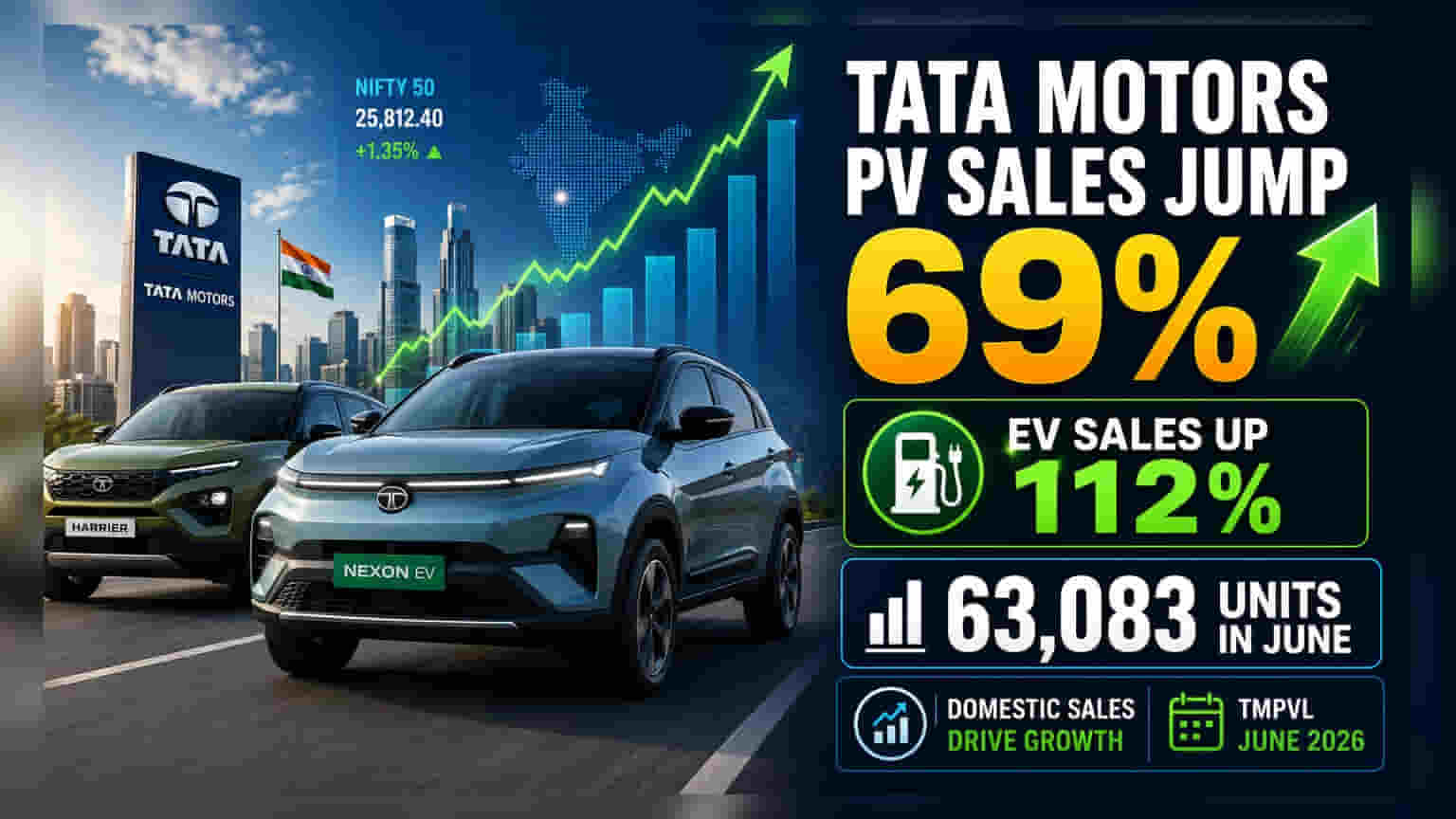
Tata Motors reported 63,083 vehicle sales in June, a 69% year-on-year increase, led by a 112% surge in electric vehicle volumes. With the company expanding its EV footprint, investors will focus on whether this volume growth can sustain profitability despite intense competition in the SUV and electric segments.
What Happened
Tata Motors Passenger Vehicles Ltd. (TMPVL) recorded 63,083 units in total sales for June 2026, representing a 69% jump compared to the same period last year. The domestic market served as the primary growth engine, with sales of 62,076 units, marking a 67% increase from the 37,083 units sold in June 2025. The company’s international business also saw a significant boost, rising to 1,007 units.
The Electric Vehicle Growth
The standout segment for the company continues to be electric vehicles (EVs). Total EV sales for the month reached 14,800 units, more than double the 5,228 units recorded in June 2025. This 112% year-on-year growth suggests that Tata Motors is successfully converting its early-mover advantage in the Indian EV space into higher sales volumes as charging infrastructure and consumer awareness improve.
The Margin And Financial Context
While volume growth is a positive signal, investors often look at the profitability of this expansion. The shift toward EVs involves significant capital spending on battery technology, R&D, and infrastructure. As the company scales, the focus for shareholders remains on operating margins. Scaling EV production is essential to reduce the cost per unit, but short-term profitability can be affected by the price of battery components and the need for heavy marketing to defend market share.
Competitive Market Landscape
Tata Motors operates in a highly competitive automotive market. In the SUV segment, it faces strong challenges from Mahindra & Mahindra and Maruti Suzuki, both of which have been aggressively expanding their product portfolios. Similarly, the entry of new global and domestic players in the electric segment means Tata Motors must balance its aggressive pricing strategies with the need to protect margins. The company’s management has previously noted that retail registrations are outpacing broader industry growth, indicating that their current product mix is finding resonance with buyers.
Risks And Industry Pressure
Beyond immediate sales figures, investors often monitor risks related to supply chain stability and commodity costs. Automotive manufacturers remain sensitive to fluctuations in steel, aluminum, and precious metal prices, which can impact bottom-line performance. Furthermore, the reliance on high-tech components for EVs leaves the company exposed to global supply chain disruptions. Any delay in the execution of new product launches or a slowdown in general consumer spending could also temper the current growth momentum.
What Investors May Focus On
Moving forward, the key metrics for investors will be the sustainability of these growth rates in the coming quarters. Specifically, tracking whether the company can maintain or improve its EBITDA margins while continuing to ramp up EV production will be vital. Other points to monitor include updates on new product launches, raw material cost trends, and how the company manages its overall debt levels as it continues to invest in new manufacturing capacity.