

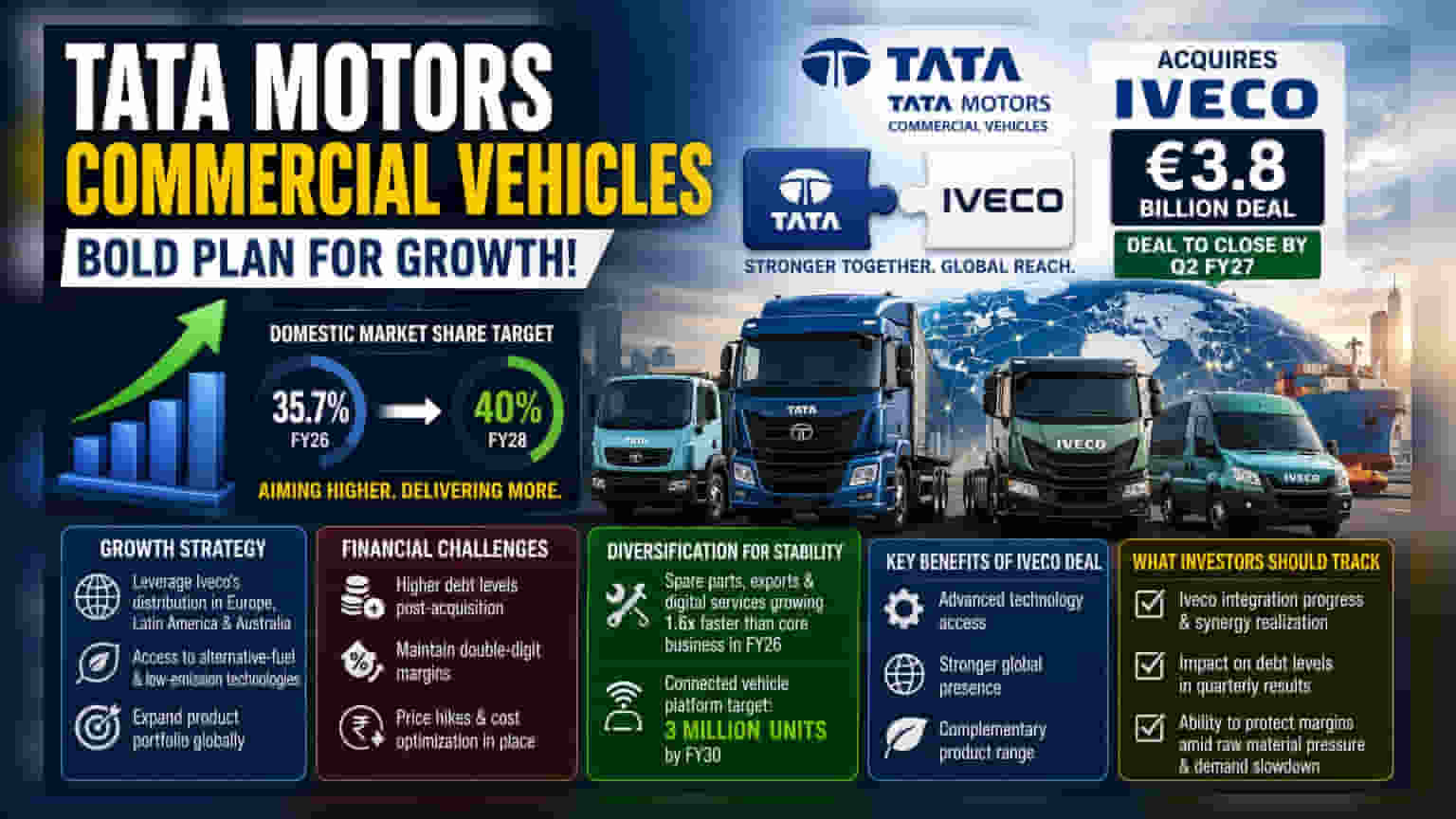
Tata Motors Commercial Vehicles (TMCV) aims to grow its market share to 40% by FY28, using its new €3.8 billion Iveco acquisition to expand into global markets. Investors are weighing this growth plan against concerns over increased debt and the difficulty of merging international operations.
What Happened
Tata Motors Commercial Vehicles (TMCV) has shared a detailed plan for future growth. The company intends to increase its domestic market share from 35.7% to 40% by the 2028 financial year (FY28). A major part of this strategy is the acquisition of the Italian vehicle maker Iveco for €3.8 billion. While this move aims to provide the company with access to new technologies and global markets, it arrives at a time when the commercial vehicle industry in India expects a growth slowdown in the second half of the year.
The Growth Strategy and Iveco Deal
The €3.8 billion acquisition, which is expected to finish by the second quarter of FY27, is the main driver of the company’s new roadmap. By integrating Iveco, TMCV plans to use its distribution networks across Europe, Latin America, and Australia to sell its products. The deal also gives the company access to Iveco’s alternative-fuel and low-emission vehicle technologies. However, merging two large international companies is a complex process. Analysts at Nomura have noted that while the deal offers growth avenues, investors should look for clarity on how the two businesses will effectively work together to produce tangible benefits.
Debt and Margin Challenges
Expansion comes with financial risks. A primary concern for investors is how the company will handle the costs associated with such a large acquisition. Analysts at ICICI Securities have mentioned that the company’s debt levels may rise following the deal. Maintaining profit margins in the double digits will also be a challenge. TMCV is currently implementing price increases and cost-optimization measures to counter rising raw material prices. However, if these price hikes are too steep, they could potentially impact demand in a market that is already showing signs of a slowdown.
Diversification for Stability
To become less dependent on the core commercial vehicle business—which often moves up and down based on the economy—TMCV is expanding its non-cyclical segments. These include selling spare parts, exports, and digital services. These areas grew 1.6 times faster than core operations in the previous financial year (FY26). Furthermore, the company has set a goal to expand its connected vehicle platform to 3 million units by FY30, which could provide a steady stream of income outside of vehicle sales.
What Investors Should Track
Looking ahead, the success of this strategy will depend on execution. Investors may watch for updates on how smoothly the Iveco integration proceeds, as any delays or unexpected costs could impact the company's financial performance. Additionally, tracking the company's debt levels in upcoming quarterly reports will be important to see how the acquisition affects the balance sheet. Finally, monitoring the company’s ability to protect its profit margins despite raw material pressures and potential demand slowdowns will provide a clearer picture of its operational health.