

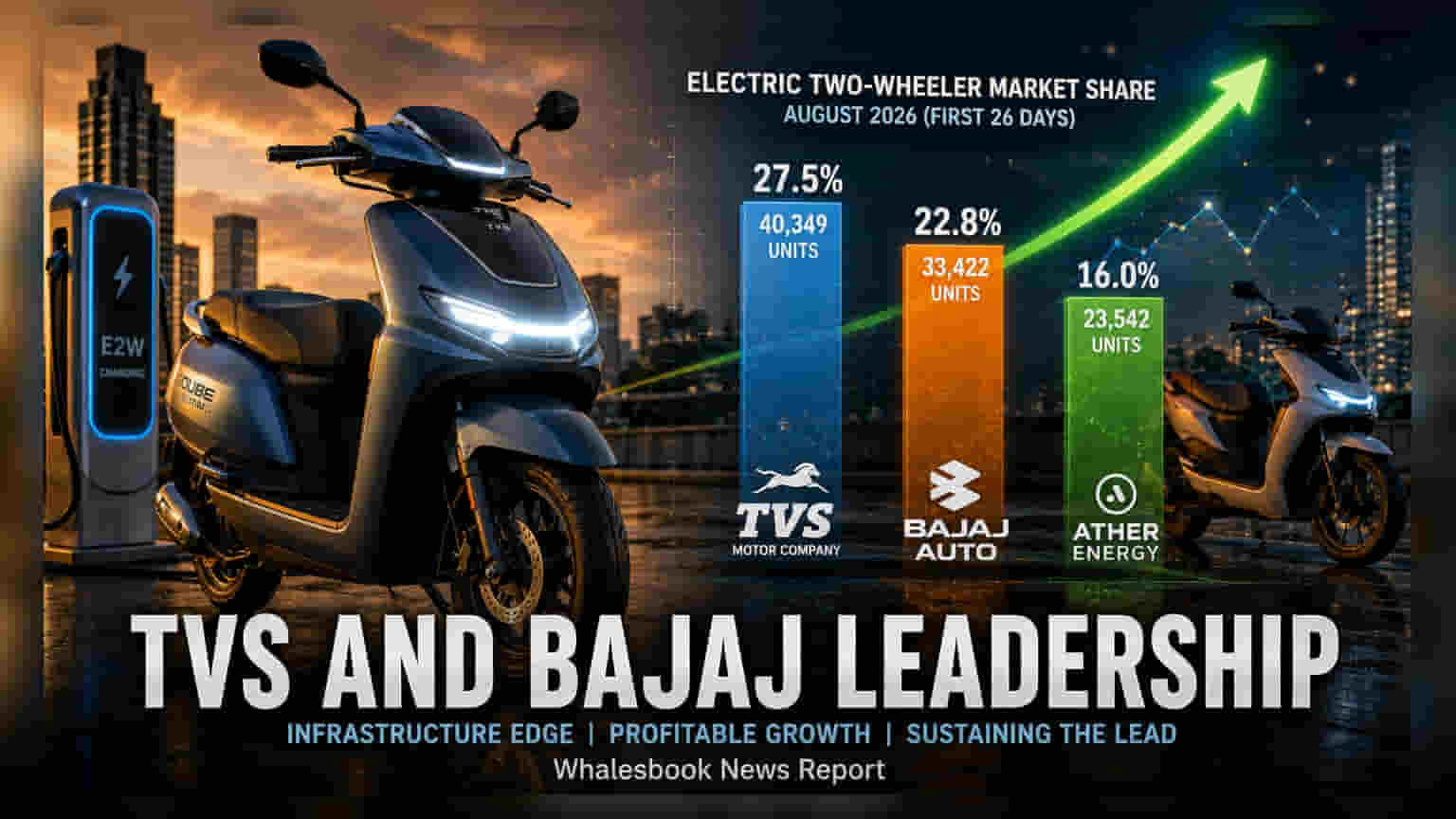
TVS Motor and Bajaj Auto have strengthened their dominance in India’s electric two-wheeler market, capturing a combined market share of over 50% as of late August 2026. Legacy manufacturers are outpacing newer rivals by leveraging established service networks and brand trust. Investors are monitoring this trend, balancing the companies' strong financial performance against the risks of high capital spending and raw material cost volatility.
TVS Motor and Bajaj Auto continued to widen their lead in India’s electric two-wheeler (E2W) market during August 2026. Data from the Vahan portal shows that as the overall industry records a moderation in sales volume compared to July, these legacy manufacturers are successfully converting their existing retail and service infrastructure into a distinct competitive advantage. The market is shifting from a phase of rapid, indiscriminate growth toward a more discerning environment where buyers increasingly prioritize brand reliability and the availability of maintenance services over aggressive discounting.
In the first 26 days of August, TVS Motor secured a 27.5% market share with 40,349 registrations, while Bajaj Auto followed with a 22.8% share and 33,422 units. Ather Energy also demonstrated resilience in this competitive landscape, capturing 16% of the market with 23,542 registrations. This trend highlights that the companies with extensive physical dealer networks are better positioned to attract customers who are cautious about after-sales support.
Financial Context and Expansion
The strong performance in electric vehicle sales complements the solid financial footing of these established manufacturers. Bajaj Auto, for instance, posted a 42.3% year-on-year growth in net profit during the first quarter of fiscal year 2027, maintaining operating margins of 20.7%. This profitability allows these companies to fund their electric mobility expansion internally, reducing the need for high-interest borrowing. However, the aggressive push into electric mobility requires significant money spent on expansion and new capacity, which remains a key area for investors to monitor.
Risks and Market Challenges
Despite the recent market share gains, investors remain cautious regarding potential downsides. A major risk factor involves the high valuation of automotive stocks, which may leave little room for error if future growth does not meet market expectations. Additionally, the sector remains sensitive to raw material cost volatility, particularly for essential components made of copper and steel. Geopolitical tensions that could influence global energy prices also create uncertainty for production costs. Furthermore, as the market matures, the ability of these companies to sustain their current profit margins while competing on price with smaller, aggressive entrants will be critical.
Moving forward, the primary monitorable for shareholders will be the sustainability of this market share lead as the sector moves past its early growth phase. Investors may track monthly registration trends, management commentary on future capital spending plans, and how the companies manage input costs to protect their bottom line.