 Whalesbook


The Seamless Link
The optimistic projections for the Indian two-wheeler sector are being driven by a confluence of factors including sustained government support, evolving consumer preferences, and the lingering positive effects of tax rationalization. As the industry navigates this growth phase, TVS Motor Company stands as a prominent participant, yet its current market standing is defined by a significant valuation premium over its closest rivals.
The Core Catalyst
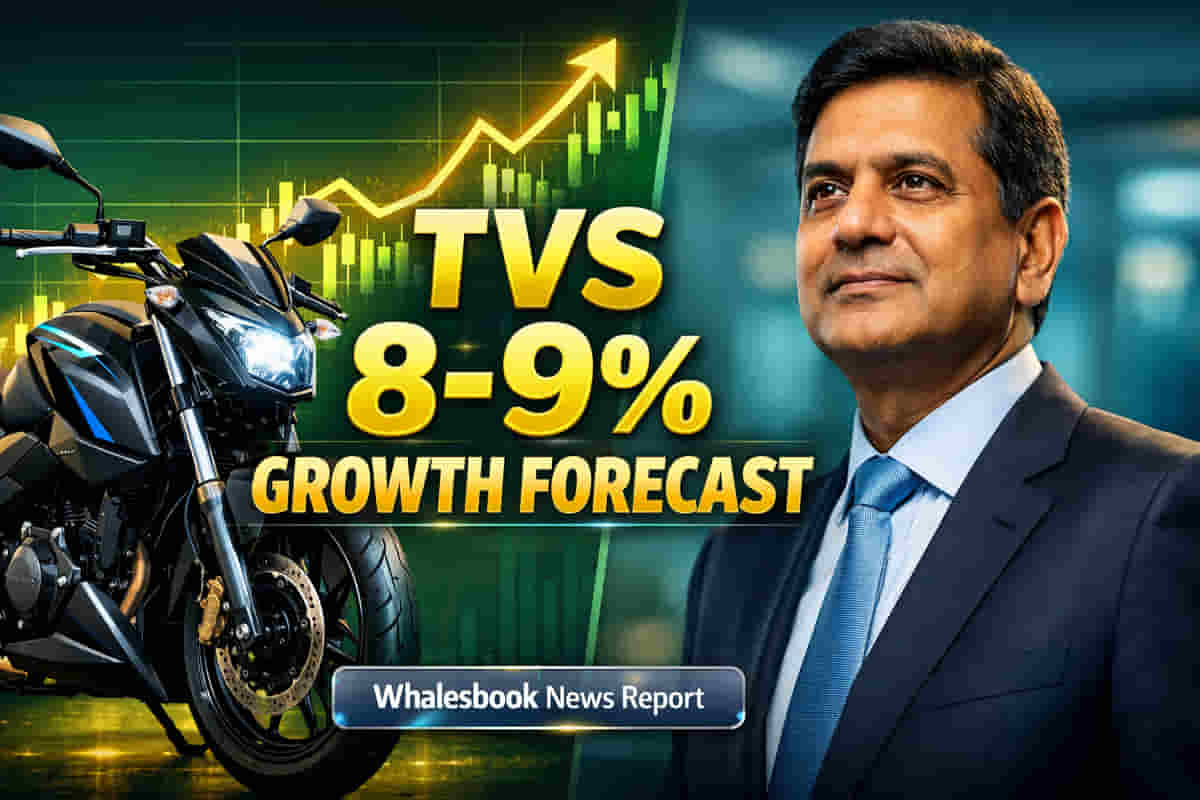
The Indian two-wheeler industry is forecasted to expand by 7-9% in fiscal year 2027, potentially crossing 29 million unit volumes [14, 18, 30]. This projection is underpinned by a strong domestic market, projected to grow 6-8%, and robust export performance, which is anticipated to outpace domestic expansion for the third consecutive year [14, 18, 30]. TVS Motor Company, with its diverse product portfolio spanning commuter motorcycles, scooters, and premium segments, is well-positioned to capitalize on these trends. The company has demonstrated strong financial performance, with revenue growing 20.36% and profits by 44.76% over the past three years, supported by healthy returns on equity and capital employed [11]. Its market capitalization stood at approximately ₹1.81 trillion as of February 2026 [26]. Despite this positive momentum, the stock's current trading price of around ₹3,816.20 [4] reflects high market expectations, amplified by a Price-to-Earnings (P/E) ratio reported as high as 84.03 [8] or 66.96 [27], considerably steeper than industry norms.
The Analytical Deep Dive
This premium valuation for TVS Motor starkly contrasts with its peers. Bajaj Auto trades at a P/E ratio of approximately 30.50 [17, 24], while Hero MotoCorp commands a P/E around 21.37 [23] to 22.03 [21]. This valuation gap suggests investors are willing to pay substantially more for each rupee of earnings from TVS Motor, likely factoring in its strong growth trajectory, premiumization strategy, and leadership in specific segments like electric scooters [14, 18]. The industry's growth drivers remain compelling: the continued benefits of GST rate cuts improving affordability [Original Text, 48], government infrastructure spending enhancing rural and urban connectivity [Original Text], and a shift towards scooters and higher-capacity motorcycles reflecting evolving urban mobility needs and increasing female participation [14, 18, 25, 28]. Broader economic indicators are also supportive, with India's real GDP projected to grow between 6.8% and 7.2% in FY27 [35]. However, the sustainability of TVS Motor's premium valuation hinges on its ability to consistently deliver growth exceeding that of its peers and the broader market.
The Forensic Bear Case
The elevated P/E ratio of TVS Motor presents a significant risk. At ~67x earnings [27], the stock implies exceptionally high growth expectations. Should the company falter in meeting these projections, or if industry growth decelerates due to unforeseen factors like commodity price volatility or intensified competition, the stock could face considerable downside. While TVS Motor leads in EV market share (26% in August 2025) [47], the unit economics in the burgeoning electric segment remain complex [25]. Furthermore, analyst sentiment, while generally leaning towards 'Moderate Buy' with an average price target around ₹4,175 [32], shows notable divergence. Some firms have set targets as low as ₹2,250 [12, 46], indicating differing views on future performance and valuation, which contrasts with the consensus view of a 5.54% upside from the current price of ₹3,830.10 [44]. The company's own price targets from some analysts, like ₹3,150 from JM Financial and ₹2,774 from Geojit Financial Services, further highlight potential headwinds or differing outlooks on its growth trajectory relative to its current valuation [33].
The Future Outlook
Despite the valuation concerns, the industry outlook remains positive, with projections for continued growth through FY27 driven by domestic demand, exports, and premiumization. TVS Motor's strong financial health and market position in key segments provide a solid foundation. However, investors will be closely scrutinizing its ability to justify its premium valuation through sustained operational outperformance and consistent earnings growth that outpaces its lower-valued competitors. The market will likely demand continued execution excellence to support the current price levels.