

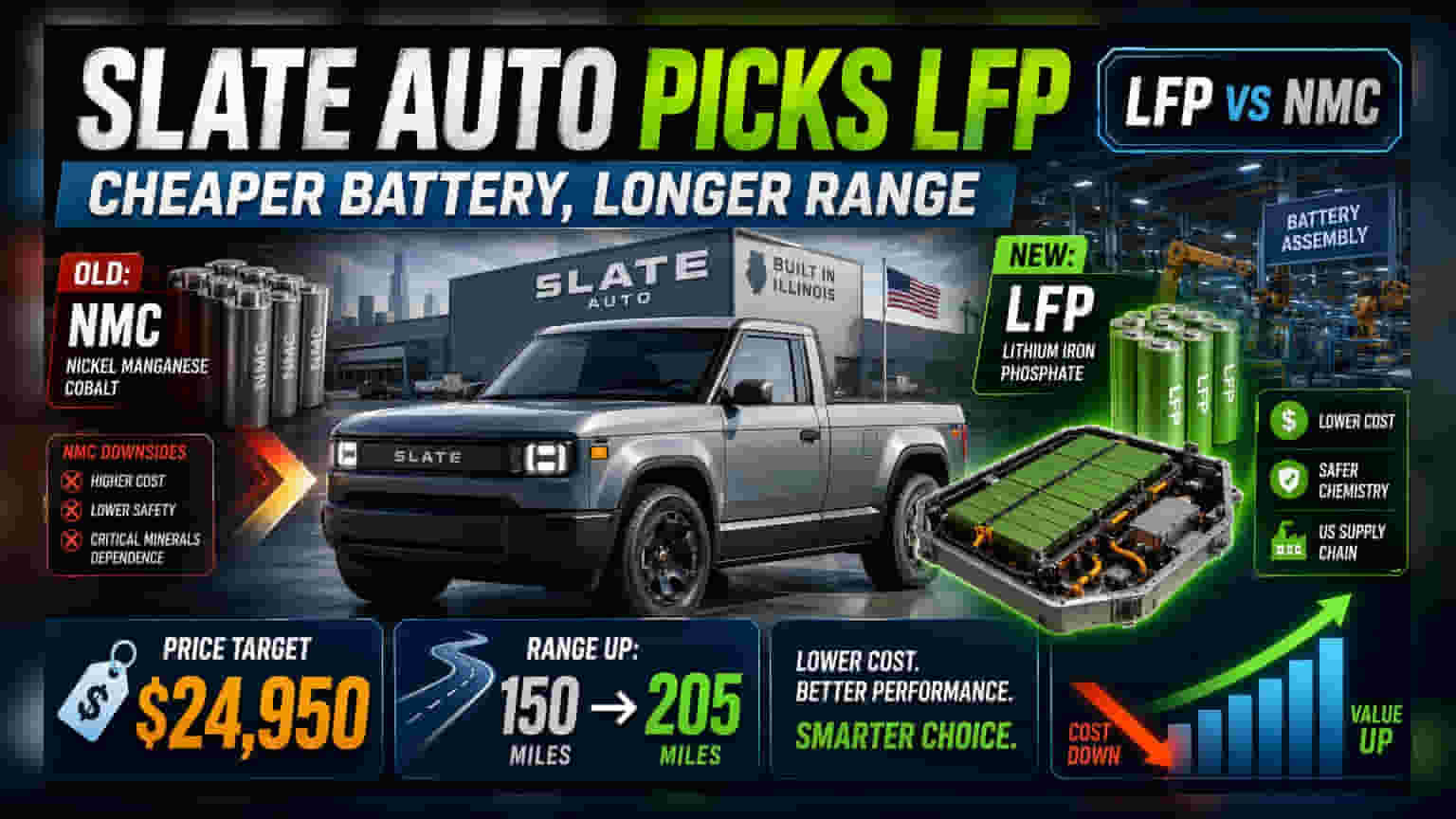
US-based EV startup Slate Auto is replacing its original battery plan with Lithium-Iron-Phosphate (LFP) cells to lower vehicle costs. This move, supported by domestic supply from Gotion, aims to bring the truck to market at a competitive $24,950. The shift reflects a growing industry trend toward affordable battery chemistries for mass-market electric vehicles.
What Happened
Slate Auto, an American electric vehicle startup backed by investors including Jeff Bezos, has announced a significant change in its product strategy. The company will pivot from its previously planned Nickel-Manganese-Cobalt (NMC) battery packs to Lithium-Iron-Phosphate (LFP) cells for its upcoming compact electric pickup truck.
This decision is aimed at reducing manufacturing costs, enabling the company to maintain a starting price of $24,950. By adopting LFP technology, Slate has also managed to improve the truck’s estimated driving range from 150 miles to 205 miles, thanks to more efficient manufacturing techniques like cell-to-pack design. The company plans to source these batteries from Gotion, which is setting up production at a facility in Illinois, USA.
Why The Battery Change Matters
For any EV manufacturer, the battery is the single most expensive component. By switching to LFP chemistry, Slate is tapping into a battery type that is roughly 40% cheaper to produce than the NMC cells it originally considered.
LFP batteries use iron and phosphate, which are significantly more abundant and affordable than the nickel and cobalt required for NMC batteries. While NMC batteries historically offered higher energy density—allowing for more range in a smaller space—the gap has narrowed. Modern engineering, such as Slate’s "cell-to-pack" construction, allows the company to fit more battery cells directly into the vehicle structure, successfully offsetting the lower density of LFP and delivering a respectable 205-mile range.
The Economic Logic of LFP
Beyond cost, the move addresses critical supply chain and durability concerns. LFP batteries are known for their longer cycle life, meaning they can typically be charged and discharged more times before losing capacity. They are also safer and can be charged to 100% capacity daily without the same degradation risks often associated with NMC chemistries.
By sourcing from Gotion’s Illinois-based factory, Slate is also positioning itself to better navigate regulatory requirements. This domestic production footprint helps ensure that the vehicles and their components align with local manufacturing incentives, a strategy increasingly used by EV makers to maintain price competitiveness in a high-cost environment.
Business and Supply Chain Risks
While the switch to LFP offers a clearer path to a $24,950 price tag, it is not without risks. The startup faces the challenge of execution—moving from a prototype to a full-scale production vehicle is notoriously difficult in the auto industry.
Furthermore, the dependence on a specific supplier for LFP technology in a U.S. facility is a potential bottleneck. If the Illinois plant faces delays or quality issues, it could directly impact Slate’s production timeline. Additionally, while LFP is cheaper, the company remains in a highly competitive segment where legacy automakers with massive scale have significant advantages in purchasing power and logistics.
What Investors Should Watch in the EV Sector
For investors monitoring the broader electric vehicle landscape, this development highlights the "LFP race." Across the globe, including in the Indian market, major EV players are aggressively shifting toward LFP chemistry to bring vehicle prices down to mass-market levels.
Key monitorables for the EV sector include how effectively companies can balance range requirements with the lower cost of LFP batteries. As more startups and incumbents adopt LFP, investors should track the stability of the iron and phosphate supply chain, the ability of manufacturers to maintain profit margins at these lower price points, and how these vehicles perform in real-world conditions compared to traditional, higher-priced NMC-powered models.