

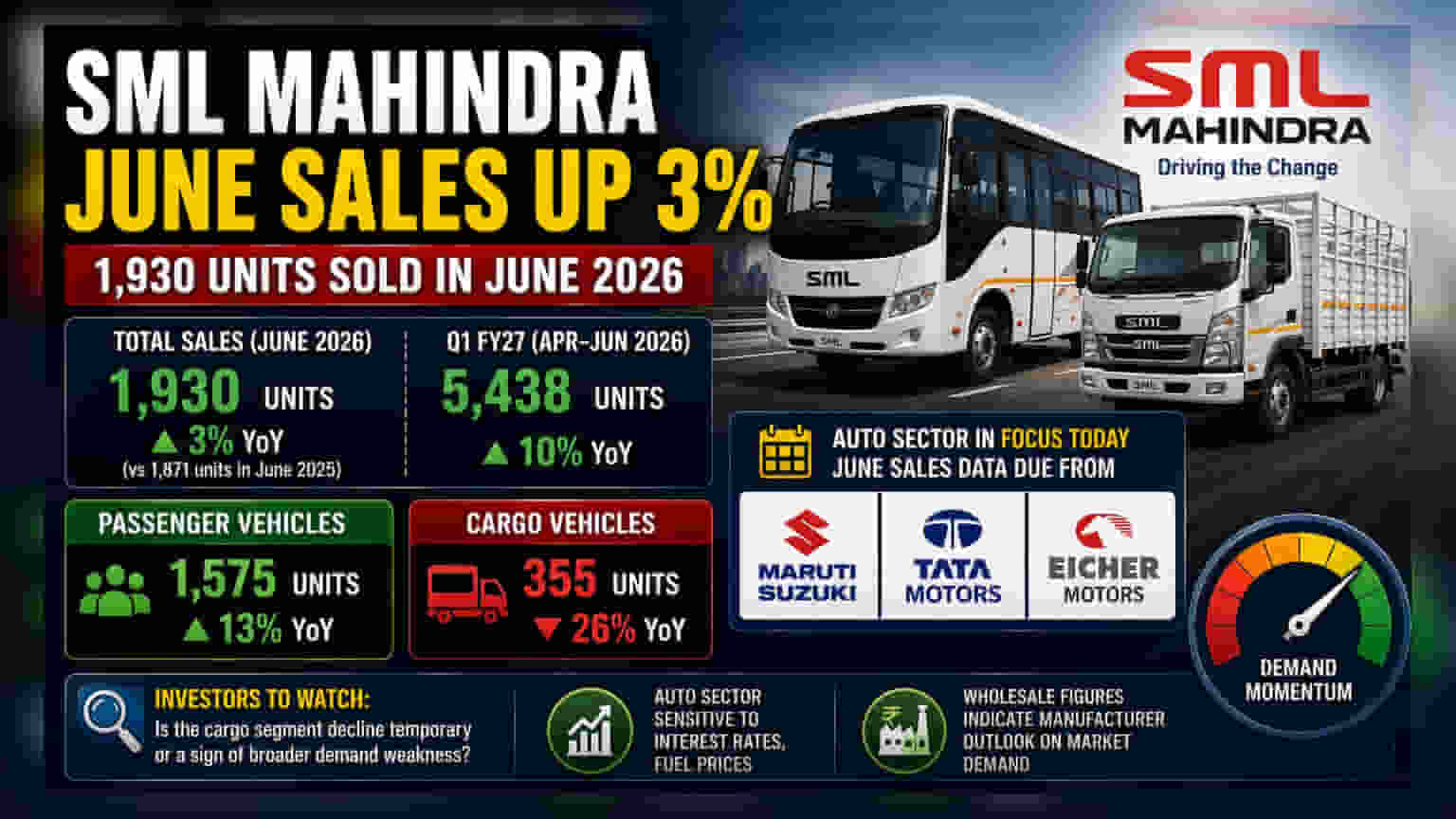
SML Mahindra reported total vehicle sales of 1,930 units for June 2026, marking a 3% year-on-year increase. While passenger vehicle sales rose by 13%, the cargo segment saw a 26% decline, highlighting mixed demand. Investors are now focused on upcoming June sales data from industry leaders like Maruti Suzuki and Tata Motors, which serve as key indicators for the broader automotive sector's performance.
SML Mahindra June Sales Performance
SML Mahindra, formerly known as SML Isuzu, has released its monthly sales figures for June 2026, showing a 3% year-on-year increase in total sales volume. The company sold 1,930 units during the month compared to 1,871 units in the same period last year. For the April-June 2026 quarter, total sales grew by 10% to 5,438 units, reflecting overall positive growth for the first quarter of the financial year.
Mixed Demand Trends
The company’s performance was notably split between its two primary segments. Passenger vehicle sales, which are a major part of the company’s business, grew by 13% year-on-year to 1,575 units in June. However, the cargo vehicle segment experienced a significant 26% decline, with sales dropping to 355 units. This divergence suggests that while passenger transportation demand remains resilient, the goods carrier segment is facing stiffer pressure. Investors often track these figures to gauge the strength of underlying demand in the light and medium commercial vehicle market.
Sector Focus: What Investors Are Watching
Today marks a critical day for the Indian auto sector as industry giants including Maruti Suzuki, Tata Motors, and Eicher Motors are scheduled to release their June sales data. These numbers are widely watched by investors as a barometer for domestic consumption and economic activity. Because the automotive sector is sensitive to interest rates, fuel prices, and general economic health, these wholesale figures—the number of vehicles dispatched from factories to dealerships—provide an immediate signal on how manufacturers perceive market demand.
Business Context and Monitoring
SML Mahindra, now a subsidiary of Mahindra & Mahindra, continues to focus on its core portfolio of buses and trucks. As the commercial vehicle industry navigates changes in demand, the company’s ability to manage its product mix between passenger and cargo segments will be important. For investors, the key monitorable will be whether the cargo segment decline is a temporary trend or a sign of broader logistics or demand weakness in the small-to-medium commercial vehicle space. Watching how the larger automakers perform in today's data release will provide necessary context for the overall health of the Indian automobile sector.