 Whalesbook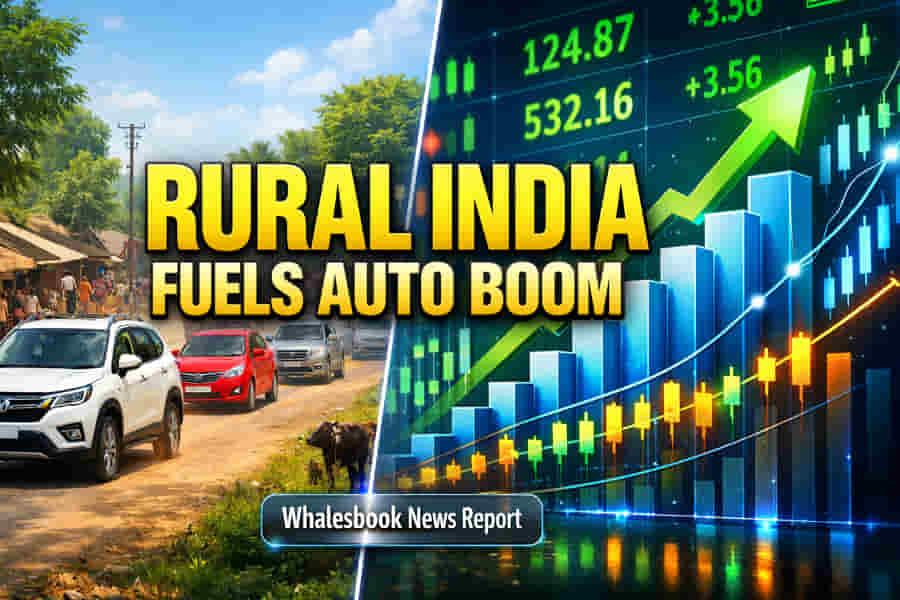
1. THE SEAMLESS LINK
The robust growth in passenger vehicle sales underscores a deepening structural expansion of demand beyond India's major metropolitan areas. This pivotal shift in consumer behavior, particularly evident in the robust performance of rural markets, is reshaping the competitive landscape and forcing manufacturers to recalibrate their strategies for sustained market penetration.
2. THE STRUCTURE (The 'Smart Investor' Analysis)
Rural Demand Takes the Wheel
Passenger vehicle retail sales in January 2026 saw a notable 7.22% year-on-year increase, reaching 513,475 units. This growth was disproportionately driven by rural India, which registered a 14.43% expansion, far surpassing the 2.75% growth observed in urban markets. While urban centers still account for the majority of sales at 59.2%, the non-metro segment's accelerating pace signals a fundamental rebalancing of consumer purchasing power and aspirations. This trend has been a consistent theme, with rural demand outperforming urban areas in passenger vehicle sales for over a decade. The underlying catalysts include sustained healthy rural cash flows from agricultural harvests and wedding seasons, coupled with the lingering effects of Goods and Services Tax (GST) rationalization and supportive government policies that enhance affordability.
Manufacturer Strategies Adapt to Rural Focus
Maruti Suzuki India solidified its market leadership, capturing approximately 42% of the market with 216,043 retail sales. Its long-established, extensive sales and service network, deeply ingrained in Tier-2 and Tier-3 cities, provides a significant competitive advantage in these burgeoning rural markets.
Hyundai Motor India achieved its highest-ever monthly domestic sales, selling 59,107 units, a 9.5% year-on-year increase. Its strong performance was bolstered by models like the Venue and Aura, which recorded their best monthly sales figures. While Hyundai's urban-centric models remain key, aggressive discounting and improved supply have aided its recent sales surge.
Tata Motors secured the second position in the manufacturer rankings with 65,558 units sold, a 12.38% market share. The company has actively pursued rural expansion through initiatives like 'Anubhav,' a mobile showroom program designed to bring the car-buying experience directly to rural customers, leveraging the fact that rural sales constitute approximately 40% of total PV sales in India.
Mahindra & Mahindra (M&M) reported sales of 63,366 units, holding a 12.34% share. M&M has a well-defined rural strategy, particularly strong in its tractor division, focusing on accessible after-sales service, financing options, and product designs suited for rural conditions. The company's efforts aim to capitalize on the agricultural economy's buoyancy to drive vehicle sales.
Overall automobile retail sales across all segments grew by 17.61% year-on-year to 2.72 million units, with two-wheelers also showing robust demand driven by rural markets.
Inventory Levels and Valuation Metrics
Passenger vehicle inventory levels softened to a constructive 32-34 days in January, indicating improved supply-demand balance and dealer working capital efficiency.
Valuation metrics for the leading players present a mixed picture. Maruti Suzuki's P/E ratio stands around 30.52-32.27, Tata Motors' P/E varies significantly but is currently cited around 29.55-61.61, and Mahindra & Mahindra's P/E is around 26.1-32.21. These figures suggest varying investor expectations for future earnings growth, with Tata Motors' wider P/E range potentially reflecting its diverse business segments and ongoing transformation.
3. THE FORENSIC BEAR CASE
Despite the surge in rural demand and positive sales figures, structural vulnerabilities persist. The reliance on rural income makes the sector susceptible to the vagaries of the monsoon and agricultural output, creating cyclical risks not present in more diversified urban economies. While manufacturers like Maruti Suzuki have deep rural penetration, companies like Tata Motors and Mahindra & Mahindra, while investing in rural strategies, may still face challenges in replicating Maruti's established trust and network effect. Furthermore, rising input costs, as noted by Maruti Suzuki, could pressure margins despite higher volumes, potentially leading to price hikes that could dampen demand, especially in the price-sensitive rural segment. Analysts warn of potential headwinds from tighter regulations in the coming years, including CAFE norms, which could escalate compliance costs and impact pricing strategies, particularly for entry-level vehicles where rural demand is strong. The current P/E multiples, especially for Maruti Suzuki and M&M, suggest that the market has priced in considerable growth, making them vulnerable to sentiment shifts if rural economic growth falters or if competition intensifies further without commensurate earnings growth.
4. The Future Outlook
Looking ahead, FADA anticipates a strong February-March period for passenger vehicles, driven by a healthy booking pipeline, new model launches, and year-end purchases. Analyst firms like Jefferies and Nuvama project overall auto sector growth to exceed 10% in FY26, underpinned by sustained local demand, rural recovery, and ongoing policy support. However, potential election-related disruptions and persistent model-specific supply constraints remain key watchpoints that could temper this optimism, alongside the aforementioned rising costs and regulatory pressures.