

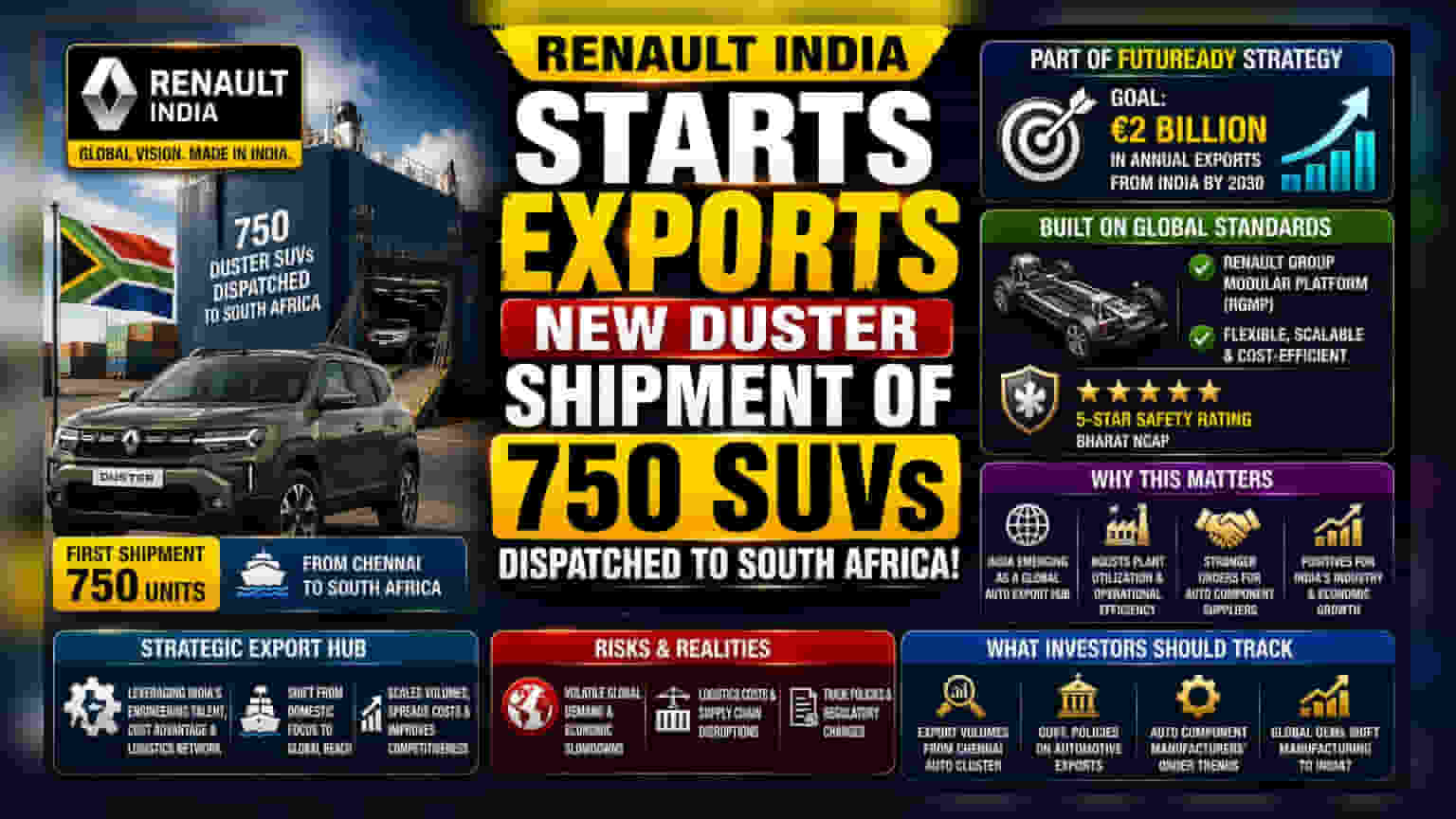
Renault India has shipped 750 units of its new Duster SUV from Chennai to South Africa. This milestone aligns with the company’s target to reach €2 billion in annual exports from India by 2030. While Renault’s Indian operations are private, the move highlights the country’s growing importance in the global automotive manufacturing network.
What Happened
Renault India has officially started exporting the new generation of its Duster SUV. The company recently dispatched an initial shipment of 750 vehicles from its manufacturing facility in Chennai to South Africa. This development is a key part of the automaker’s “futuREady” strategy, which seeks to transform India into a major production and export hub. The company has set a goal to generate €2 billion in annual exports from India by 2030, making international markets a central pillar of its long-term business plan.
The Strategic Export Goal
The move to South Africa is part of a broader shift in how global automobile companies view their Indian operations. Rather than serving only the domestic market, Renault is leveraging India’s engineering talent, cost-effective manufacturing capabilities, and established logistics infrastructure to supply global demand. By scaling its export volumes, the company aims to improve capacity utilization at its Indian plant, which can help in spreading fixed costs over a larger number of units.
Technology And Safety Standards
The new Duster is built on the Renault Group Modular Platform (RGMP). This platform is designed to be highly flexible, allowing the company to build different vehicle types using the same structural base. This modular approach is common among global automakers because it reduces development time and costs for new models. Additionally, the Duster has secured a five-star rating under the Bharat NCAP safety program. Achieving high safety ratings is increasingly important for export markets, where stringent safety standards are often a prerequisite for entry.
Why This Matters For The Indian Auto Sector
Although Renault India is an unlisted private company, its focus on Indian manufacturing has implications for the broader automotive ecosystem. India has emerged as a significant export hub for several global manufacturers, including Hyundai and Kia, alongside domestic players like Maruti Suzuki. When global companies increase their export output from India, it often creates a positive ripple effect for local auto component suppliers, as they secure larger and more stable orders.
Risks And Market Realities
For the Indian auto sector, the primary challenge remains the volatility of global demand and logistics costs. While the export push is a positive signal, its ultimate success depends on sustained demand in international markets like South Africa. Additionally, any slowdown in global economic growth or changes in trade regulations can impact export volumes. Investors tracking the automotive space often watch these manufacturing trends to gauge the overall health and competitiveness of India’s industrial export capabilities.
What Investors Should Track
While Renault’s Indian subsidiary does not trade on the stock exchanges, investors in the Indian auto sector should monitor the performance of auto component manufacturers that supply to these global hubs. Key monitorables include the overall export volumes from the Chennai auto cluster, changes in government policy regarding automotive exports, and whether more global companies shift their manufacturing bases to India to take advantage of competitive production costs.