

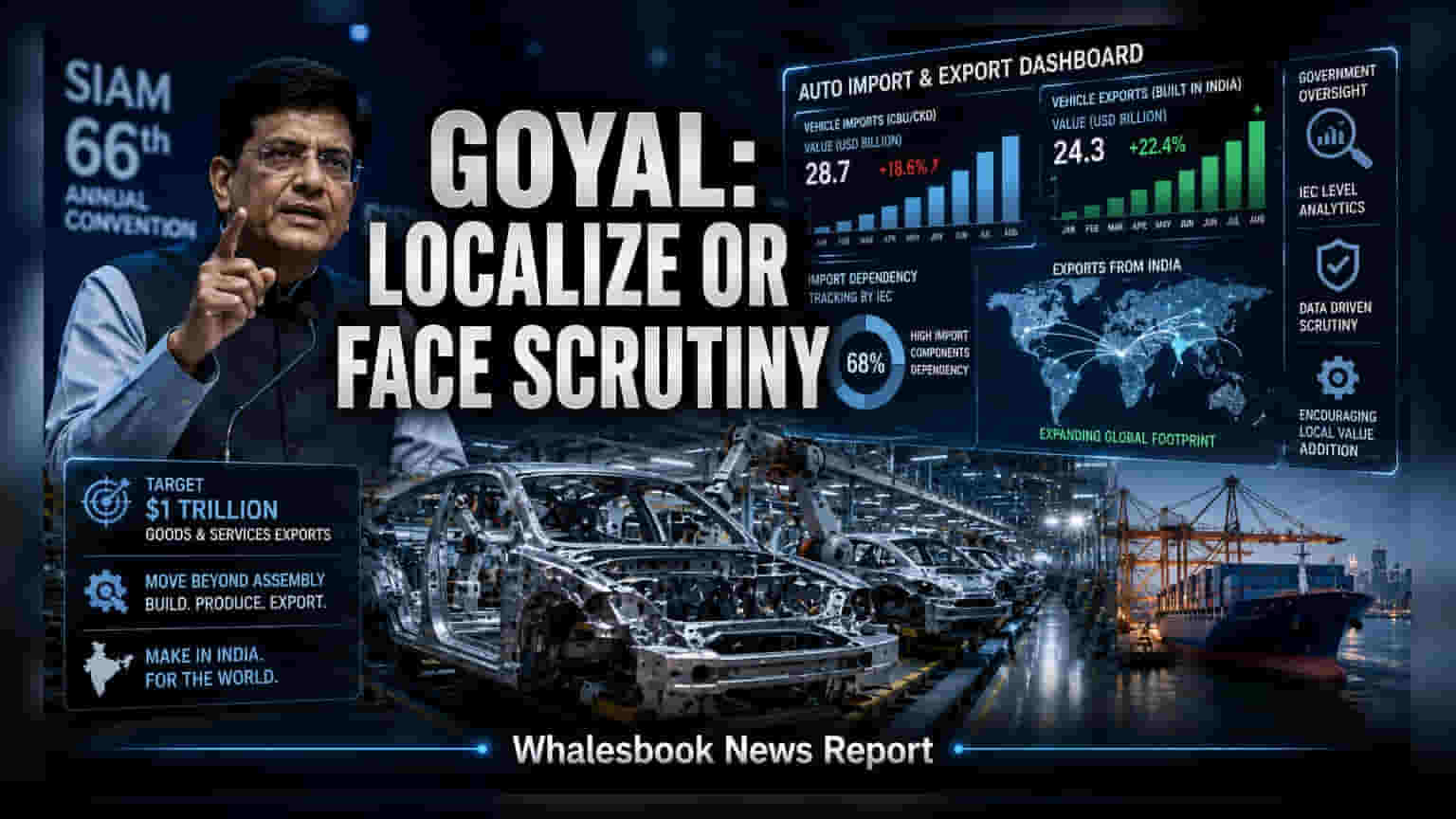
Commerce Minister Piyush Goyal has challenged global automobile manufacturers to improve local production standards or increase exports at the 66th SIAM Annual Convention. The government is now using detailed import data to monitor companies that rely on low-level local value addition. This development may influence future policy support and operational strategies for auto companies dependent on imported components.
Union Commerce and Industry Minister Piyush Goyal issued a strong message to the automotive sector at the 66th SIAM Annual Convention held on September 3, 2026. The Minister warned global car manufacturers against relying on what he termed "nominal localisation," where companies perform only 10% to 15% of value addition within India while claiming to be fully local. The government’s stance emphasizes that reliance on imported components without substantial domestic investment will no longer be overlooked.
To enforce this focus, the Ministry of Commerce and Industry is utilizing advanced data analytics to track the Import Export Code (IEC) of individual companies. This granular oversight allows regulators to identify firms that import the majority of their vehicle components while maintaining only an assembly-focused presence in the domestic market. The Minister characterized firms failing to meet expected indigenisation levels as companies that need to align more closely with national economic goals.
Minister Goyal advised companies that may face difficulties in immediate, deep localisation to compensate by significantly increasing their exports from India. This shift aligns with the government's broader objective of reaching $1 trillion in total goods and services exports for the current year. By pushing the automotive sector to serve global demand rather than just assembling vehicles for domestic sale, the government aims to strengthen India's position as a genuine manufacturing hub.
For investors and market participants, this signal from the government could lead to shifts in the operational environment for automotive original equipment manufacturers (OEMs). Companies heavily dependent on imported completely knocked-down (CKD) kits or similar models may face pressure to restructure their supply chains. If firms are required to accelerate localisation, this could lead to increased capital spending or higher production costs, which may impact profit margins in the short to medium term.
While no specific penalties or regulatory orders against individual companies have been issued as of September 3, 2026, the heightened government scrutiny suggests that future policy support, incentives, or benefits could be linked to demonstrable improvements in local sourcing. The key monitorable for the industry will be how manufacturers adjust their procurement strategies and whether they choose to expand their export footprint to satisfy the government's trade balance expectations.