

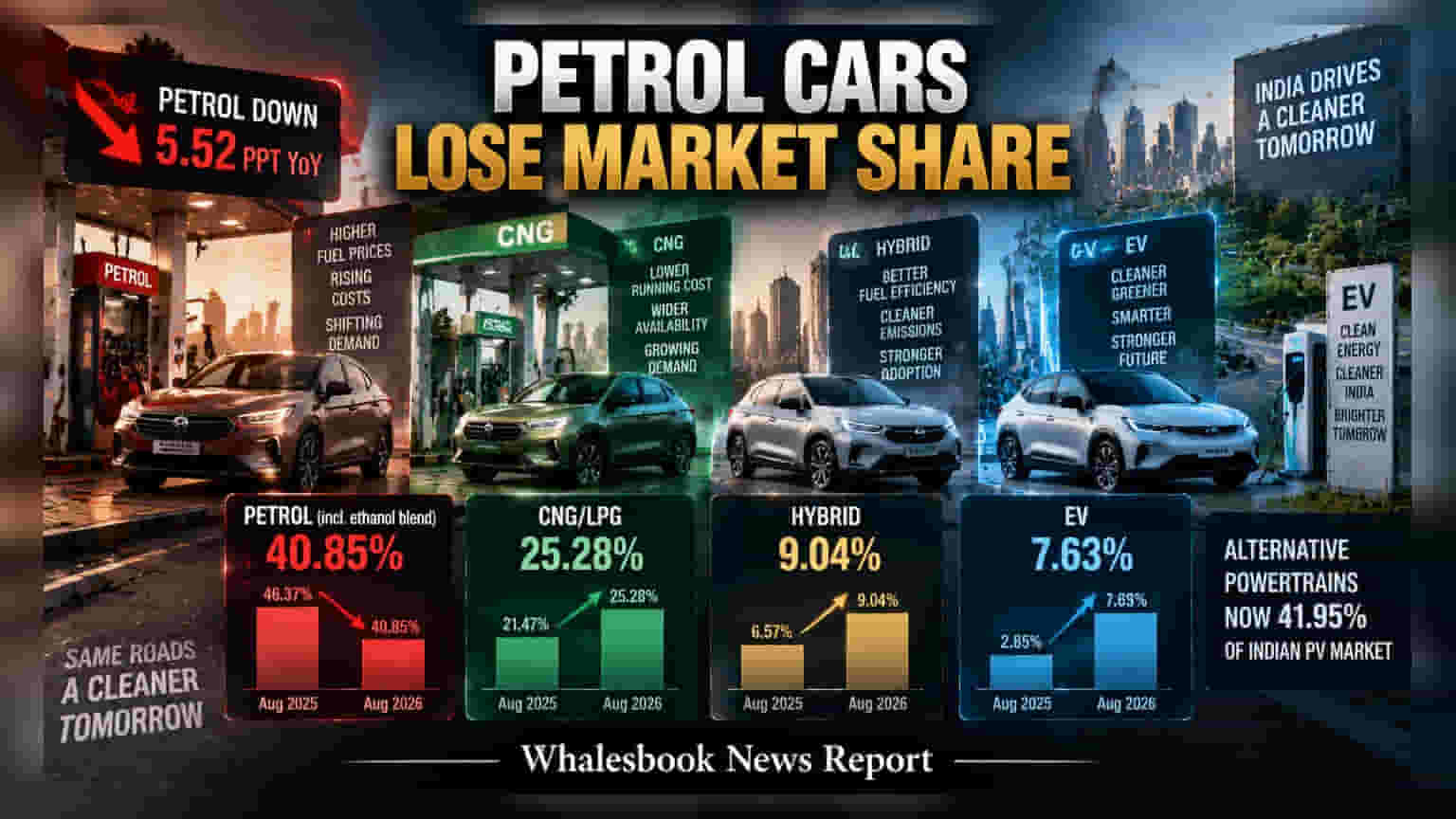
In August 2026, petrol-powered passenger vehicles accounted for 40.85% of retail sales, falling from 46.37% a year prior, as consumers turned to CNG, hybrids, and EVs. This 41.95% combined share for alternative fuels signals a significant market shift. Investors are now watching how major automakers like Maruti Suzuki and Tata Motors adjust their product portfolios and manage profitability amid these changing fuel economics.
The Indian passenger vehicle market witnessed a structural shift in August 2026, with traditional petrol-powered cars losing their position as the dominant choice. Latest retail sales data shows that petrol and ethanol-blend vehicles held a 40.85% share, down from 46.37% in the same month last year. Meanwhile, alternative-powertrain vehicles—comprising CNG, hybrids, and electric vehicles—collectively captured 41.95% of the market.
This shift is largely driven by a search for lower running costs. With petrol prices staying high, CNG has become an attractive option for budget-conscious buyers. CNG vehicles now account for 25.28% of the market, a rise from 21.47% a year earlier. Improvements in factory-fitted CNG technology, which now offer better luggage space and reliability, have also supported this growth.
Market Leaders and Competitive Positioning
Automakers are responding differently to this change, and the impact on their business models is becoming clear. Maruti Suzuki remains the dominant player in the CNG segment, holding an estimated 71% market share. For Maruti, the ability to offer factory-fitted CNG across its mass-market portfolio provides a volume advantage. Tata Motors holds roughly 17% of the CNG market and continues to lead the electric vehicle segment with an approximately 43% share as of August 2026. Hyundai maintains a presence in the CNG space with about 9% of that market.
The challenge for manufacturers is managing their product mix. While CNG and hybrids offer a way to cater to cost-sensitive buyers, the rapid growth in EVs requires significant investment in technology and infrastructure. Manufacturers that cannot quickly adapt their product offerings to include more CNG and hybrid models risk losing market share to rivals who have already built strong portfolios in these areas.
Risks and Market Monitorables
Investors should monitor how automakers handle the transition, particularly regarding profit margins. While alternative fuels help maintain sales volumes, they often come with different manufacturing costs and pricing strategies compared to pure petrol cars. Furthermore, the industry is grappling with consumer confusion regarding E20 fuel, which blends 20% ethanol with petrol. While some buyers are concerned about potential long-term engine performance and efficiency with higher ethanol blends, this remains a point of debate among industry experts.
Looking ahead, the market mix will be influenced by how quickly automakers can launch new CNG and hybrid models. Intense competition in the EV space, with new entrants and existing players fighting for market share, could also put pressure on pricing and promotional spending. The key monitorables for shareholders in the coming quarters will be the raw material costs for these new-tech vehicles, the pace of CNG infrastructure expansion, and whether companies can protect their profit margins while expanding their alternative-fuel lineups.