

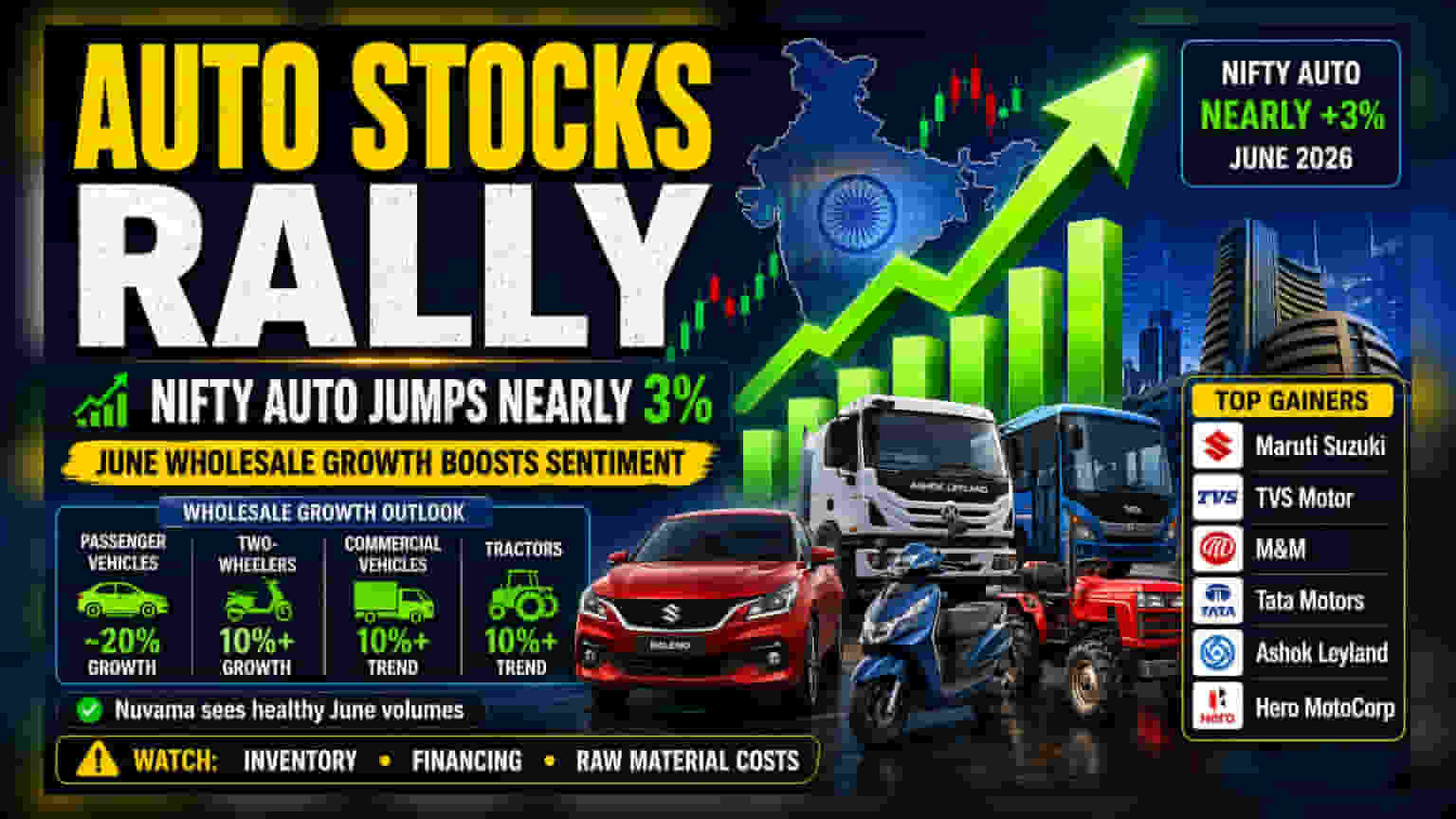
The Nifty Auto index rose nearly 3% as brokerage Nuvama predicted strong wholesale growth for June 2026 across major segments. While demand indicators like financing and exports remain healthy, investors should keep a close eye on whether dealer inventory levels remain manageable.
What Happened
The Indian automotive sector saw a positive market reaction on Thursday, with the Nifty Auto index climbing nearly 3% during the trading session. This optimism followed a report from brokerage Nuvama, which projected healthy wholesale volume growth across passenger vehicles, two-wheelers, commercial vehicles, and tractors for June 2026.
Major manufacturers recorded gains, with Maruti Suzuki India shares rising over 4.5%, while TVS Motor Company and Mahindra & Mahindra both saw increases of more than 4%. Tata Motors, Ashok Leyland, and Hero MotoCorp also traded in the green, reflecting positive market sentiment.
Why Wholesale Growth Matters
For investors, it is important to distinguish between 'wholesale' and 'retail' sales. Wholesale figures track the number of vehicles the company sends from its factory to its dealers. Retail figures track the actual number of vehicles sold to end customers.
While Nuvama’s forecast of 20% growth in passenger vehicle volumes and over 10% in other segments suggests a strong pipeline, investors often look at whether this wholesale growth matches retail demand. If manufacturers ship too many vehicles to dealers when actual customer demand is lower, it can lead to high inventory levels. This may eventually force companies to offer higher discounts to clear stock, which can put pressure on profit margins.
Growth Drivers And Segment Outlook
The report cites improved affordability, better financing availability, and robust export demand as the main pillars supporting the current growth trend.
In the passenger vehicle segment, Tata Motors and Mahindra & Mahindra are positioned to see significant year-on-year volume expansion. The two-wheeler segment is also showing resilience, with Nuvama anticipating double-digit volume growth led by companies like TVS Motor and Eicher Motors. However, the report noted that Hero MotoCorp might face a slower growth rate due to a high base effect from the previous year.
For commercial vehicles, Tata Motors is highlighted as a potential outperformer, supported by the launch of new products and favorable operating economics.
Risks And Investor Monitorables
While the current outlook is positive, the auto sector is cyclical and sensitive to several external factors. Investors may want to track a few key areas moving forward:
Inventory Levels: Watch for company comments in upcoming quarterly results regarding inventory at the dealership level. A healthy inventory balance is critical to maintaining profit margins.
Interest Rates and Financing: Since the report highlights 'improved financing' as a growth driver, any unexpected change in interest rates or lending norms could affect consumer affordability.
Base Effect: As seen in the two-wheeler segment, high sales in the previous year can make current growth percentages look smaller, even if the absolute number of sales remains strong.
Raw Material Costs: Commodity prices, such as steel and aluminum, are standard risks that can impact the profitability of original equipment manufacturers.
Monitoring these factors will provide a clearer picture of whether the predicted wholesale growth translates into sustainable long-term earnings for these companies.