

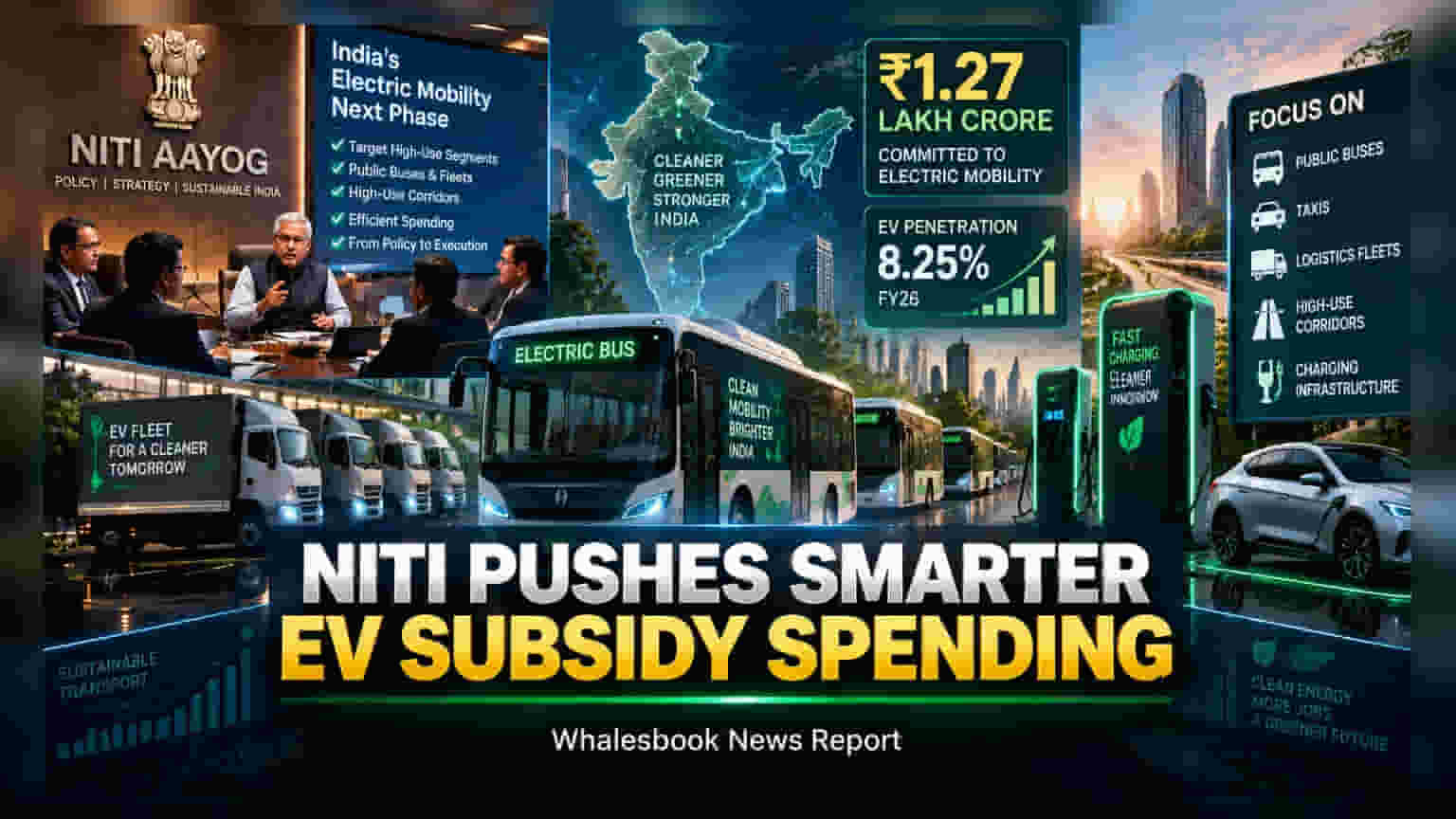
NITI Aayog is urging Indian states to pivot electric vehicle incentives toward public transport and high-use commercial fleets instead of broad retail subsidies. With EV penetration reaching 8.5% in FY26, the strategy aims to maximize the impact of the over ₹1.27 lakh crore already committed to the sector. This change signals a shift toward operational efficiency and away from indiscriminate demand support.
The central government is refining India's electric mobility strategy, with NITI Aayog calling for a strategic shift in how states approach electric vehicle (EV) support. As the industry moves from initial adoption toward scaling up, the focus is moving away from broad consumer subsidies and toward high-utility segments like public buses, taxis, and logistics fleets.
Targeting High-Usage Segments
The policy recommendation aims to maximize the return on government spending. By prioritizing vehicles that spend the most time on the road, such as public buses and commercial delivery trucks, the policy intends to replace the highest amount of fossil fuel consumption per vehicle. This approach, which NITI Aayog is calling a transition from "policy creation" to "execution," seeks to increase the utilization of charging infrastructure by concentrating demand in predictable urban corridors.
This is a significant pivot. To date, India has committed more than ₹1.27 lakh crore toward electric mobility through various central and state initiatives. With EV penetration hitting 8.5% in FY26, policymakers are now concerned with the quality of growth rather than just the number of vehicles sold. The think tank's push for this recalibration is timely, as state-level EV policies in at least 10 states are scheduled to expire by 2027.
Implications for Industry and Investors
For companies in the EV ecosystem, this shift changes the playing field. Businesses that rely solely on retail consumer subsidies may face a tougher environment as support becomes more selective. Conversely, manufacturers and service providers focused on commercial fleets, electric buses, and heavy-duty logistics could see more stable demand driven by state-level procurement and infrastructure tenders.
Investors may look to distinguish between companies that have a clear strategy for fleet-based solutions and those that are heavily dependent on mass-market subsidies. The ability to provide integrated services—such as vehicle financing, battery management, and charging uptime—is becoming as critical as the vehicle manufacturing itself.
Risks in the Transition
The shift to a more selective policy framework is not without challenges. There is a risk of short-term uncertainty for manufacturers as existing state subsidies phase out and new framework details emerge. Furthermore, the high upfront cost of commercial electric vehicles, such as buses and trucks, remains a hurdle. Success depends heavily on the introduction of innovative financing and leasing models that make these assets viable for fleet operators.
Another significant monitorable is the state of charging infrastructure. While policy is shifting toward high-use corridors, the availability of reliable, fast-charging networks for long-haul and commercial transport remains a work in progress.
What to Monitor Next
The transition toward service-oriented models, such as the PACT (Platform for Aggregating Clean Transport) and the Zero Emission Truck Marketplace, will be important for investors to track. The next phase of industry growth will likely be defined by actual deployment data, tender volumes for public transport, and the successful commissioning of charging assets. Investors should look for updates in state-level EV policy renewals over the coming months to see how individual states adapt their spending plans to this new directive.