

Ahmedabad-based Matter Motor Works has secured $25 million in funding to ramp up production of its electric motorcycles. The unlisted company aims to increase monthly output to 5,000 units and expand its retail network. While the funding supports its transition to commercial scale, the company faces stiff competition and challenges in a market where electric motorcycles currently hold a very small share.
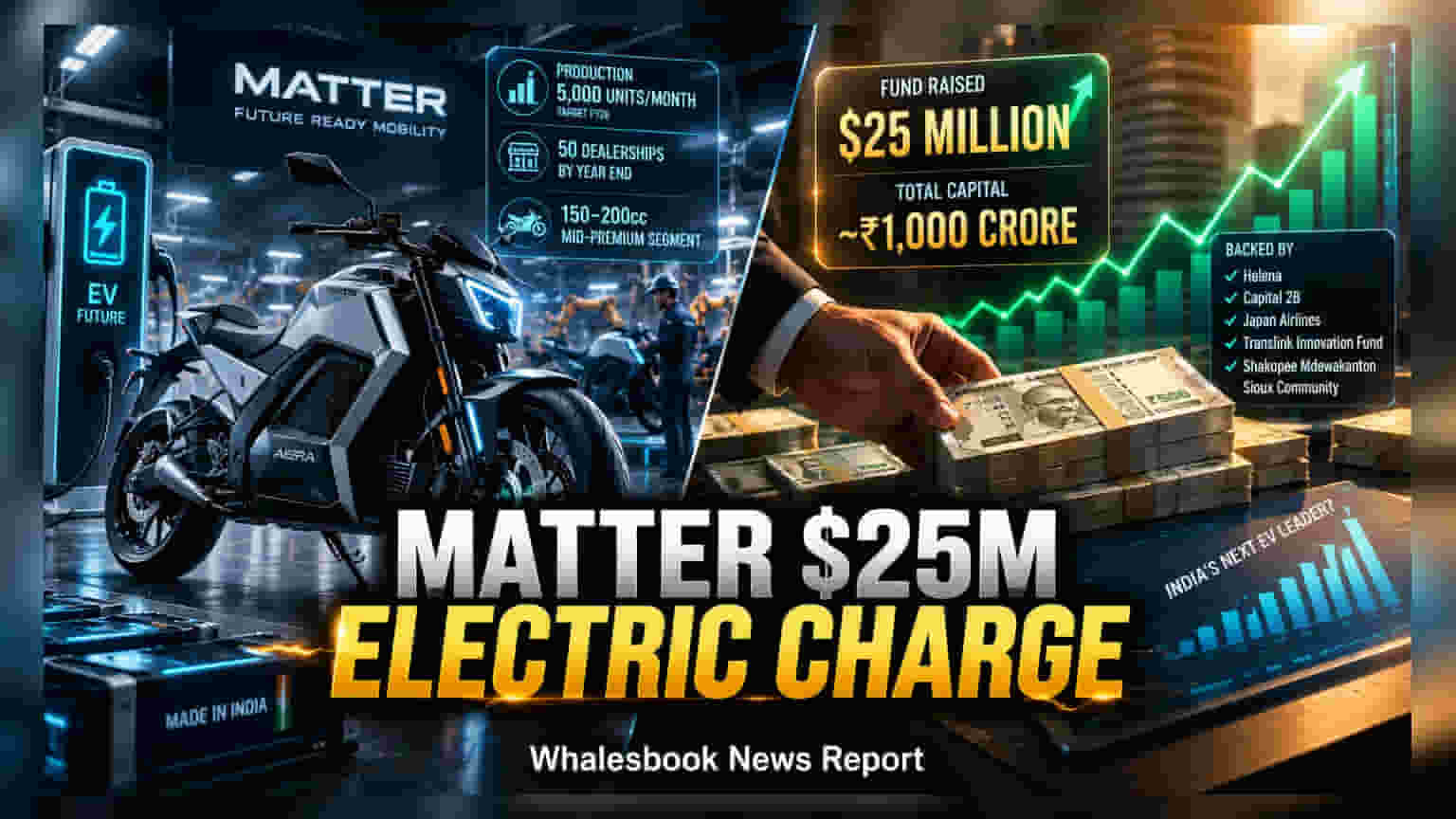
Matter Motor Works, the manufacturer of the AERA electric motorcycle, has successfully raised $25 million in a new funding round. This latest capital infusion comes from existing investors, including Helena, Capital 2B, Japan Airlines, Translink Innovation Fund, and the Shakopee Mdewakanton Sioux Community. With this development, the company has now raised approximately ₹1,000 crore in total capital to support its transition from pilot production to large-scale commercial operations.
It is important for readers to note that Matter Motor Works is a private company and is not listed on any stock exchange, such as the NSE or BSE. As it is an unlisted entity, it does not have a public share price, and it does not trade in the open market.
The funds are primarily earmarked for increasing manufacturing capacity and expanding the company's distribution footprint. During its earlier pilot phase, the company produced roughly 1,500 to 1,600 units. Now, it aims to scale its production capacity to 5,000 vehicles per month by the end of the current financial year. To sell these vehicles, the company is also growing its retail presence, moving beyond its home base in Ahmedabad. It plans to reach 50 dealerships by the end of this year, with an additional 100 touchpoints planned for the following calendar year.
Matter Motor Works is targeting the mid-premium segment, with upcoming models planned for the 150-200cc category. These motorcycles are expected to be priced between ₹1.6 lakh and ₹2.2 lakh. This puts the company in direct competition with established petrol-powered motorcycles, such as the Bajaj Pulsar and TVS Apache, rather than just other electric vehicles.
The company is operating in a segment that presents both a massive opportunity and a significant challenge. While electric scooters have seen strong adoption, accounting for about 25% of the electric two-wheeler market, electric motorcycles are still in the very early stages, currently holding only about 0.1% market share. This means the company is trying to create a category that is still largely unproven in India.
Looking ahead, the company faces notable execution risks. Scaling from a pilot project to mass manufacturing is a complex task that requires high operational efficiency, stable supply chains, and consistent quality. Because the electric motorcycle industry is still developing, the company will likely require continuous, large-scale capital to fund its growth and product development. Observers will be monitoring the company's progress on three main fronts: its ability to hit the production target of 5,000 units per month, the success of its retail expansion into western and southern India, and the market response to its upcoming motorcycle models.