 Whalesbook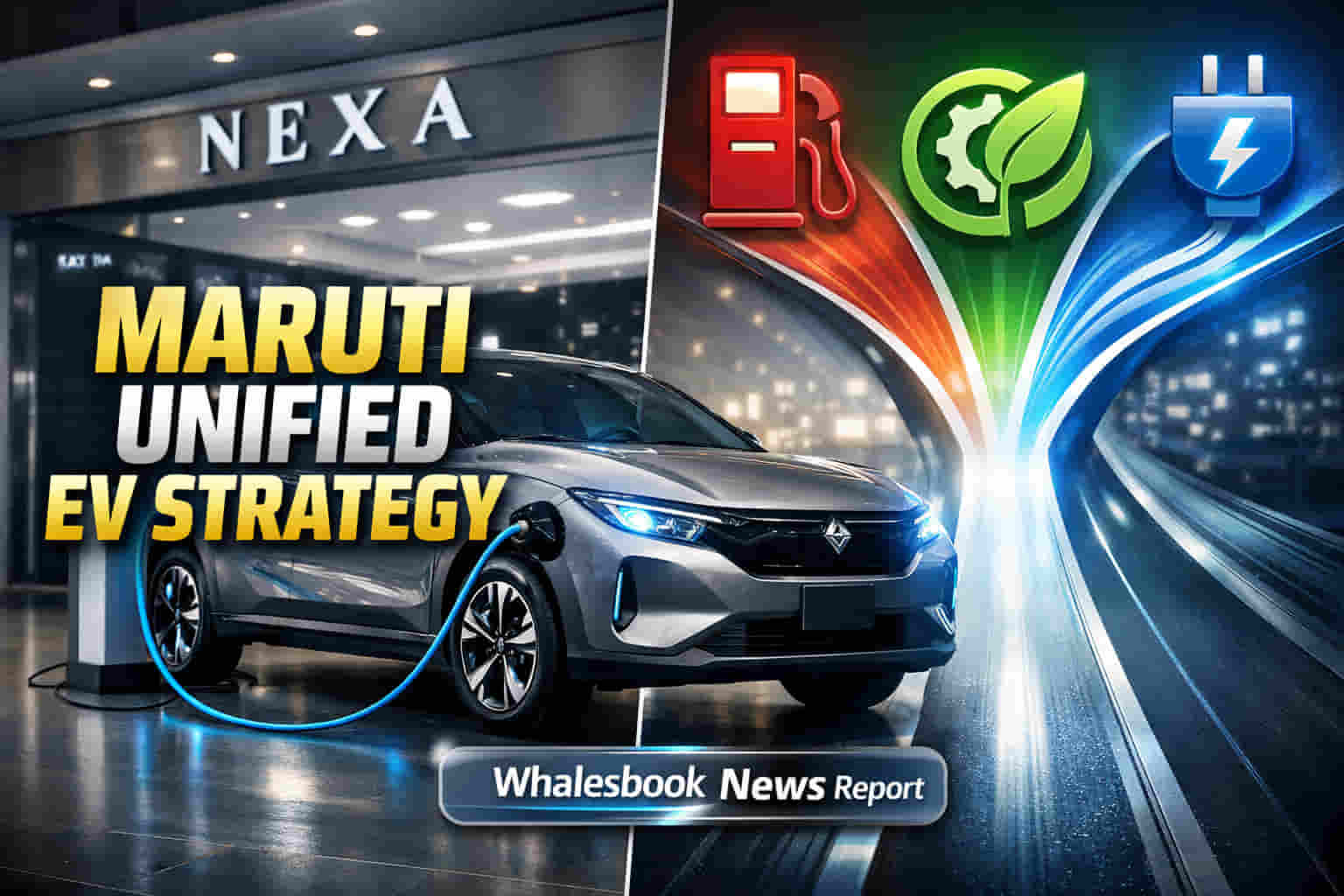


### Unified Powertrain Retail Philosophy
Maruti Suzuki India Limited (MSIL) has affirmed its strategy to integrate battery electric vehicles (BEVs) as another powertrain option within its existing multi-channel retail framework. The company will not establish exclusive sales networks for EVs, viewing them as an extension of its current offerings that include petrol, CNG, strong hybrid, and soon-to-be-introduced flex-fuel variants. Partho Banerjee, Senior Executive Officer (Marketing & Sales) at MSIL, emphasized that the core focus remains on delivering a high-quality customer experience across all vehicle types, rather than segmenting sales channels by powertrain. This approach directly contrasts with competitors like Tata Motors, which has pursued a dedicated EV-led strategy, including specialized branding and focused ecosystem partnerships, aiming for 18-20% EV market share in its passenger vehicle business by 2030. MSIL's market capitalization stands at approximately ₹4.78 trillion with a P/E ratio of 32.03, indicating investor confidence in its established operations.
### e Vitara Launch and Network Integration
The company is scaling its electric foray with the launch of its maiden BEV, the Maruti Suzuki e Vitara, manufactured at its Gujarat facility. The e Vitara is priced between ₹17.49 lakh and ₹20.99 lakh, with an introductory Battery-as-a-Service (BaaS) option at ₹10.99 lakh, excluding the battery cost. Production ramp-up will be cautious, with domestic output anticipated to remain below 2,000 units per month until July 2026, as the e Vitara shares a production line with the popular Fronx, and export allocations also influence capacity management. All EVs will be retailed through MSIL's premium Nexa network, comprising over 740 outlets, with an expansion of smaller 'Nexa Studio' formats to enhance reach. Charging infrastructure is being integrated across all Nexa showrooms, with most offering both AC and DC fast chargers. By the end of 2025, MSIL had already established over 2,000 exclusive EV charging points across more than 1,100 cities, with a long-term target of over 100,000 public charging points by 2030 through collaborations with 13 charge point operators.
### Competitive Positioning and Market Dynamics
Maruti Suzuki's strategy positions it to leverage its vast dealer network and established brand trust to drive EV adoption without the significant investment required for new, standalone infrastructures. This contrasts with Tata Motors, the current EV market leader with approximately 49% share in passenger EVs, which is actively expanding its dedicated EV showrooms and charging network, aiming to achieve 400,000 charging points by 2027. The Indian EV market is experiencing rapid growth, projected to reach $31.09 billion by 2026 and is expected to grow to $164.42 billion by 2033. Despite this growth, recent GST 2.0 changes reduced taxes on ICE vehicles, widening the price gap and potentially slowing EV penetration, which stood at 3.7% in November 2025. Analysts remain cautiously optimistic, with some naming MSIL a top EV pick and setting target prices around ₹17,549, suggesting an upside potential of 17%.
### Production Constraints and the Bear Case
A key concern for Maruti Suzuki's EV strategy is the initial production bottleneck. The e Vitara's domestic production is capped below 2,000 units monthly until July 2026 due to shared manufacturing lines and strong demand for other models like the Fronx, coupled with export requirements. While a dedicated EV production line with a 2.5 lakh annual capacity is slated for July 2026, this limits the immediate supply to meet the surging demand in India's EV market, which saw 108% year-on-year sales growth in H1 FY2026. Furthermore, the e Vitara's pricing, starting at ₹17.49 lakh, is higher than some competitors' offerings, potentially limiting broader adoption among price-sensitive consumers. Analysts note that while the company is debt-free, recent EBIT margins saw a slight decline due to commodity costs and supply chain pressures. The integrated retail approach, while cost-efficient, might also mean a slower pace of EV market penetration compared to rivals with dedicated strategies.
### Future Outlook and Analyst Consensus
Maruti Suzuki aims to navigate the evolving automotive landscape by balancing its traditional strengths with a strategic, phased entry into the EV segment. The company is investing significantly in charging infrastructure and expanding its Nexa network to support its EV rollout. Analysts generally hold a positive view, with many reiterating 'BUY' ratings and setting price targets that suggest further upside. For instance, HDFC Securities and Motilal Oswal have set targets of ₹14,839 and ₹14,500 respectively, while broader analyst consensus points to a ₹17,549.13 target price. The success of the e Vitara, coupled with the planned expansion of dedicated EV production capacity and a comprehensive charging network, will be crucial in determining Maruti Suzuki's competitive stance in the rapidly growing Indian EV market.