

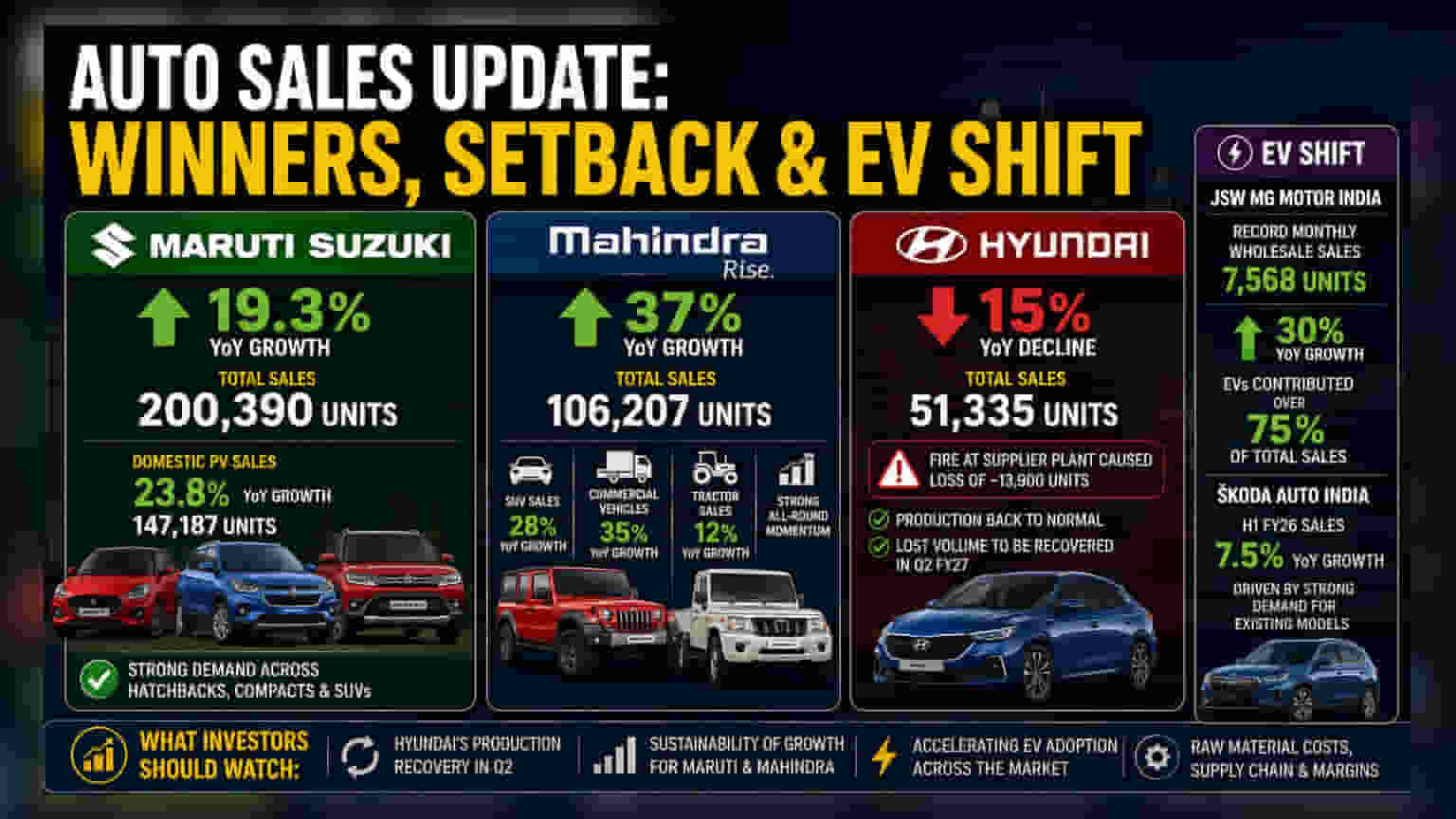
Indian automakers showed mixed results in June. Maruti Suzuki and Mahindra & Mahindra reported strong double-digit sales growth. In contrast, Hyundai Motor India’s sales fell 15% due to a temporary supplier fire. Investors are now watching whether Hyundai can quickly recover lost production and if the strong demand trend holds for major manufacturers.
What Happened
June sales data for Indian automakers shows a divergence in performance. Maruti Suzuki and Mahindra & Mahindra recorded robust year-on-year growth, signaling continued momentum in both passenger and commercial vehicle segments. Conversely, Hyundai Motor India experienced a 15% drop in total sales, primarily due to a temporary supply chain disruption caused by a fire at a vendor's facility.
Growth Drivers for Maruti and Mahindra
Maruti Suzuki India posted a 19.3% increase in total sales, reaching 200,390 units. A key highlight was the 23.8% growth in domestic passenger vehicle sales, which hit 147,187 units. Demand remained broad-based, with sales across mini cars, compact models like the Swift, and utility vehicles like the Brezza showing strong movement.
Mahindra & Mahindra reported a sharp 37% jump in total sales to 106,207 units. The company benefited from sustained demand in its SUV and commercial vehicle segments, which grew by 28% and 35%, respectively. Additionally, the tractor business saw a 12% increase, providing a positive signal for rural economic demand.
Understanding Hyundai’s Temporary Dip
Hyundai Motor India’s decline to 51,335 units in June was directly linked to a specific operational challenge. The company stated that a fire at a critical supplier's factory resulted in the loss of approximately 13,900 units during the month. This highlights the sensitivity of automotive production to single-point supply chain failures.
The management has confirmed that production operations have since returned to normal. The company expects to recover the lost volume during the second quarter of the fiscal year, suggesting that the drop in sales is likely a temporary timing issue rather than a decline in underlying customer demand.
Electric Shift and Market Trends
Beyond the large-cap players, other manufacturers reported notable shifts. JSW MG Motor India achieved record monthly wholesale sales of 7,568 units, a 30% increase year-on-year. A significant trend in these numbers is the reliance on electric vehicles, which accounted for over 75% of their total sales. This shift underscores a growing consumer appetite for electric mobility. Meanwhile, Skoda Auto India reported a steady 7.5% growth in the first half of 2026, driven by consistent demand for its existing model lineup.
What Investors Should Track Next
Investors will be looking for confirmation that Hyundai’s production recovery goes according to plan in the upcoming monthly updates. For Maruti and Mahindra, the key focus remains on whether this strong growth in June is sustainable throughout the rest of the quarter or if it was supported by specific promotional or seasonal factors. Additionally, the high percentage of EV sales reported by JSW MG Motor is a trend to watch, as it may indicate how quickly the broader market is transitioning toward electric mobility, potentially impacting the strategy of other major manufacturers.