

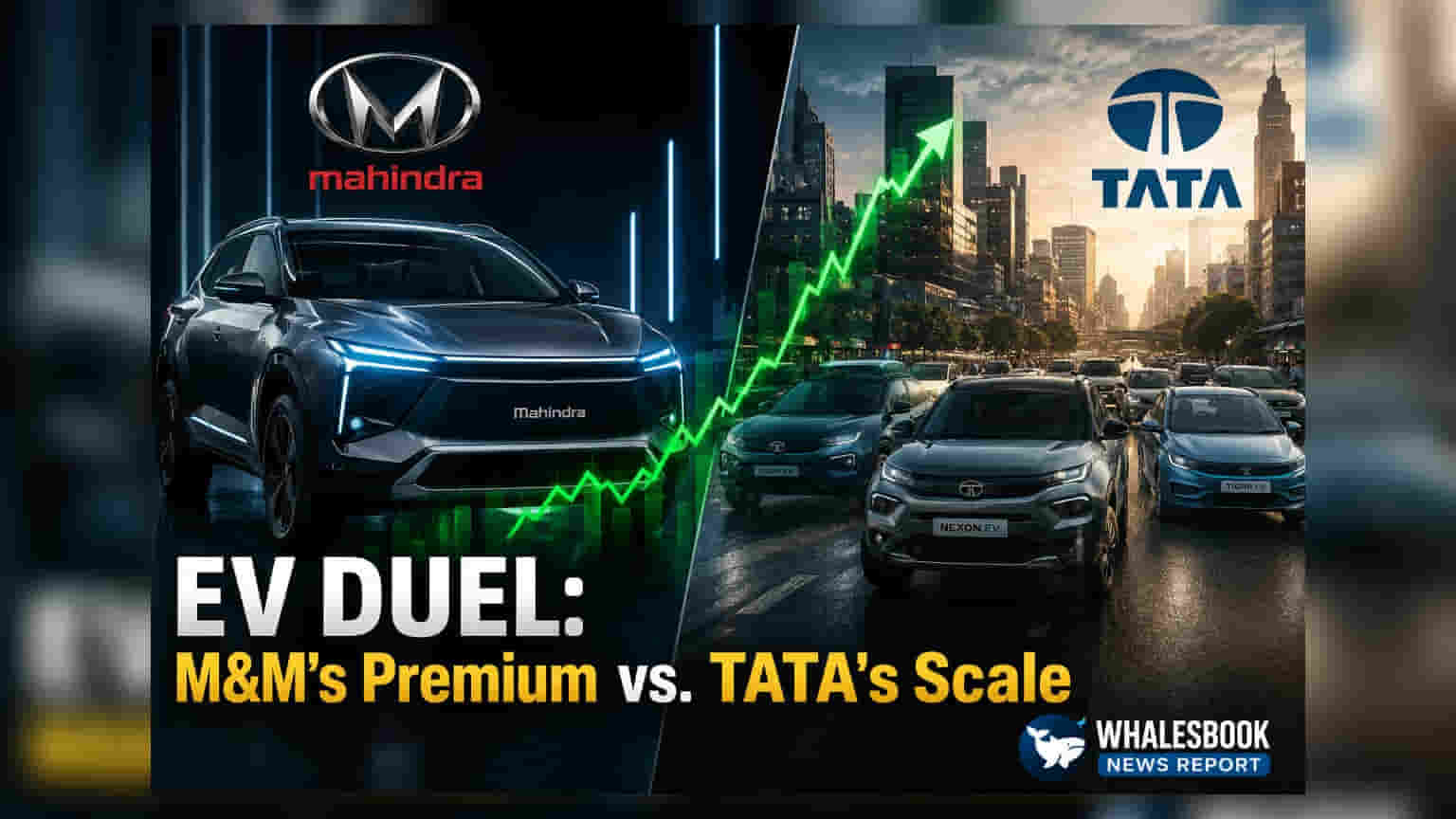
Mahindra & Mahindra and Tata Motors are pursuing different paths in India's electric vehicle market. M&M is focusing on premium e-SUVs to drive profitability, while Tata Motors is prioritizing volume and market scale. Investors are tracking how these strategies impact long-term financial performance and market share in an evolving sector.
As the Indian electric vehicle (EV) sector matures, two major players, Mahindra & Mahindra (M&M) and Tata Motors, have adopted distinct strategies to capture market share. M&M is betting on the premium SUV segment, while Tata Motors continues to leverage its early-mover advantage to build scale across a wider range of products.
Strategic Divergence in EV Roadmaps
For the fiscal year 2026, the two companies highlighted different long-term targets. Mahindra & Mahindra expects its e-SUVs to account for 18% to 20% of its total vehicle penetration within the next five years. The company is investing in a series of 'born-electric' platforms, planning to launch six new models by FY31. This approach is designed to move the brand toward higher-value products, with a clear focus on maintaining healthy profit margins rather than just chasing volume growth.
In contrast, Tata Motors is aiming for a more aggressive expansion of the overall market. The company has set a goal for electric vehicles to make up approximately 30% of its passenger vehicle sales by the end of the decade. By offering a diverse portfolio and multiple powertrain options, Tata Motors aims to lower the barrier to entry for mainstream consumers.
Financial Performance and Market Position
Financial data for FY26 underscores these different models. M&M reported ₹15,089 crore in revenue from its e-SUV business, driven by the sale of 50,835 vehicles. This segment achieved an EBITDA margin of 9.1% and an EBIT margin of 2%. M&M currently holds a significant revenue market share in the premium e-SUV space.
Meanwhile, Tata Motors reported ₹13,410 crore in revenue from its electric passenger vehicle business in FY26, a 63.8% increase compared to the previous year. The company sold 92,179 electric units, a 43% increase in volume. While Tata Motors remains the largest player by sales volume, its financial reporting integrates EV profitability within its broader passenger vehicle division, making a direct margin comparison with M&M's standalone e-SUV unit difficult for investors to assess precisely.
Investor Monitorables
Both strategies carry inherent risks and opportunities. M&M's reliance on premium 'born-electric' platforms depends heavily on the sustained demand for high-end SUVs and its ability to manage the costs associated with new technology development. If the market for premium electric vehicles does not grow as expected, the return on its heavy investment in these platforms could be delayed.
For Tata Motors, the primary challenge lies in scaling its operations profitably while facing increased competition from new entrants and legacy players. Management has indicated that revenue growth is currently outpacing volume growth, suggesting a transition toward higher-value offerings, but the ability to protect margins in a competitive, price-sensitive market will remain a key monitorable. Investors will continue to watch how these companies balance capital spending with the need for sustainable profitability in the coming quarters.