

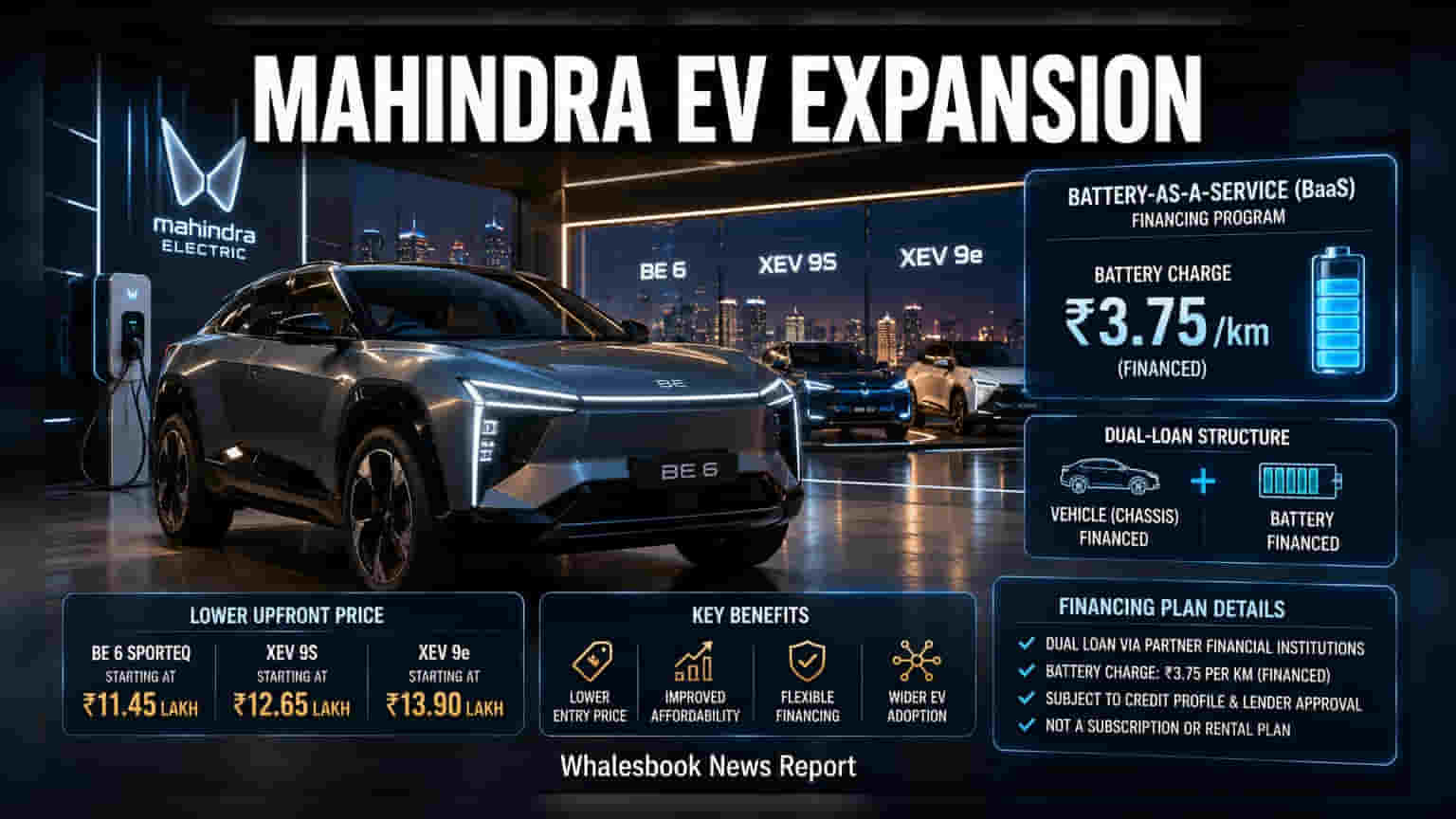
Mahindra & Mahindra has rolled out its Battery-as-a-Service model across its full Electric Origin SUV range, including the BE 6 SPORTEQ, XEV 9S, and XEV 9e. This financing scheme separates the battery cost from the vehicle price, lowering the initial entry barrier with starting prices as low as ₹11.45 lakh.
Mahindra & Mahindra has expanded its Battery-as-a-Service (BaaS) financing program to cover its entire Electric Origin SUV portfolio. This strategic shift is designed to address the primary consumer hurdle for electric vehicle adoption: the high upfront purchase price. By separating the vehicle chassis financing from the battery cost, the company aims to make its electric models more affordable and comparable to traditional internal combustion engine vehicles.
Understanding the Dual-Loan Structure
It is important for investors to note that this program is not a pay-per-use rental or subscription service. Instead, it is a dual-loan financing structure provided through partner financial institutions. When a customer purchases a vehicle, the cost of the chassis and the lithium-ion battery are financed through two separate loans. This allows for a lower initial price tag.
Under this scheme, the BE 6 SPORTEQ now carries an entry price of ₹11.45 lakh. The XEV 9S begins at ₹12.65 lakh, while the flagship XEV 9e starts at ₹13.90 lakh. In addition to the base financing, the battery component incurs a charge of ₹3.75 per kilometer, which is paid as part of the financing terms. Availability of this scheme is subject to the buyer’s credit profile and the specific approval criteria set by the lending partners.
Evaluating Financial and Operational Risks
While this model serves to lower the entry price and may boost sales volumes, it introduces specific complexities for the consumer and the company’s financing partners. For high-mileage users, the per-kilometer battery financing cost could potentially lead to a higher total expenditure over the vehicle's lifespan compared to an outright purchase. Investors should also consider that the total cost of ownership, including electricity for charging and the combined interest on two separate loans, requires careful calculation.
Furthermore, because this is a credit-dependent program, the adoption rate will rely heavily on the willingness of financial partners to extend these dual-loan structures to a wider customer base. Any tightening in credit standards could limit the effectiveness of this strategy in driving sales growth.
Investor Monitorables
The long-term success of this initiative will depend on how effectively the company manages customer education regarding the dual-loan structure and the total cost of ownership. For shareholders, the key monitorables moving forward will be the impact of this financing model on overall booking volumes, the ability of financing partners to scale the program, and whether the company can maintain healthy margins while offering these reduced upfront entry points. Tracking the mix of sales between traditional financing and this new dual-loan model in upcoming quarterly updates will provide insight into whether this strategy is successfully capturing a broader segment of the market.