

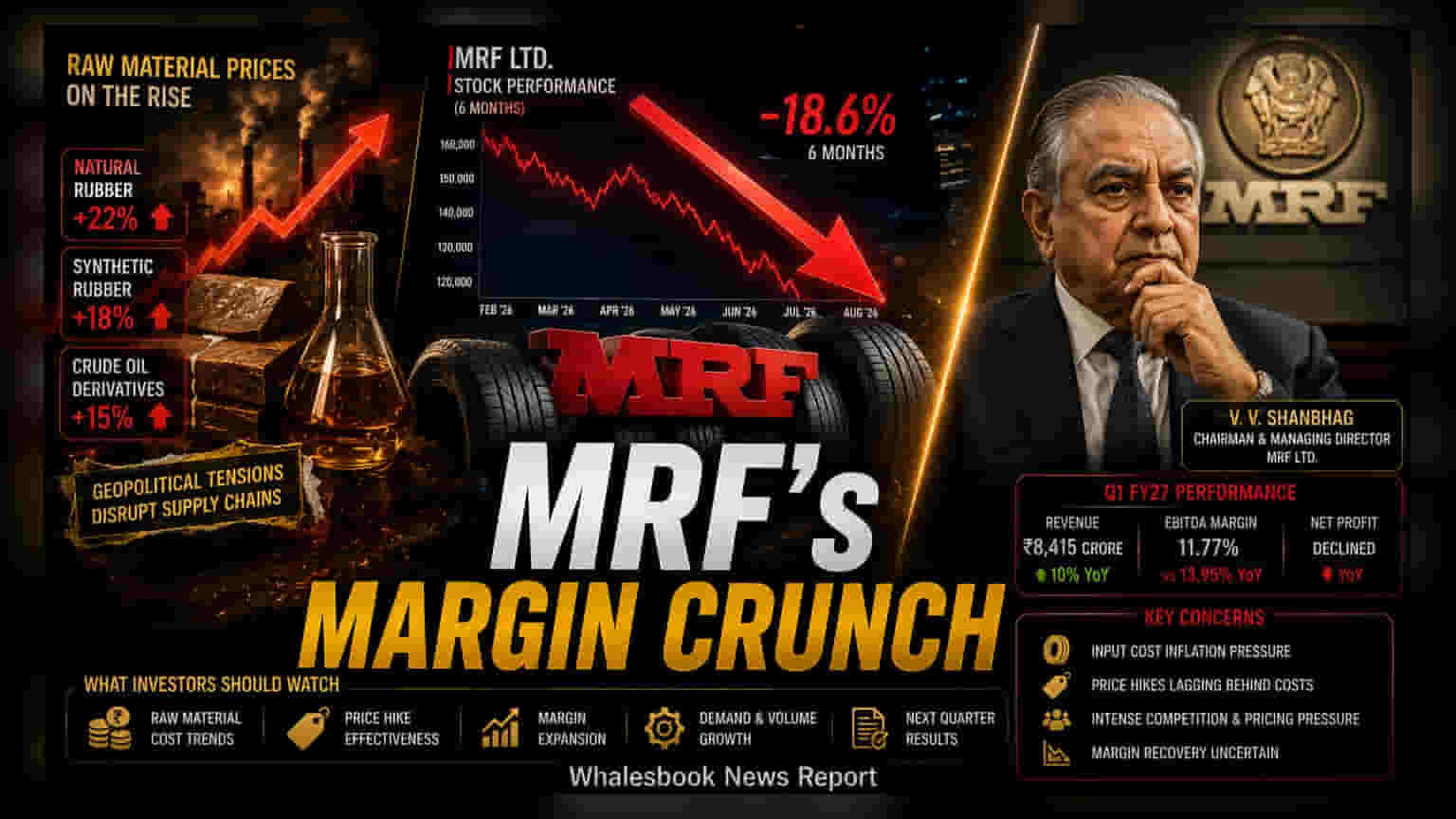
MRF Ltd. reported a net profit decline in Q1 FY27 as rising raw material costs outpaced price hikes. While revenue grew 10% year-on-year, operating margins contracted to 11.77%, highlighting the difficulty in passing on costs amid intense industry competition. Investors are tracking how the tyre maker manages these margin pressures in the coming quarters.
MRF Ltd. faced a challenging start to the 2027 fiscal year, with its June quarter results showing the impact of sharp input cost inflation. The company reported a year-on-year revenue increase of approximately 10% to ₹8,415 crore, supported by steady demand from both replacement markets and vehicle manufacturers. However, this growth was overshadowed by a decline in net profit and a noticeable compression in operating margins.
For the quarter ending June 30, 2026, MRF’s EBITDA margin dropped to approximately 11.77%, down from 13.95% in the previous year. The core issue behind this performance is the rising cost of raw materials, particularly natural rubber and crude oil derivatives. Management has pointed to ongoing geopolitical conflicts in the Middle East as a primary driver of these supply chain disruptions, which have kept material costs elevated. Despite implementing some price adjustments, the company struggled to fully offset these expenses, leading to the margin contraction.
Pricing Strategy and Competitive Landscape
Unlike some peers in the tyre sector, MRF has seen its price hikes lag behind the pace of rising raw material costs. This delay in adjusting product prices has made it harder to maintain profitability compared to competitors who may have navigated similar inflation with faster or more aggressive pricing strategies. The tyre industry is highly sensitive to raw material fluctuations, and as costs remain high, the ability to pass these increases to customers becomes a key factor in protecting bottom-line growth.
Adding to the complexity, the industry faces broader competition, including the impact of infrastructure changes like the Western Dedicated Freight Corridor, which affects demand for medium and heavy commercial vehicle tyres. Investors are also noting that new players entering the market can lead to more aggressive pricing wars, potentially limiting any immediate recovery in profit margins.
Market Reaction and Valuation
Following the earnings announcement on August 11, 2026, MRF’s stock price reacted with a decline of approximately 3% as the market assessed the margin pressure. Since then, the share price has seen some stabilization, trading near the ₹133,000–₹134,000 level as of August 20, 2026.
With the stock trading at a valuation of around 20 times estimated FY28 earnings, some market participants remain cautious. The current price-to-earnings multiple leaves little room for earnings disappointments, making the company vulnerable to volatility if profit margins do not improve.
The key monitorable for shareholders in the upcoming quarters will be the company's ability to balance price hikes with demand, particularly as raw material cost pressures are expected to persist. Investors will likely look for signs of margin expansion in the next earnings update to see if the current cost-management measures have been effective.