 Whalesbook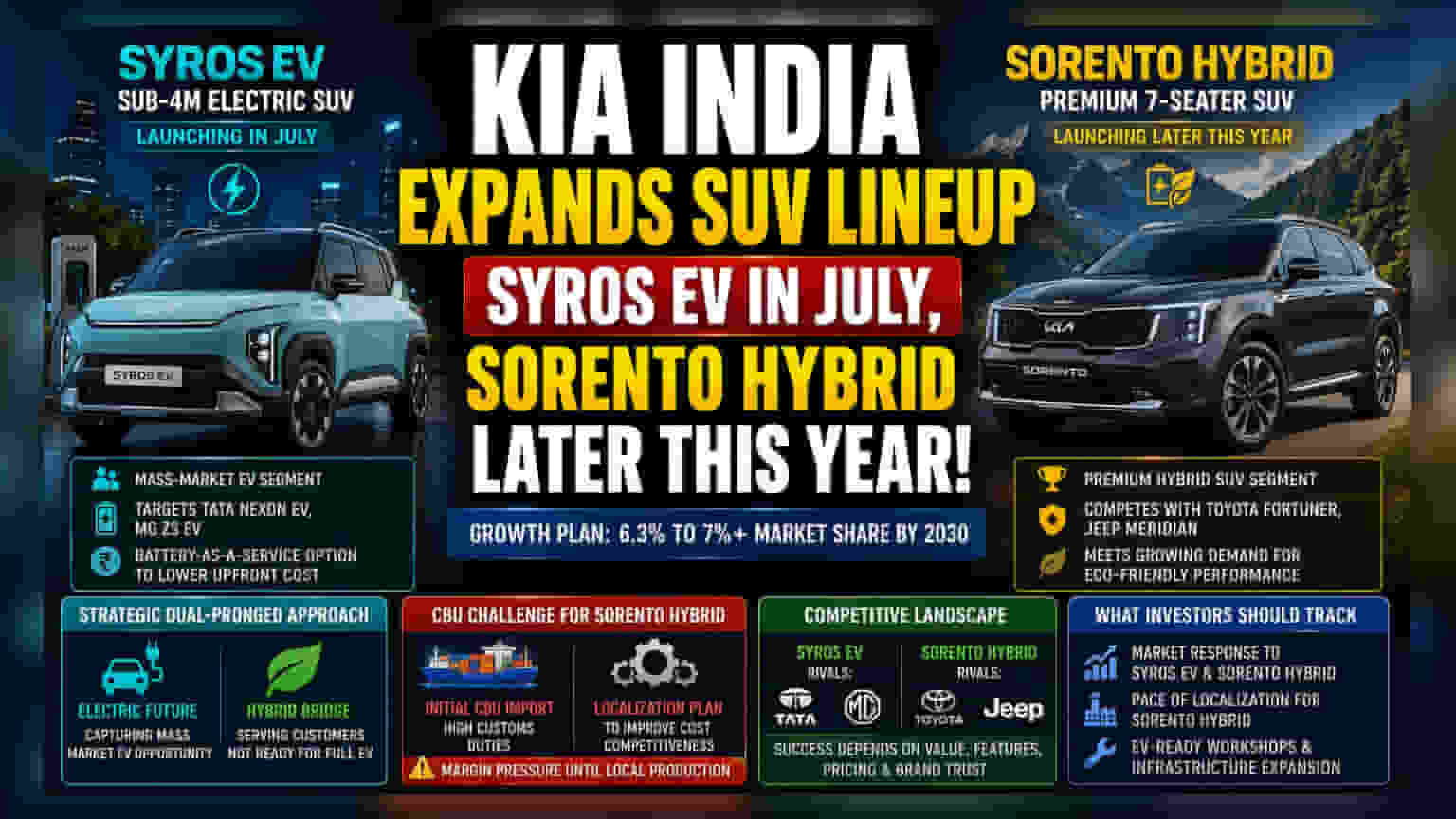


Kia India plans to launch the Syros EV and Sorento Hybrid, aiming to boost market share above 7% by 2030. While the Syros EV eyes the mass-market electric segment, the Sorento Hybrid faces a competitive premium SUV space. Investors may focus on the company's ability to manage high import duties on initial hybrid models and intense competition from domestic and international rivals in the growing EV and hybrid landscape.
What Happened
Kia India has announced plans to expand its vehicle portfolio with the introduction of two new SUV models. The company is set to launch the Syros EV, a sub-4-meter electric vehicle, in July. This model is positioned for the mass-market electric segment, filling a gap in the company’s current offerings. Additionally, the company intends to launch the Sorento Hybrid, a premium SUV, later this year. These additions are part of Kia’s strategic goal to increase its market share in India from approximately 6.3% to more than 7% by 2030.
Strategic Pivot Towards EVs and Hybrids
The launch of these two vehicles highlights Kia’s dual-pronged approach to the evolving Indian automobile market. By entering the mass-market electric segment with the Syros EV, the company is attempting to compete directly with established electric offerings from companies like Tata Motors and MG. The potential use of a Battery-as-a-Service model could be a strategy to lower the upfront purchase price for customers, which is a common barrier for EV adoption in India. Meanwhile, the decision to introduce the Sorento Hybrid demonstrates a recognition of the growing demand for hybrid vehicles, which offer a bridge for consumers not yet ready to shift fully to electric propulsion.
The CBU and Localization Challenge
For investors, the most critical aspect of the Sorento Hybrid launch is its initial route to market. Kia plans to introduce the Sorento as a Completely Built Unit, or CBU. In India, CBU imports are subject to significantly higher customs duties compared to locally manufactured vehicles. This structure creates a challenge for pricing and profit margins. While the company has indicated that it is exploring the localization of hybrid components to improve cost-effectiveness, the initial phase may face margin pressure. The ability of the company to transition from imports to local manufacturing will be a key factor in determining long-term profitability for this model.
The Competitive Landscape
The Indian SUV segment is highly crowded and competitive. The Syros EV will enter a space currently dominated by models such as the Tata Nexon EV and the MG ZS EV. To gain market share, Kia will need to differentiate its product through features, range, or pricing, especially against domestic rivals that have already established strong supply chains and charging infrastructure. In the premium segment, the Sorento Hybrid will face off against well-entrenched competitors like the Toyota Fortuner and Jeep Meridian. Success here will depend on whether consumers perceive enough value in the hybrid technology to justify the price point compared to traditional diesel or petrol SUVs.
What Investors Should Track
Investors looking at the company’s growth trajectory should monitor several factors. First is the actual market response to these new models; consumer acceptance of the Syros EV will determine if Kia can effectively challenge current leaders in the sub-4-meter EV space. Second is the pace of localization for the Sorento Hybrid. Any delays in shifting from CBU imports to local production could prolong margin pressure. Finally, keeping an eye on the company's broader infrastructure expansion, including the number of EV-ready workshops, is important, as this support system is essential for maintaining brand loyalty and vehicle uptime in a competitive market.