

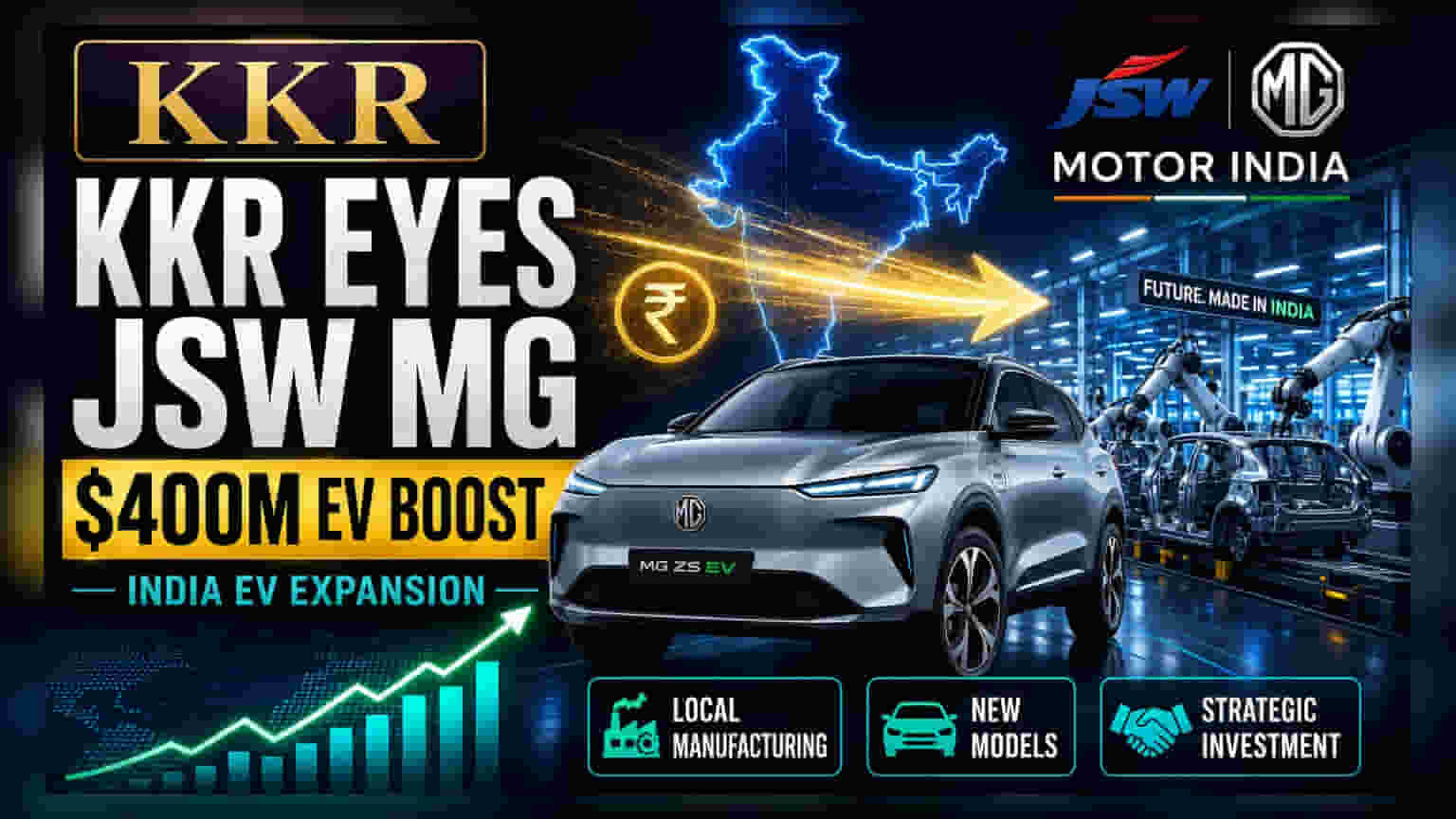
Private equity firm KKR is negotiating a $400 million investment in JSW MG Motor India to fund the company's electric vehicle expansion. The potential deal aims to support new model launches and plant upgrades, helping the joint venture compete more effectively in the Indian EV market. This marks the first major external equity raise for the entity established by JSW Group and SAIC Motor.
What Happened
JSW MG Motor India, a joint venture between the JSW Group and China's SAIC Motor, is reportedly in discussions with the U.S.-based private equity firm KKR for an investment of up to $400 million. This potential funding round, which aims for a company valuation of $3 billion, would be the first major external equity infusion for the venture since it was formed in March 2024.
The proposal is expected to involve a combination of fresh capital to boost the company’s expansion plans and a partial sale of shares held by SAIC Motor. While the deal is still in the negotiation stage, it highlights the growing interest of global financial investors in India's electric vehicle (EV) sector.
Why This Matters For The Business
The investment is designed to provide the capital needed to maintain the company’s momentum in a highly competitive market. JSW MG Motor India has been aggressive in its expansion, reporting a 73% surge in EV sales volume for the 2026 financial year. To sustain this, the company has lined up a significant capital spending plan of approximately Rs 3,700 crore over the next two years.
This money is earmarked for expanding manufacturing capacity and launching three to four new models in 2026, including a plug-in hybrid. The company is also pushing hard on localization, aiming to increase local sourcing of components to 70% to better manage costs and supply chain risks.
Competition And Market Position
JSW MG Motor India currently ranks as the second-largest EV maker in the country by volume, trailing behind Tata Motors. The company’s "Battery-as-a-Service" (BaaS) model, launched in late 2024, has been a key strategy to lower the upfront price of electric cars, which remains a significant hurdle for Indian buyers.
However, the EV space is becoming crowded. Traditional automakers like Tata Motors and Mahindra & Mahindra, as well as global players like Hyundai, are all scaling up their EV portfolios. For JSW MG Motor, the challenge is not just launching cars, but doing so while managing the high costs associated with electrification.
The Risk And Financial Reality
While volume growth has been strong, the company has faced financial pressure. Despite surpassing $1 billion in revenue in FY25, the venture has reported net losses. These losses are primarily due to heavy spending on building the business, developing new technology, and scaling up production capacity.
Investors should also note the ownership structure. SAIC Motor, the Chinese partner, holds a significant 49% stake. While the JSW Group holds a majority, the involvement of a Chinese stakeholder in the Indian auto sector has historically invited regulatory and public scrutiny. Balancing this partnership with the need for rapid growth remains a task for the management.
What Investors Should Track Next
The primary monitorable is whether the KKR deal is finalized and at what valuation. Investors should also watch for:
- Execution of the Model Pipeline: Success will depend on whether the 3-4 new models planned for 2026 can gain traction against established competitors.
- Profitability Trends: As the company matures, the market will look for a path toward breaking even, even as they continue to spend on expansion.
- Localization Targets: Progress on the 70% localization goal will be crucial to protect profit margins from import-related costs.
- Market Share Defense: With competition increasing, maintaining its position as the second-largest EV player in India will be a key test.