

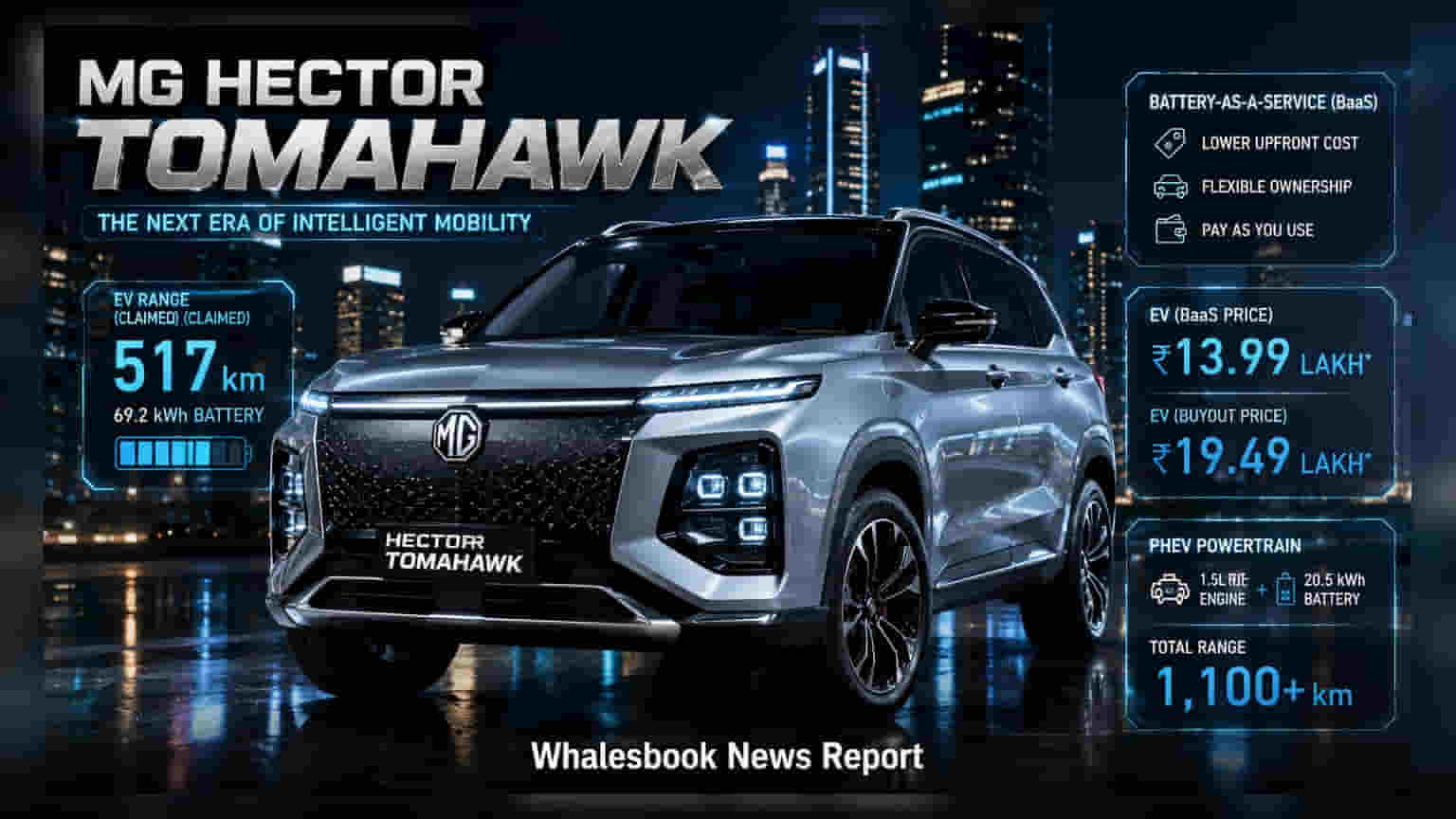
JSW MG Motor India has introduced the Hector Tomahawk SUV in both EV and plug-in hybrid models, utilizing a battery-rental plan to bring EV prices down to ₹13.99 lakh. Since the company is a private joint venture, it is not listed on the stock market. The launch reflects the firm's strategy to capture the mid-size SUV market while managing high capital requirements.
On August 26, 2026, JSW MG Motor India officially introduced the Hector Tomahawk, a new SUV available in both electric vehicle (EV) and plug-in hybrid (PHEV) variants. The company is scaling its Battery-as-a-Service (BaaS) model, which allows buyers to rent the battery separately from the vehicle. This pricing structure reduces the entry cost for the EV model to ₹13.99 lakh, while an outright purchase of the vehicle is priced at ₹19.49 lakh.
The vehicle is built on the company's new ADAPT platform, designed to support flexible energy solutions. The EV variant is equipped with a 69.2 kWh battery, delivering a claimed range of 517 km on a single charge. For buyers preferring a mix of fuel and electricity, the PHEV variant pairs a 1.5-litre petrol engine with a 20.5 kWh battery, offering a total driving range of over 1,100 km. These features are intended to help the company compete with traditional combustion-engine SUVs in the mid-size segment.
Investors should note that JSW MG Motor India is a private joint venture and is not publicly listed on the NSE or BSE. Therefore, investors cannot buy shares in this specific entity. However, the company remains an important player to watch within the broader automotive sector. As of July 2026, the company reported a 22% year-on-year sales growth, with new energy vehicles accounting for the majority of its sales volume.
Despite the product expansion, the company faces significant financial challenges. JSW MG Motor India has committed to a ₹5,000 crore capital expenditure plan to increase manufacturing capacity. This heavy spending comes at a time when the company has historically recorded accumulated losses of approximately ₹3,000 crore over the last five years. Improving operational efficiency while funding this large-scale expansion will be a critical task for the management.
The mid-size SUV market in India is highly crowded, with established competitors such as Tata Motors, Mahindra & Mahindra, and Hyundai. Success for the Hector Tomahawk will depend on customer acceptance of the BaaS model, which creates a recurring payment obligation for owners. Furthermore, the entire automotive sector is currently dealing with margin pressure due to intense competition and the need to balance growth with the high costs of developing electric vehicle infrastructure.
The key monitorable for the industry will be the adoption rate of the BaaS model in this higher-tier SUV segment. Additionally, observers will look for updates on whether the company can successfully narrow its historical losses while scaling up production volumes in the coming quarters.