

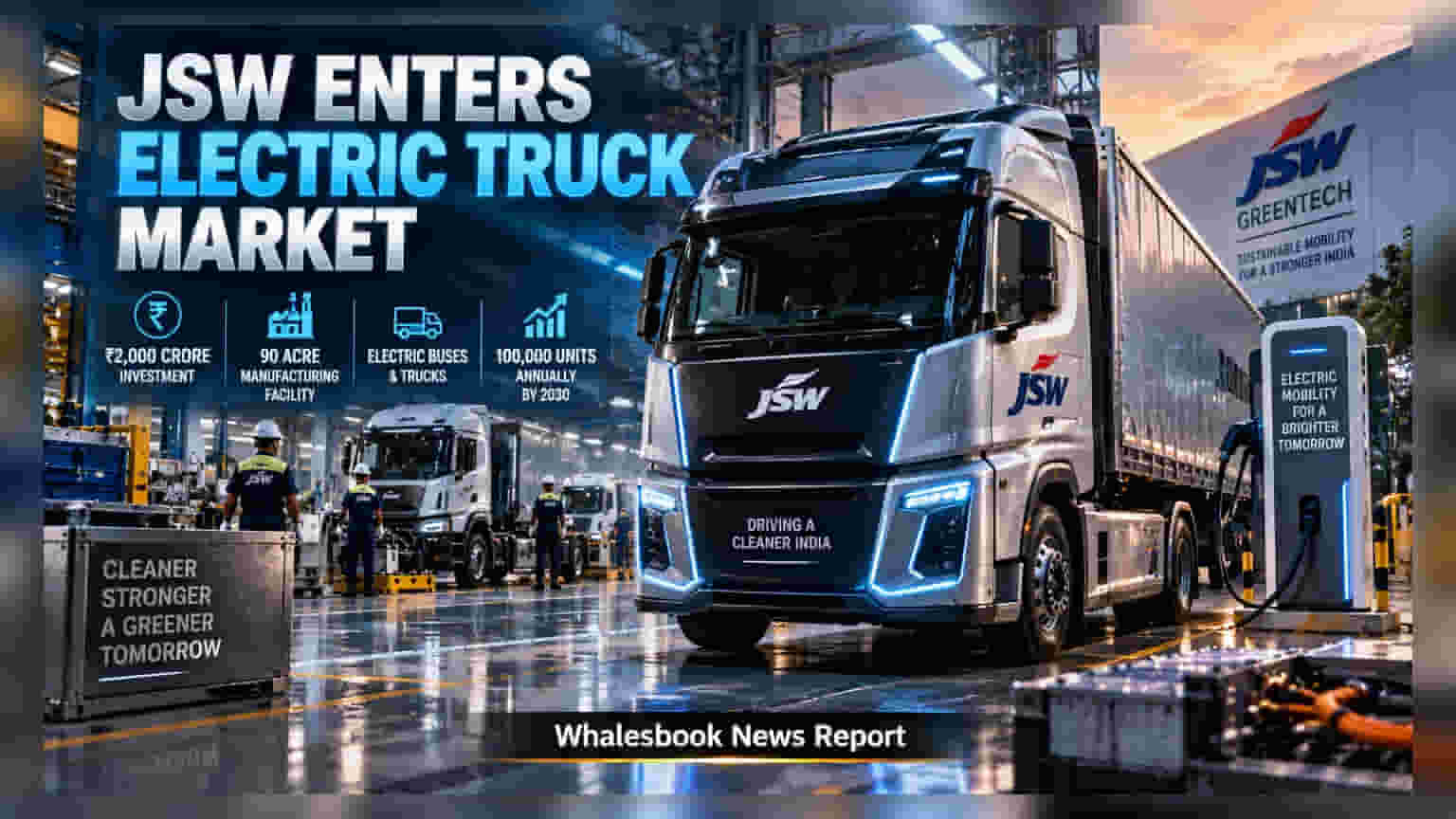
JSW Group is entering the electric commercial vehicle market with a ₹2,000 crore investment in a Chhatrapati Sambhajinagar facility. The conglomerate aims to produce 100,000 electric trucks and buses annually by 2030, utilizing its own fleet to drive initial adoption. This move positions the group to compete with established players in a capital-intensive sector where high initial costs remain a key challenge.
JSW Group has officially marked its entry into the electric commercial vehicle space with a ₹2,000 crore investment aimed at establishing a manufacturing base in Chhatrapati Sambhajinagar. The project, managed by the group's subsidiary JSW Greentech, involves a 90-acre facility designed to produce both electric buses and trucks. The company has set an ambitious long-term goal of manufacturing 100,000 electric vehicles annually by 2030, starting with an initial capacity of 15,000 units split between the two segments.
The venture is capital-intensive, a factor that differentiates it from the group's core operations in steel and energy. JSW is entering a competitive landscape already occupied by established automotive manufacturers such as Tata Motors and Ashok Leyland. For investors, the success of this initiative will depend on how the company manages the high barrier to entry associated with electric commercial vehicle production, including technology integration and the scale of manufacturing.
A significant part of the company's strategy involves leveraging its internal demand. JSW Group operates a substantial logistics fleet of approximately 17,000 trucks for its various business divisions, including steel, cement, and ports. Management has indicated that a large portion of this fleet could transition to electric power, particularly for short-haul or closed-loop routes. By using its own operations as a primary customer, the company aims to secure a base level of demand and prove the reliability of its technology without relying solely on external logistics providers in the initial phase.
The economics of the sector present another important monitorable. While a traditional heavy-duty diesel truck is priced around ₹25 lakh, electric equivalents currently come with a much higher purchase price, often reaching ₹85 lakh to ₹88 lakh. JSW Greentech management argues that the total cost of ownership favors electric vehicles over the long term, citing potential savings on fuel and maintenance, with estimates suggesting a 15% to 20% reduction in operational expenses. However, the viability of this model will depend heavily on the actual utilization levels and the cost of charging infrastructure.
Technically, the company plans to focus on deep integration, covering everything from cell-to-battery-pack manufacturing to vehicle assembly. The Sambhajinagar plant will feature specialized production lines, including India’s first commercial vehicle facility with a dedicated pre-treatment and electro-deposition process. Investors should track the progress of this project, specifically looking for updates on the construction timeline, the actual commissioning of the plant, and the pace at which the internal fleet transitions to electric power. As the company competes with legacy manufacturers who have already invested heavily in diesel technology, the ability to scale production while controlling costs will be a critical factor for long-term growth.