

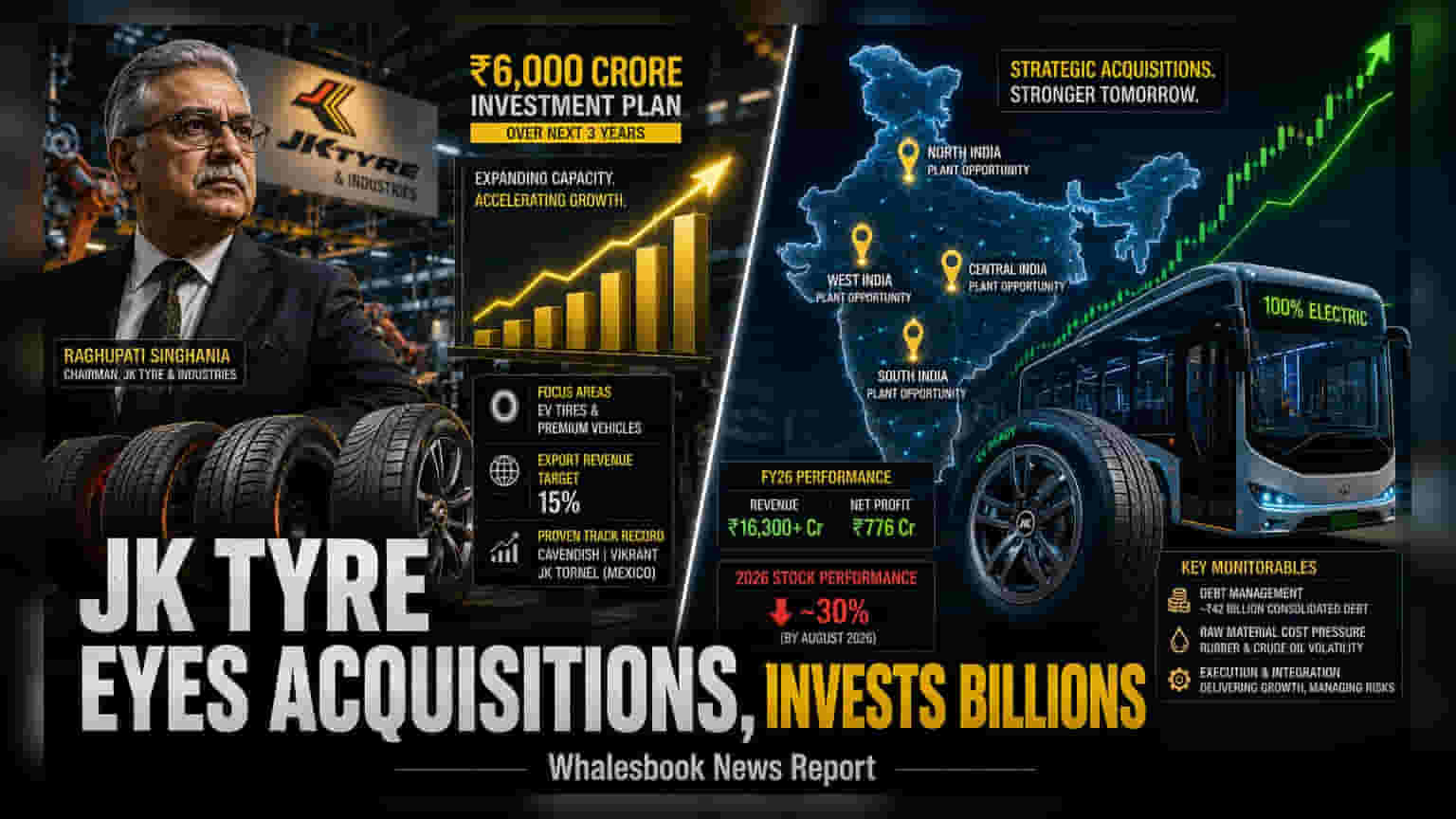
JK Tyre & Industries is set to invest ₹6,000 crore over three years to expand capacity and is actively looking for new acquisitions. While the company aims to capture growth in premium and electric vehicle tire segments, the stock has faced a roughly 30% decline in 2026 amid rising raw material costs and global uncertainty.
JK Tyre & Industries is stepping up its growth strategy, announcing a ₹6,000 crore investment plan to expand its manufacturing capacity over the next three years. Beyond building new facilities, the company is also looking at potential acquisitions to grow its business, banking on its past success in turning around entities like Cavendish Industries, Vikrant Tyres, and its Mexican unit, JK Tornel.
Focus on Premium and EV Segments
The company is directing its resources toward high-growth areas, specifically tires for electric vehicles (EVs) and premium passenger vehicles. Management intends to use this investment to bolster its market position and increase its export revenue share to 15%. By acquiring existing businesses, the company aims to add capacity and gain market access faster than building new plants from scratch. This strategy is becoming a common trend in the Indian tire industry, as companies look to consolidate and scale operations quickly.
Financial Context and Market Pressure
In FY26, JK Tyre posted a strong performance with revenue reaching over ₹16,300 crore and a net profit of nearly ₹776 crore. However, despite these solid operational results, the stock has faced significant pressure in 2026, dropping by approximately 30% by August. This performance gap is largely attributed to global geopolitical tensions and high raw material costs for rubber and crude oil-linked inputs, which have created profit margin pressure across the entire tire sector.
Monitoring Debt and Execution
As the company embarks on this substantial capital spending plan, investors are closely monitoring its financial health. The company’s consolidated debt currently stands at approximately ₹42 billion. Large-scale spending on expansion can often lead to higher debt levels or increased interest expenses, so the market will watch how management funds these projects while maintaining its balance sheet strength.
Another key factor for investors to track is the execution of these projects. The ability to manage costs effectively in an environment of volatile raw material prices will determine the company's long-term profitability. Furthermore, the success of any new acquisition will depend on whether the company can integrate these assets effectively, similar to its past turnaround stories, without overstretching its financial resources.