 Whalesbook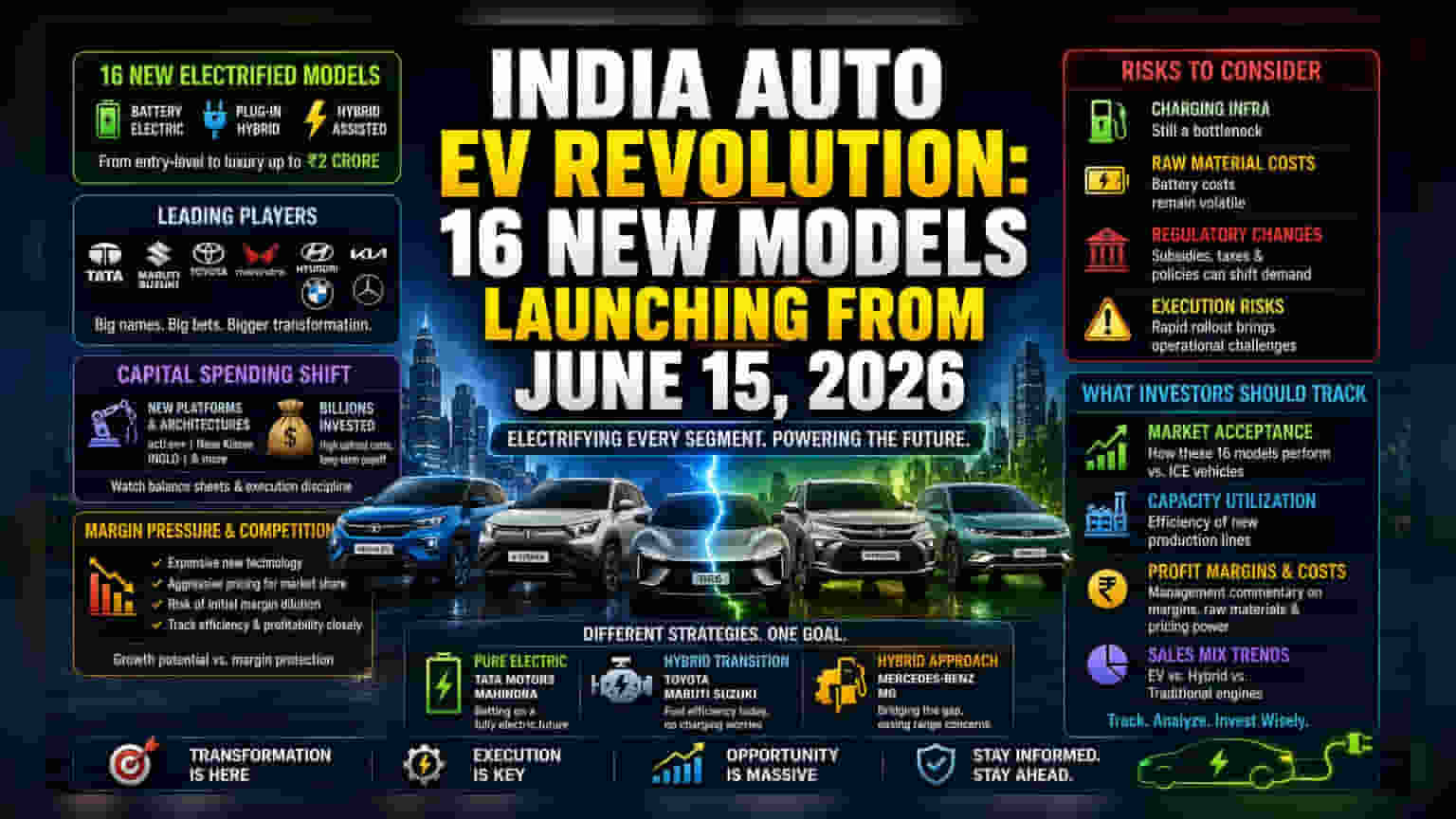


India’s auto market accelerates its green transition with 16 new electric and hybrid models launching from mid-June 2026. This aggressive expansion marks a shift as manufacturers move beyond traditional engines. For investors, the focus is now on capital spending, potential margin pressure in a highly competitive market, and the success of varied powertrain strategies ranging from pure battery-electric to hybrid systems.
What Happened
Starting June 15, 2026, the Indian automotive sector is set for a major transformation with the introduction of 16 new electrified models. This launch cycle, moved up by several months, features a mix of battery-electric vehicles, plug-in hybrids, and hybrid-assisted cars. Major manufacturers including Tata Motors, Maruti Suzuki, Toyota, Mahindra, Hyundai, Kia, BMW, and Mercedes-Benz are participating in this rollout. The new models cover a broad range of price points, from affordable entry-level cars to luxury vehicles priced up to ₹2 crore, signaling that electrification is rapidly moving from a niche segment to the mainstream.
The Capital Spending Shift
For investors, the most critical aspect of this transition is the significant amount of capital being deployed. Automakers are not just launching cars; they are betting billions on new technology architectures. Companies like Tata Motors are relying on dedicated platforms such as their 'acti.ev+' system, while global players are introducing architectures like BMW’s 'Neue Klasse' and Mahindra's 'INGLO'.
This massive investment in new capacity and technology platforms means that companies must manage high upfront costs before seeing meaningful returns. Investors should observe whether these companies can maintain their balance sheet strength while funding these heavy expansion projects. The ability to effectively transition manufacturing lines without disrupting existing revenue streams from traditional petrol and diesel vehicles will be a key performance metric in upcoming quarters.
Margin Pressure and Competition
While the expansion indicates strong growth potential, it also brings risk regarding profit margins. Introducing new technology is often expensive, and the competitive nature of the Indian market—where manufacturers must price products attractively to gain market share—may put pressure on operating margins.
As manufacturers fight for dominance across segments like entry-level hatchbacks and family SUVs, they may engage in aggressive pricing strategies. Investors should monitor whether these companies can balance market share gains with the need to protect profitability. Historically, new product launches in the auto sector can lead to initial margin dilution, and the market will be looking for signs of efficiency gains as production scales up.
Varying Strategic Approaches
Manufacturers are taking different routes to win over the Indian consumer. The market is effectively splitting into distinct strategies. Companies like Tata Motors and Mahindra are prioritizing a 'pure electric' approach, betting that the future is entirely battery-powered. In contrast, Toyota and Maruti Suzuki are leveraging hybrids as a transitional technology, aiming to offer the fuel efficiency of electrification without requiring the charging infrastructure that pure EVs demand. Mercedes-Benz and MG are employing a hybrid approach to bridge the gap and ease consumer concerns regarding driving range. These differing strategies mean that investors should look at each company's specific product mix and how well it aligns with consumer demand and infrastructure readiness.
Risks to Consider
Several challenges could impact the success of these launches. First, the pace of charging infrastructure development remains a bottleneck; if public charging networks do not grow as fast as EV sales, demand could hit a ceiling. Second, raw material costs for batteries remain volatile, which could squeeze margins if companies are unable to pass these costs on to consumers. Finally, regulatory changes regarding subsidies and taxes on EVs and hybrids can shift the demand landscape suddenly. Investors should remain cautious about the execution risks associated with such a rapid rollout of new technology.
What Investors Should Track
Going forward, the key monitorables include the actual market acceptance of these 16 models compared to internal-combustion engine vehicles. Investors should track quarterly updates on 'capacity utilization' to see how efficiently the new production lines are running. Management commentary on profit margins, the cost of raw materials, and the ability to maintain pricing power in a crowded market will be essential. Additionally, monitoring the sales mix between EVs, hybrids, and traditional engines will provide insight into how quickly the market is actually shifting.