

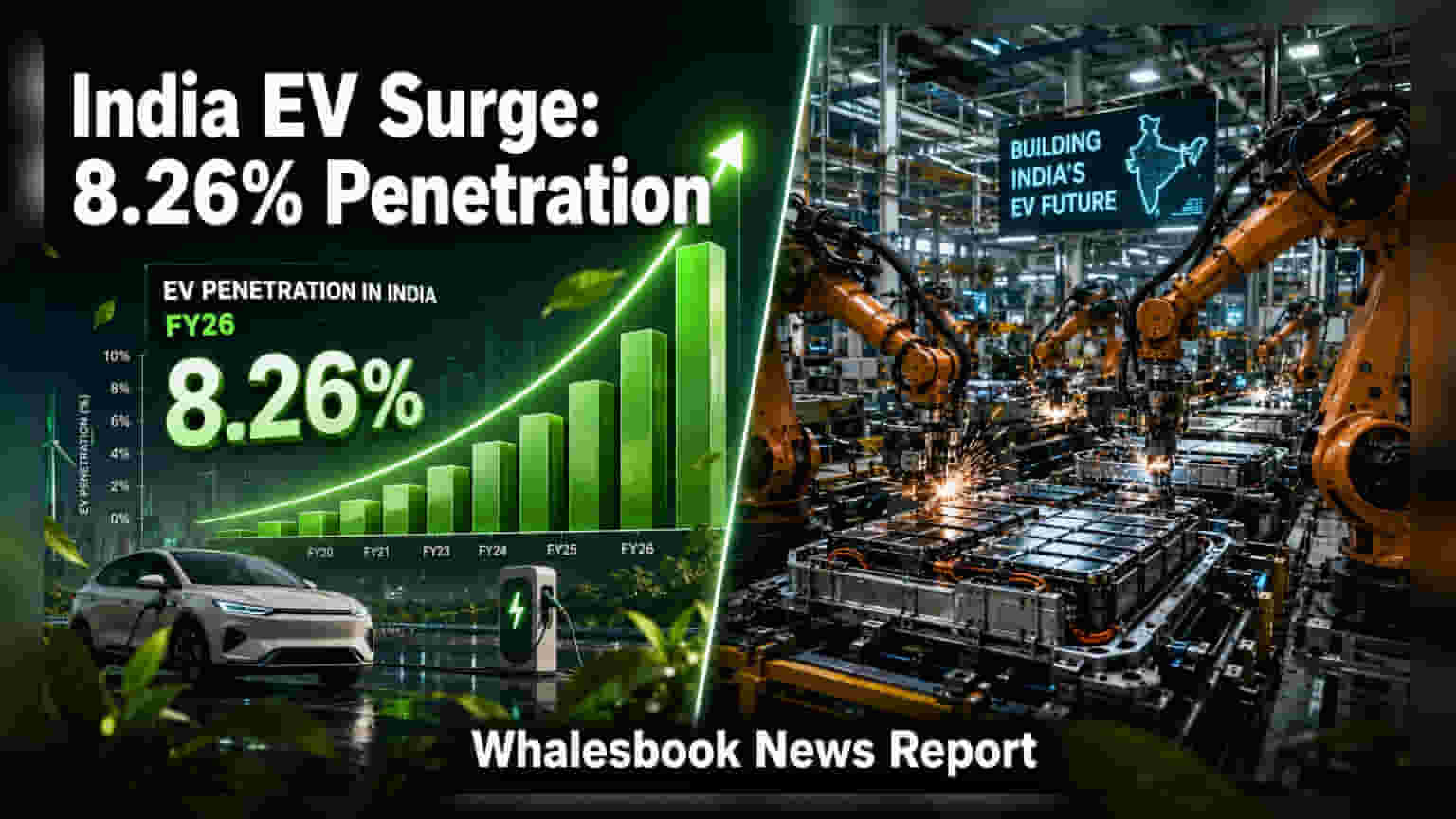
India's electric vehicle adoption climbed to 8.26% in FY2025-26, with total registrations crossing 10 million. While government-backed PLI schemes are boosting domestic manufacturing, investors should track the infrastructure gap and the high capital requirements for legacy automakers transitioning to electric models.
India's transition to electric mobility reached a significant milestone in FY2025-26, with EV penetration rising to 8.26% compared to just 0.71% in FY2019-20. Total registered electric vehicles in the country surpassed the 10 million mark by July 2026, signaling a major shift in the automotive landscape. This growth is supported by a mix of government incentives aimed at building a domestic ecosystem for batteries and automotive components.
Manufacturing Push and PLI Impact
A core driver of this shift is the heavy investment in domestic manufacturing. Two major Production-Linked Incentive (PLI) schemes are playing a central role in this strategy. The ₹18,100-crore scheme for Advanced Chemistry Cell (ACC) battery storage aims to create 50 GWh of local manufacturing capacity to reduce reliance on imported batteries. Simultaneously, the ₹25,938-crore PLI scheme for the automobile and auto component industry focuses on 19 categories of advanced technology vehicles and 103 specific components. For investors, these initiatives are crucial because they represent a structural move to reduce the import bill and deepen the localization of the auto supply chain.
The Infrastructure Challenge
While vehicle sales are rising, the supporting infrastructure remains a key monitorable. As of March 31, 2026, there were 52,718 public charging stations operational across India. This indicates a ratio of roughly one charging station for every 190 electric vehicles, highlighting an infrastructure bottleneck. To address this, the government has allocated ₹2,000 crore under the PM E-DRIVE scheme to expand the network, specifically targeting rural and semi-urban areas. Furthermore, the decision to classify the installation of EV charging stations as an unlicensed activity is designed to encourage more private sector participation, which could create new business opportunities for power and infrastructure companies.
Investor Context and Risks
For investors evaluating the sector, the transition to EVs is capital-intensive. Legacy automakers face the challenge of investing heavily in new production lines while managing declining returns from traditional internal combustion engine vehicles. Additionally, the industry remains vulnerable to supply chain issues, particularly due to heavy reliance on imported critical electronics and battery materials. Another factor to watch is price sensitivity; the current cost gap between electric and traditional vehicles remains a hurdle for mass-market adoption. Future performance in the sector will likely depend on how effectively companies can manage this transition, the speed at which charging infrastructure expands, and their ability to improve localization levels to protect profit margins from import fluctuations.