 Whalesbook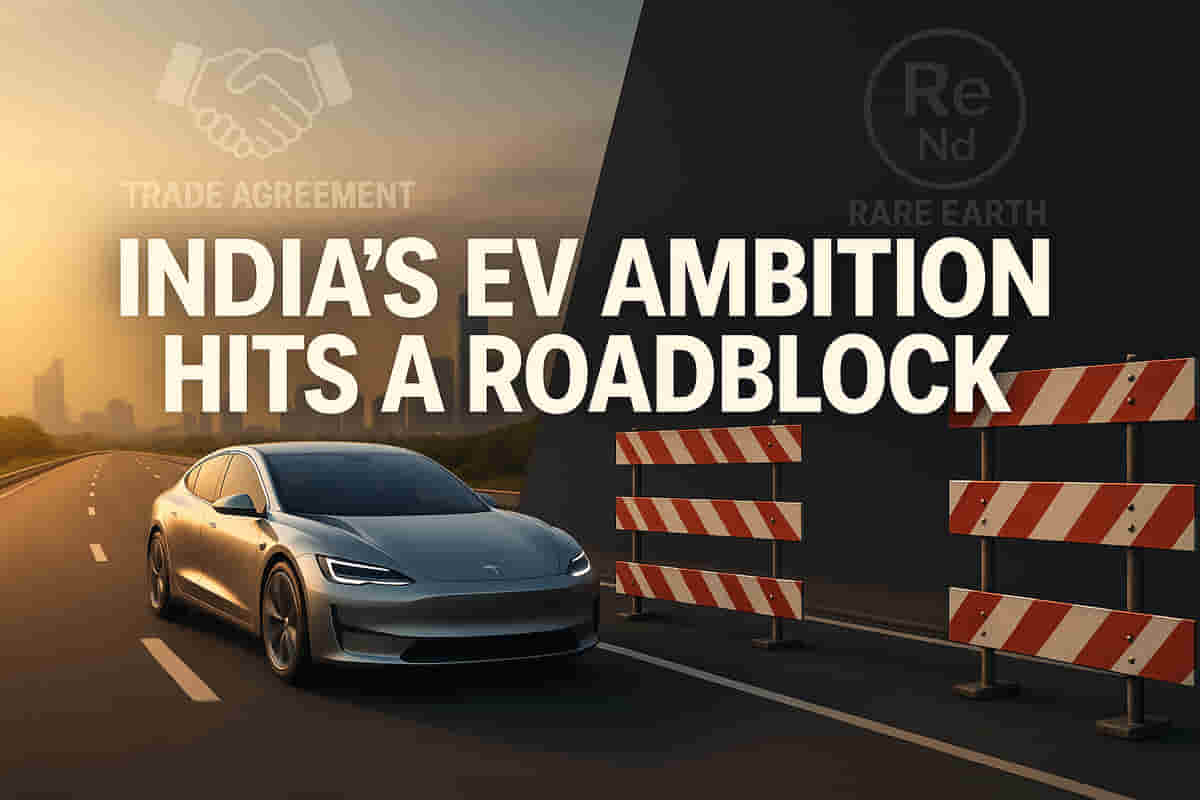
India's ambition to boost electric vehicle (EV) manufacturing through its Scheme to Promote Manufacturing of Electric Passenger Cars (SPMEPC) is facing an unexpected hurdle. Global car makers have indicated hesitation in participating, citing key international factors rather than domestic shortcomings.
Scheme Overview
- The SPMEPC, announced on March 15, 2024, aims to encourage substantial investment in the local production of high-end electric cars in India.
- Under the scheme, companies could import completely built-up electric cars valued at a minimum of $35,000 (cost, insurance, freight) at a concessional 15% import duty for five years.
- This incentive is contingent upon companies making a minimum investment of $500 million (over Rs 4,300 crore) to establish local manufacturing facilities.
Automaker Concerns
- During recent consultations, Original Equipment Manufacturers (OEMs) conveyed their intention to defer participation decisions until the conclusion of the ongoing India-European Union (EU) free trade agreement (FTA) negotiations.
- Minister of State for Heavy Industries, Bhupathiraju Srinivasa Varma, confirmed this in a written response to the Lok Sabha.
- Sector analysts suggest that the scheme's primary incentive – a concessional import duty – might become available through the India-EU FTA without the mandatory capital expenditure commitment.
Global Factors Influencing Decisions
- India-EU Free Trade Agreement (FTA): OEMs are keen to see the outcome of these trade talks. A finalized FTA could potentially offer similar import duty benefits, making the SPMEPC's investment mandate seem less attractive.
- China's Rare Earth Magnet Restrictions: The supply chain for critical components like rare earth magnets, essential for EV motors, is heavily influenced by China. Automakers expressed concerns that these restrictions could jeopardize their ability to meet the Domestic Value Addition (DVA) targets stipulated under the SPMEPC.
Investment and Timelines
- Beyond these international considerations, automakers also find the threshold investment requirements and the stipulated timelines for setting up manufacturing facilities to be challenging.
Impact
- The reluctance of global car makers to commit to the SPMEPC could significantly slow down India's push towards electric mobility and local EV manufacturing. It may also affect foreign direct investment targets in the automotive sector.
- Impact Rating: 7/10
Difficult Terms Explained
- SPMEPC: Scheme to Promote Manufacturing of Electric Passenger Cars. India's initiative to boost local production of EVs.
- OEM: Original Equipment Manufacturer. A company that manufactures products based on designs supplied by another company. In this context, it refers to car manufacturers.
- India-EU FTA: India-European Union Free Trade Agreement. A proposed trade pact aimed at reducing tariffs and barriers between India and the EU.
- Rare Earth Magnets: Strong magnets made from rare earth elements, crucial for electric motors in EVs and other electronic devices.
- DVA: Domestic Value Addition. The extent to which a product is manufactured or processed within a country, often a requirement for trade benefits or incentives.
- Cost, Insurance, and Freight (CIF): A shipping term indicating the price of goods including the cost of insurance and freight to bring them to the destination port.