

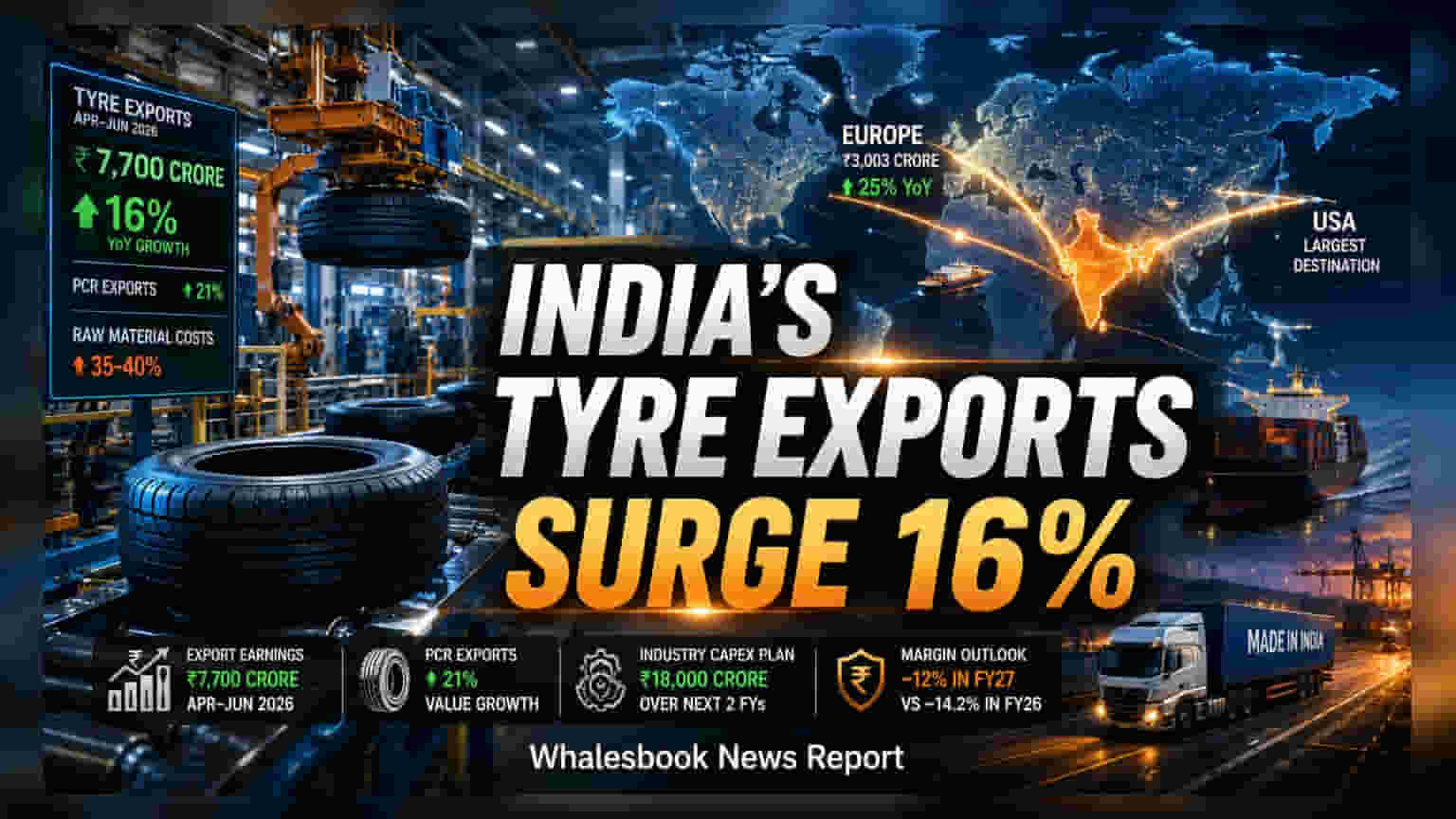
India’s tyre industry reported a 16% increase in exports to ₹7,700 crore for the June 2026 quarter, driven by strong European and US demand. However, investors are cautious as rising raw material costs threaten to compress profit margins in the coming months.
The Indian tyre manufacturing sector achieved a notable 16% year-on-year growth in exports for the April-June 2026 quarter, with earnings reaching ₹7,700 crore. This performance highlights the global acceptance of Indian-made tyres, particularly in Passenger Car Radial (PCR) categories, which saw a 21% jump in value-based exports. European markets were a key driver, with demand growing by 25% to reach ₹3,003 crore, while the United States held its position as the largest individual destination for Indian tyre shipments.
While the rise in export volume points to strong demand, the financial reality for tyre manufacturers is more complex. Investors are closely watching the impact of a sharp 35-40% increase in raw material costs, primarily driven by higher prices for natural rubber and crude-linked inputs like synthetic rubber and carbon black. This cost inflation is expected to pull down operating profit margins for the industry to around 12% for the full 2027 fiscal year, compared to approximately 14.2% in the previous year.
To keep up with global demand, major players such as Apollo Tyres, CEAT, and JK Tyre are moving ahead with significant expansion plans. The industry has committed to investing an estimated ₹18,000 crore in capital spending over the next two fiscal years to increase production capacity. While this expansion aims to capture more market share, the increased spending, combined with high raw material costs, means companies will need to manage their debt levels and cash flow carefully.
To counter the pressure on profits, companies have started implementing staggered price hikes to pass on some of these costs to customers. The success of this strategy, however, depends on whether global demand remains robust enough to absorb these higher prices. The industry also continues to face external challenges, including geopolitical instability in West Asia, which has caused freight disruptions and added uncertainty to supply chains.
Moving forward, the primary factor for investors will be whether companies can effectively protect their profit margins despite high input costs. Key developments to track include whether tyre makers successfully pass on price increases, the trajectory of natural rubber and crude oil prices, and the timely commissioning of new capacity projects without incurring excessive debt burden.