

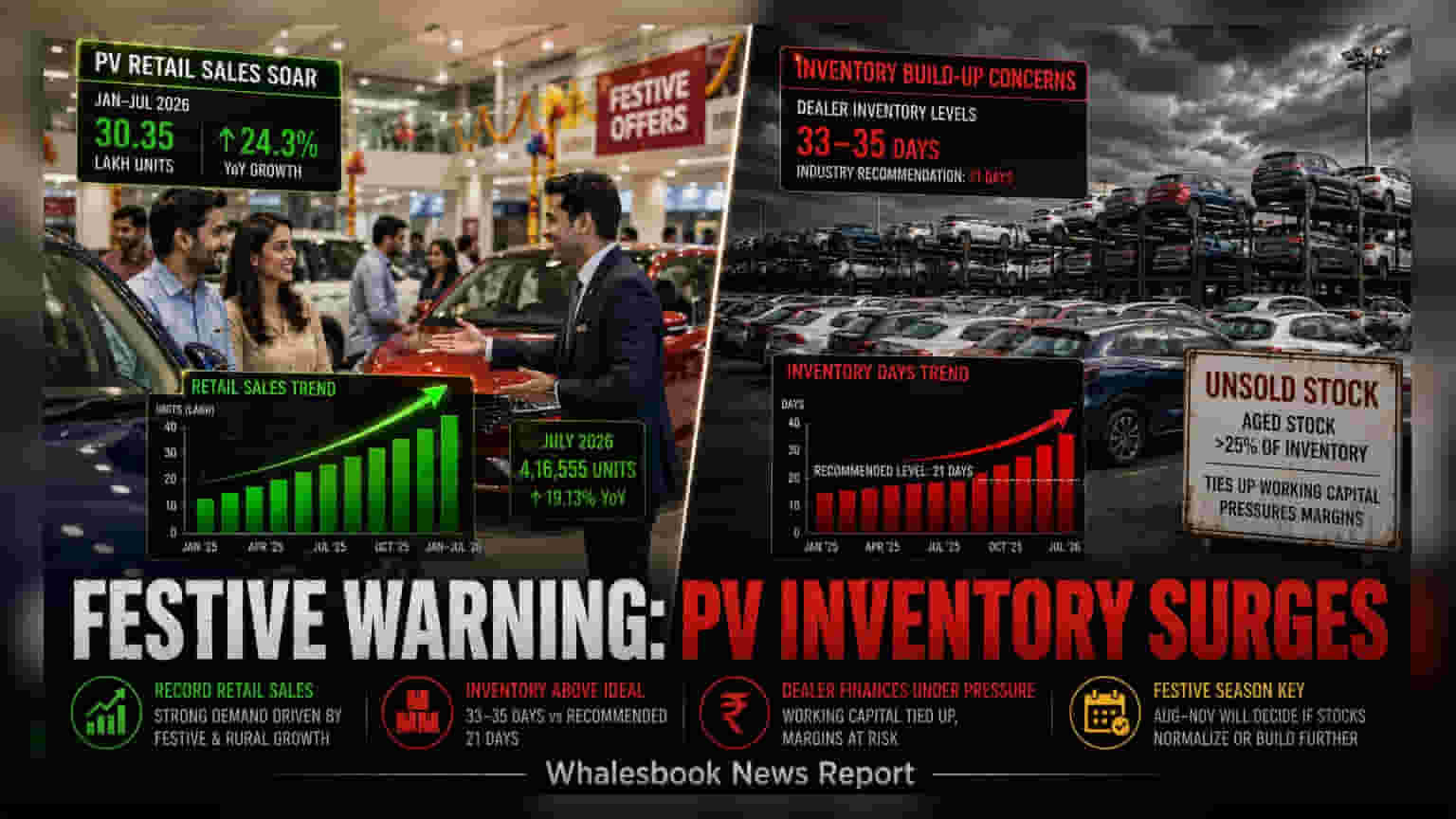
Despite record retail sales in early 2026, passenger vehicle inventory at dealerships has climbed to 33-35 days, exceeding the recommended 21-day limit. This mismatch between wholesale dispatches and retail demand is putting pressure on dealer capital as the industry prepares for the festive season.
The Indian passenger vehicle (PV) market is currently facing a supply-demand mismatch. While retail sales have hit record levels, dealer inventory levels have risen to 33-35 days. This inventory buildup exceeds the industry-standard recommendation of 21 days, raising concerns about the financial health of dealership networks as the festive season approaches.
Data from the Federation of Automobile Dealers Associations (FADA) shows that the industry recorded a 24.3% year-on-year increase in retail sales during the January-July 2026 period, with total units reaching approximately 30.35 lakh. July alone was a landmark month, with 4,16,555 PV registrations, marking a 19.13% jump compared to the same month last year. While high retail numbers typically signal a healthy market, the simultaneous rise in inventory suggests that Original Equipment Manufacturers (OEMs) may be dispatching more vehicles to dealers than the market can absorb in the short term.
Impact on Dealer Finances
The build-up of stock at the dealer level is a significant concern for investors and industry observers. When inventory levels stay elevated, it ties up working capital, meaning dealers have their cash locked in vehicles sitting on the lot rather than in liquid assets. FADA has indicated that roughly one-quarter of dealers are currently holding high levels of aged stock, defined as more than 25% of their total inventory. If this trend continues without a corresponding surge in retail sales, it could force dealers to offer aggressive consumer discounts to clear the backlog, which can, in turn, pressure the profit margins of both the dealers and the manufacturers.
Changing Consumption Patterns
The market structure is also evolving, which adds another layer of complexity for manufacturers managing their inventory. In July, alternative fuel vehicles—including CNG, hybrid, and electric models—accounted for 40.59% of total PV retail sales. This represents a significant shift from the previous year. Additionally, the growth in rural markets, which stood at 24.72% in July, has outperformed urban market growth of 15.76%. Manufacturers are tasked with managing production and dispatches to match these shifting consumer preferences while avoiding the accumulation of slow-moving inventory.
Outlook for the Festive Season
The industry is now looking toward the upcoming festive season, which typically spans from August through November, as a crucial window to normalize stock levels. While industry experts generally view the current inventory levels as manageable, they warn that the situation could deteriorate if the macro environment weakens. The primary monitorable for investors in the coming months will be whether OEMs calibrate their wholesale dispatches to better align with actual retail demand. If inventory remains above the recommended 21-day threshold for too long, it may trigger concerns regarding sector-wide pricing pressure and reduced profitability in the second half of the fiscal year.