 Whalesbook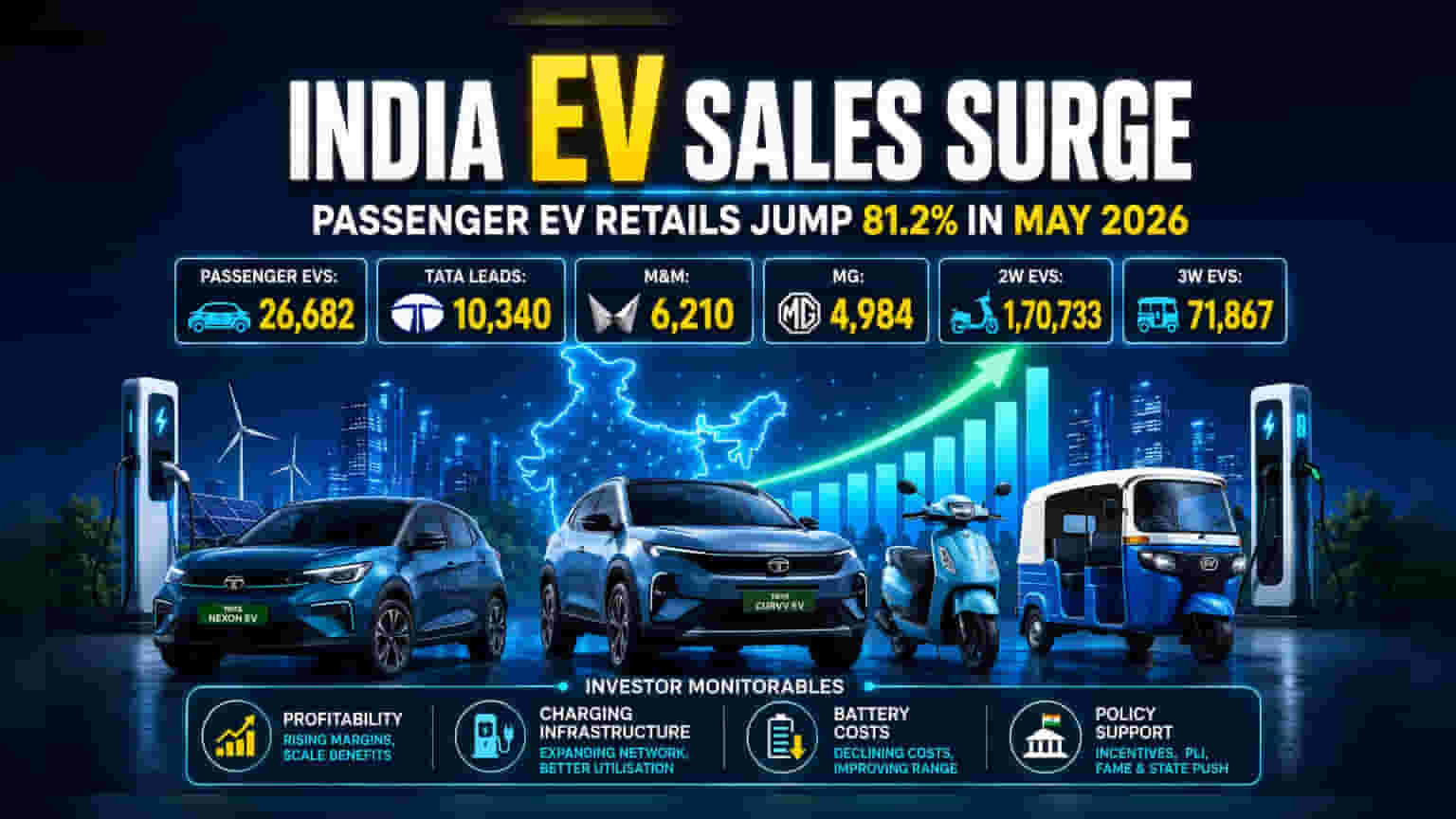


What Happened
India's electric vehicle (EV) market reported strong retail sales in May 2026, according to the latest data from the Federation of Automobile Dealers Associations (FADA). Passenger EV sales reached 26,682 units, marking an 81.20% increase compared to the 14,725 units sold in the same month last year. Tata Motors Passenger Vehicles Ltd. maintained its market lead with 10,340 units sold, recording a year-on-year growth of 103.42%. Mahindra & Mahindra followed, with sales reaching 6,210 units, while JSW MG Motor India recorded 4,984 units.
Why EV Sales Growth Matters
The rapid growth in retail numbers suggests that the transition toward electric mobility is gaining traction among Indian consumers. For investors, this shift indicates a long-term change in the automotive landscape. As sales volumes rise, established automakers are increasingly focusing on scaling production and optimizing their EV business models to compete with newer entrants and maintain profitability.
Competitive Dynamics
While Tata Motors continues to lead by volume, the competitive landscape is shifting. Mahindra & Mahindra's growth of 114.8% shows it is aggressively capturing market share in the electric passenger segment. JSW MG Motor India remains a significant player, though its growth has been more modest compared to the other two majors. The ability of these companies to manage capacity, supply chains, and battery costs will define their market position in the coming quarters.
Two-Wheeler and Three-Wheeler Momentum
The surge in EV adoption is not limited to passenger cars. The electric two-wheeler segment saw sales grow by 62.76%, with 1,70,733 units sold in May. TVS Motor Company led this category with 42,459 units, followed by Bajaj Auto with 39,202 units and Ather Energy with 28,240 units. Additionally, the electric three-wheeler segment hit 71,867 units, while electric commercial vehicles doubled to 2,400 units, indicating that commercial demand is also beginning to pick up.
Potential Risks and Challenges
Despite the positive sales data, investors should note that the sector faces several structural challenges. Profitability in the EV division remains a critical test, as companies balance heavy capital spending on R&D and infrastructure with competitive pricing pressures. Furthermore, the industry is sensitive to changes in government subsidy schemes, such as FAME, which can directly influence retail demand. Reliance on imported battery components also exposes manufacturers to supply chain risks and price volatility in raw materials like lithium and cobalt.
What Investors Should Track
Moving forward, the primary monitorables for investors include the trajectory of profit margins in the EV segments of these companies. It is important to watch whether high volume growth translates into sustainable profitability. Additionally, the pace of public charging infrastructure rollout, advancements in battery technology, and any adjustments to government automotive policies will be key factors that influence long-term demand and investor sentiment.