

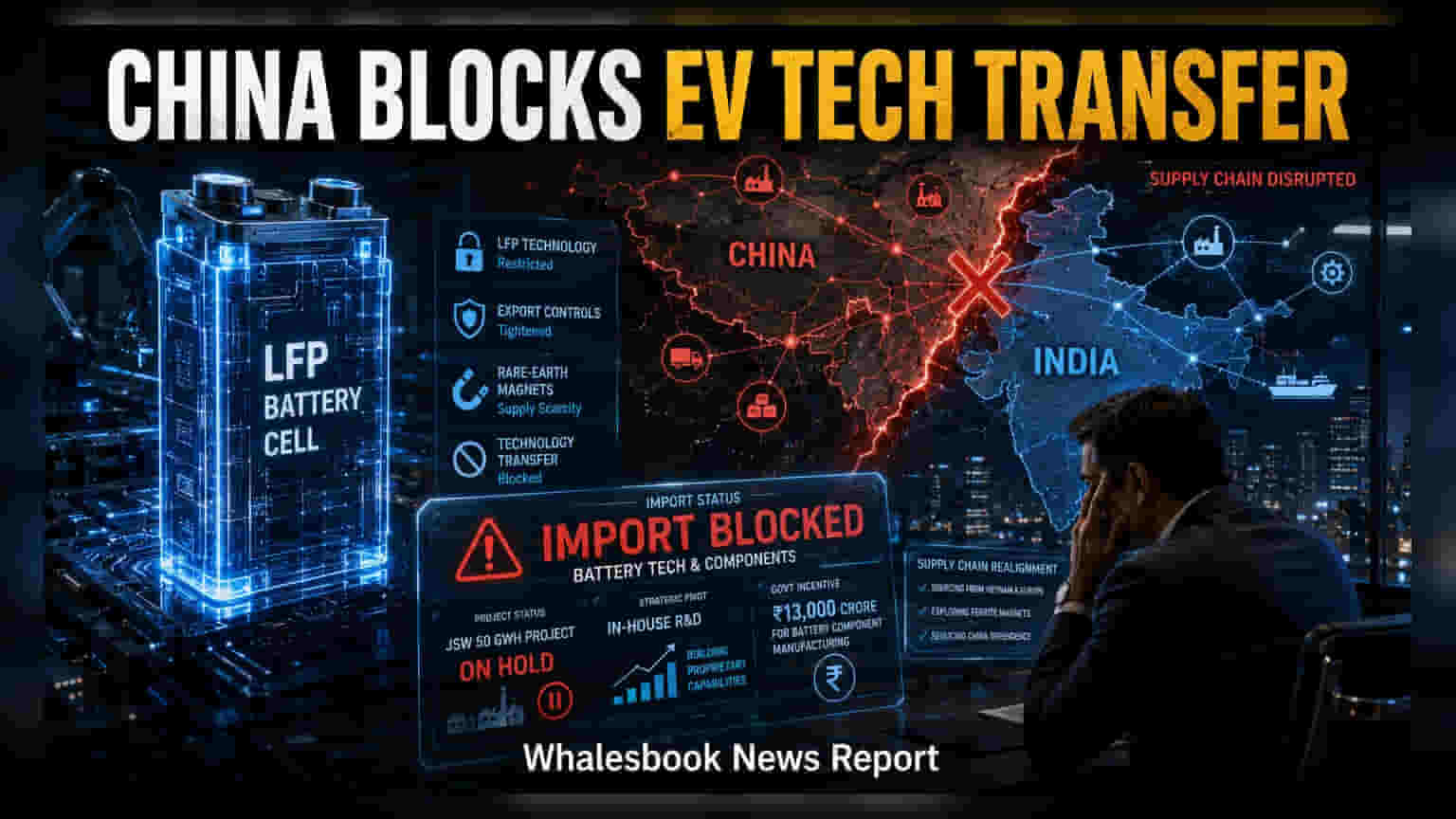
Indian EV battery projects face uncertainty as Chinese restrictions on critical technology force companies to rethink strategies. JSW Group has paused a 50 GWh gigafactory project, while Amara Raja Energy & Mobility is shifting to in-house research after licensing hurdles.
The Indian automotive industry is navigating a significant change in strategy as geopolitical barriers restrict access to essential Chinese battery technology. For years, domestic manufacturers relied on partnerships with Chinese firms to gain expertise in Lithium Iron Phosphate (LFP) battery chemistry. However, with Beijing tightening its export controls on advanced battery manufacturing and critical minerals, these technology transfer agreements have stalled, forcing a major course correction for the Indian electric vehicle (EV) supply chain.
Strategic Pivot Amid Licensing Hurdles
The impact of these restrictions is already visible in large-scale infrastructure plans. JSW Group, for instance, has officially placed its ambitious 50 GWh battery gigafactory project in Odisha on hold. The pause stems directly from the inability to secure the necessary LFP technology partnerships that were originally part of the project roadmap. Similarly, Amara Raja Energy & Mobility is recalibrating its approach. After a planned LFP technology licensing partnership with the China-based Gotion was unable to move forward due to technology transfer limitations, the company has pivoted toward internalizing its research and development. The firm is now intensifying efforts to recruit global expertise to build proprietary capabilities rather than relying on external licensing.
Supply Chain Realignment and Localisation
Beyond battery chemistry, the automotive sector is facing a scarcity of heavy rare-earth magnets, which are essential for high-performance electric motors. Manufacturers are now scrambling to find alternatives to reduce their reliance on Chinese suppliers. This move involves shifting sourcing toward geographies like Vietnam and Europe and, in some cases, re-engineering designs to use more readily available ferrite magnets. While this helps diversify the supply chain, it presents a long-term challenge for cost management. LFP technology is currently the industry standard for cost-effective mass-market electrification; finding a similarly efficient alternative without Chinese support is proving difficult.
To support this shift, the Indian government has proposed a substantial incentive package worth approximately ₹13,000 crore aimed at boosting the local manufacturing of battery cell components. This move is designed to reduce the country’s heavy dependence on imported minerals and processed components, which currently leave the industry vulnerable to external trade policies. However, building a domestic ecosystem from scratch is capital-intensive and time-consuming.
The key monitorable for investors in the coming quarters will be the execution timeline of these localized R&D efforts. As companies move away from direct partnerships, the ability to maintain profit margins while investing heavily in internal research will be tested. Furthermore, investors may track whether the industry can meet its electrification targets without the cost advantage provided by Chinese battery technology, as any delay in commissioning these local projects could impact the long-term growth plans of domestic automakers.