

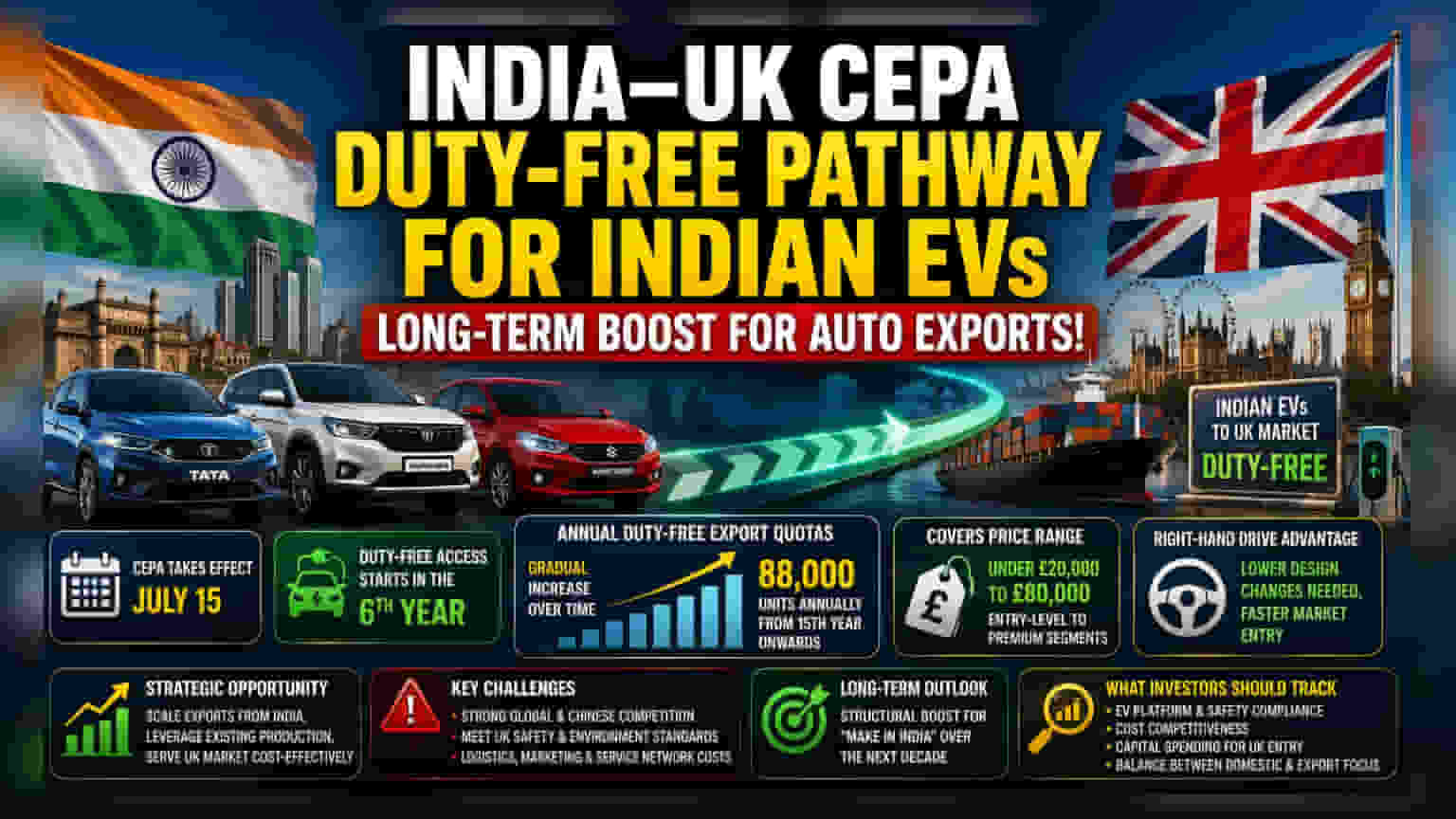
Under the new India-UK trade agreement starting July 15, Indian automakers like Maruti, M&M, and Tata Motors gain duty-free EV export access beginning in the sixth year. While this offers a long-term strategic opportunity, companies must navigate stiff competition and strict safety standards in the UK market.
What Happened
India and the United Kingdom have finalized a Comprehensive Economic Partnership Agreement (CEPA) that includes specific provisions for the automotive sector, scheduled to take effect on July 15. The agreement provides a calibrated pathway for Indian-made electric vehicles (EVs) to enter the UK market duty-free. This benefit does not start immediately; it begins in the sixth year of the agreement. The pact sets annual quotas for duty-free exports, which will gradually increase over time, eventually capping at 88,000 units annually from the 15th year onwards.
The Strategic Opportunity
For Indian automotive majors like Tata Motors, Mahindra & Mahindra (M&M), and Maruti Suzuki, this agreement provides a roadmap to scale exports. The UK market is a right-hand drive market, similar to India, which reduces the need for costly vehicle design changes. This allows manufacturers to leverage their existing production lines in India to serve an international customer base. The deal covers a broad range of price points—from under GBP 20,000 to GBP 80,000—aiming to help Indian EVs compete in both entry-level and premium segments.
The Long-Term Reality
Investors should note that this is a long-horizon development rather than an immediate catalyst for earnings. With duty-free access starting only in the sixth year, the current financial impact is minimal. The immediate focus for these companies remains domestic penetration and building EV-specific manufacturing capacity. The export benefit is a structural change, intended to support the 'Make in India' initiative over the next decade as these companies refine their global supply chains.
Challenges and Competition
The UK EV market is already highly competitive, with established global players and aggressive entrants from China, such as BYD and MG Motor (which has a legacy presence in the UK). Indian exporters will face significant hurdles beyond just tariffs. Success will depend on meeting stringent UK safety, environmental, and road-worthiness standards. Furthermore, duty-free status does not eliminate other costs, such as international logistics, local marketing, and the creation of service and distribution networks, which require significant capital investment.
What Investors Should Track
Market participants should watch for company-specific announcements regarding EV platform development and international safety compliance. The ability of Indian automakers to maintain cost competitiveness while meeting Western regulatory standards will be the key test. Additionally, investors should monitor how management teams plan to balance domestic expansion with the costs of entering the UK market once the quota period approaches. Future financial reports regarding capital spending for international market entry will be important to track as the timeline progresses.