

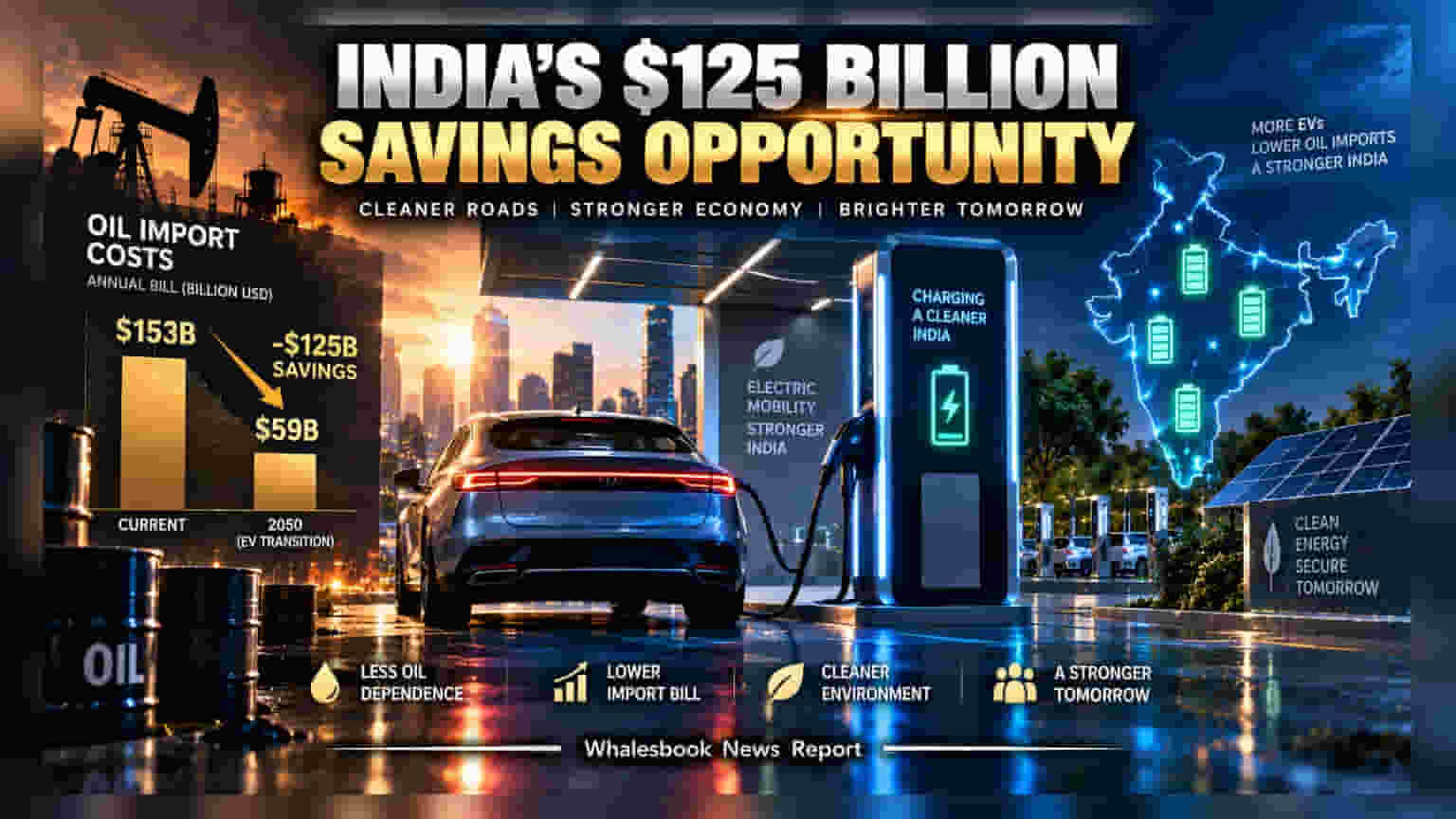
India could lower its annual import bill by $125 billion by 2050 through widespread electric vehicle adoption, recent research indicates. The savings primarily stem from reduced oil reliance, which offers a larger fiscal benefit than domestic battery production alone.
India has the potential to reduce its annual import costs by $125 billion by 2050 if it successfully pivots to a large-scale electric vehicle ecosystem. This long-term projection highlights that while local battery manufacturing is essential for energy security, the most significant fiscal gains will come from simply using less oil. Research shows that moving away from petroleum consumption provides an economic benefit far greater than the savings achieved by substituting imported battery cells with locally made ones.
The Economics of Oil Displacement
The financial argument for electrification is linked to the country’s heavy dependence on imported crude oil. Currently, transportation costs contribute significantly to India's import bill, which was estimated at $153 billion in baseline scenarios. Transitioning to an ambitious electrification path could bring this figure down to $59 billion. Because this transition directly lowers the need for crude oil, it acts as a financial buffer against volatile global energy markets. If global oil prices rise, the savings from this shift could become even more significant, shielding the economy from unpredictable price hikes.
Scaling the Battery Infrastructure
While the primary goal is reducing oil imports, the supporting infrastructure remains a significant hurdle. India’s demand for batteries is expected to grow sharply, moving from 28 gigawatt hours in 2030 to over 570 gigawatt hours by 2050. Currently, domestic production of battery cells lags behind global standards. To achieve total self-reliance, the industry needs to move beyond simple assembly and focus on deeper engineering. The challenge lies in creating an industrial base capable of not just substituting imports, but eventually competing in the global market as an exporter of EV technology.
Risks and Execution Challenges
The road to this target involves several risks. One of the main challenges is the current lag in domestic battery cell manufacturing, which makes the country dependent on imports for critical components. Additionally, the overall success of this transition is sensitive to the speed of adoption across all vehicle segments, including two-wheelers, three-wheelers, and heavy commercial vehicles. Investors and policy watchers will likely monitor the progress of local manufacturing policies, raw material access, and the actual pace of EV adoption on the ground. The ultimate economic impact will depend on how quickly India can build its internal design and engineering capabilities to handle this massive increase in battery demand.