

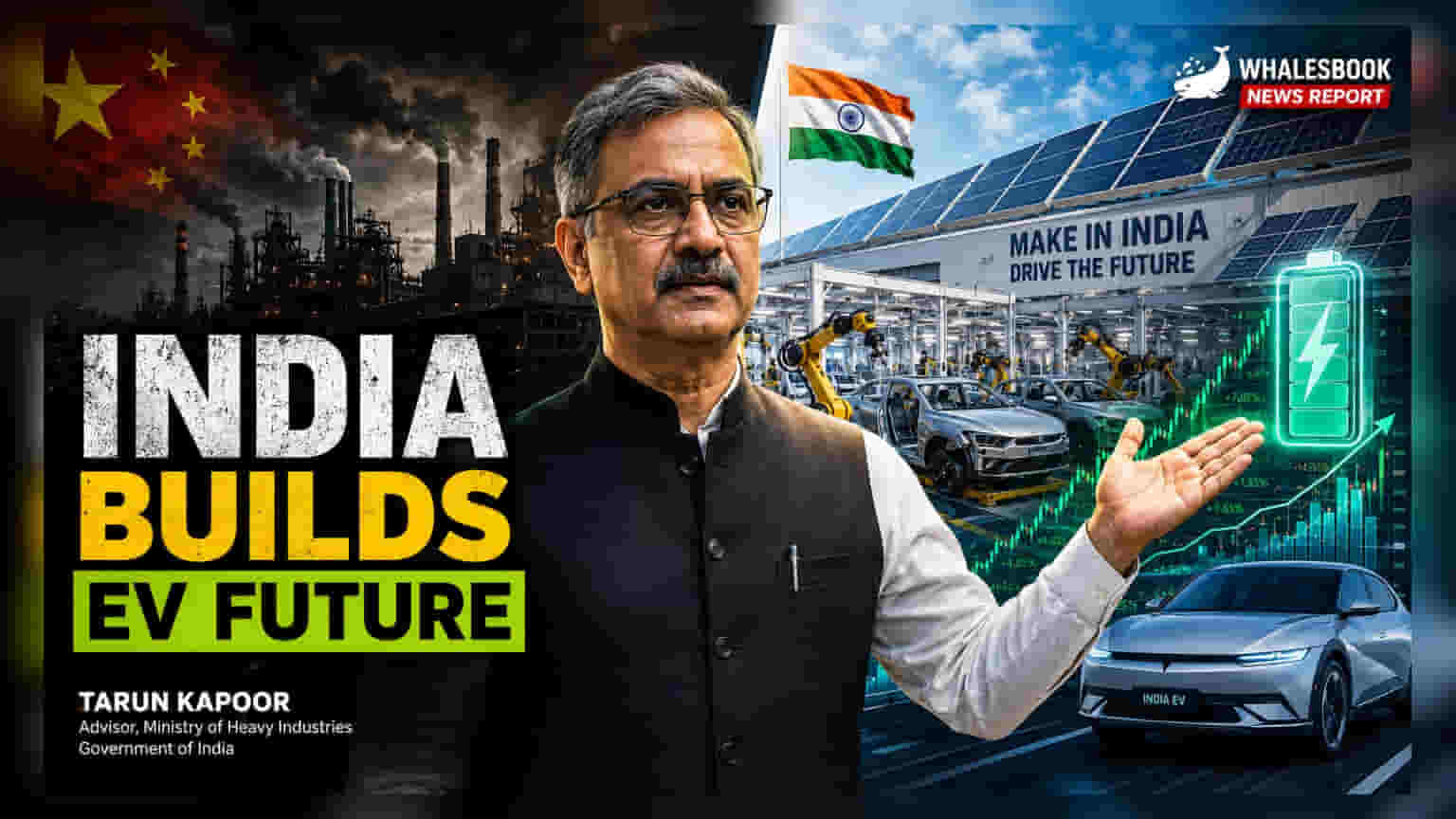
PMO Advisor Tarun Kapoor has called for reducing the reliance on China for critical electric vehicle components, emphasizing the need to build domestic manufacturing capabilities. This push aims to improve India's energy security and manufacturing competitiveness as the government continues to support the EV ecosystem through initiatives like the PM E-DRIVE scheme.
What Happened
Tarun Kapoor, Advisor to the Prime Minister, has publicly urged the Indian automotive industry to decrease its reliance on China for essential electric vehicle (EV) components. Speaking at an industry event, he highlighted that building a robust domestic manufacturing ecosystem is no longer just a strategic goal but a critical necessity for India’s energy security. While acknowledging that complete self-reliance may not be immediate, he emphasized that increasing local value addition for key parts like batteries, magnets, and power electronics is a primary objective for the government.
The Strategic Shift in EV Manufacturing
Currently, India’s EV sector remains heavily dependent on imports for high-value components. Critical parts such as lithium-ion cells, semiconductor chips, and rare-earth magnets—which often constitute a significant portion of an EV's cost—are largely sourced from international markets, with China being a major supplier. This reliance exposes domestic manufacturers to global supply chain disruptions, currency volatility, and geopolitical risks. By pushing for localization, the government aims to insulate the industry from these external shocks while simultaneously creating more resilient local supply chains.
The Policy Environment
This call for localization aligns with the government’s broader electric mobility mission. The PM E-DRIVE scheme, with an outlay of ₹10,900 crore, is currently in operation to accelerate EV adoption and support infrastructure development. However, achieving deep localization remains a complex challenge. Previous initiatives and the Production-Linked Incentive (PLI) schemes have sought to encourage domestic battery cell production and component manufacturing, yet progress has faced hurdles due to the high capital requirements and technological complexity involved in setting up advanced manufacturing facilities.
The Investor Reality Check
For investors, this shift toward localization carries both potential and risk. On one hand, companies that successfully build domestic capacity for motors, power electronics, and battery packs may benefit from government support and reduced import costs over time. On the other hand, the manufacturing of advanced EV components requires high capital expenditure and specialized technology. Many Indian firms are still in the early stages of developing these capabilities, and the process of moving from imported kits to indigenous production is time-consuming. Additionally, raw material sourcing remains a bottleneck, as India lacks significant domestic reserves of critical minerals like lithium, cobalt, and nickel.
Risks and Execution Challenges
The path to a self-reliant EV supply chain is not free of obstacles. The domestic supply ecosystem is still evolving, and fragmentation in component specifications across different vehicle makers can limit the economies of scale needed to lower costs. Furthermore, smaller manufacturers may struggle to compete with established global players who already benefit from massive scale and integrated supply chains. Investors should be aware that while the policy push is strong, the transition depends heavily on the execution speed of companies, their ability to secure technology partnerships, and their success in managing the high cost of entry into the component manufacturing space.
What Investors Should Track
Looking ahead, market participants may monitor several factors. These include updates on localized manufacturing targets set by major automotive companies, progress on large-scale battery cell manufacturing plants under PLI schemes, and any further policy changes that incentivize domestic sourcing over imports. Additionally, tracking company-specific capital expenditure plans for component localization will provide insight into which businesses are best positioned to navigate this transition.