

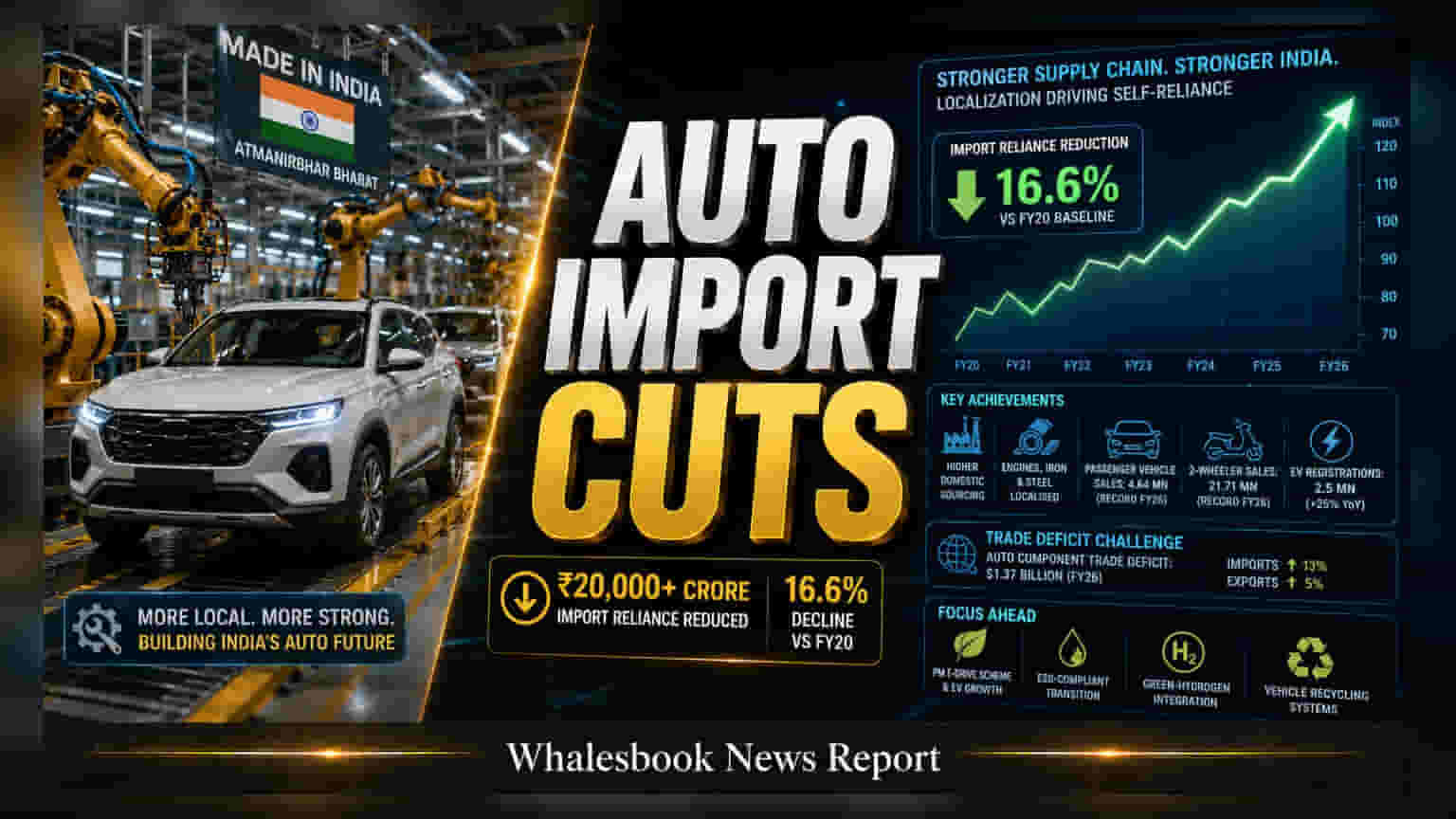
India’s automotive industry has cut import dependence by over ₹20,000 crore, a 16.6% drop since FY20, as local production scales up to meet record vehicle demand. Despite this localization progress, the sector faces challenges from a rising trade deficit in auto parts and ongoing pressure on profit margins due to raw material costs.
The Indian automotive industry has achieved a notable reduction in its dependence on foreign markets, slashing import reliance by over ₹20,000 crore. According to the Society of Indian Automobile Manufacturers (SIAM), this shift represents a 16.6% decline from the FY20 baseline. The progress has been driven by increased domestic sourcing of critical vehicle components, including engines, iron, and steel, in collaboration with the Automotive Component Manufacturers Association of India (ACMA).
This localization effort comes at a time when the industry is seeing high domestic activity. In the last financial year (FY26), the sector witnessed record-breaking numbers, with passenger vehicle sales reaching 4.64 million units and two-wheeler sales hitting 21.71 million units. Commercial vehicle sales also performed well, recording 1.08 million units.
The Trade Deficit Reality
While the reduction in import reliance is a positive step for domestic manufacturing, the sector faces a complex reality regarding its trade balance. Data indicates that the auto component industry entered a trade deficit of approximately $1.37 billion in FY26. This occurred because the growth in component imports, which rose by 13%, outpaced the growth in exports, which rose by only 5%. For investors, this mismatch suggests that while local capacity is growing, demand for certain high-tech or specialized foreign components remains strong, keeping the pressure on the trade balance.
Margin Pressures and Risks
Despite high sales volumes, companies in the automotive sector are managing significant financial challenges. Profit margins have come under pressure due to the rising costs of raw materials like steel and rubber. Geopolitical tensions in regions such as West Asia continue to impact global supply chains, leading to uncertainty regarding input costs.
Furthermore, the automotive sector has experienced recent selling pressure in the stock market in early September 2026. This reflects broader market volatility rather than company-specific issues, but it indicates that investors are currently cautious about the sector's short-term profitability and the impact of these input cost pressures.
Future Focus
Looking ahead, the industry is realigning its strategy to focus on energy transition. The PM E-Drive scheme has helped boost electric vehicle registrations to 2.5 million units in FY26, a 25% year-over-year increase. The industry has also completed the transition to E20-compliant fuel systems. Moving forward, stakeholders will be monitoring how the Automotive Mission Plan 2025-2047 unfolds, particularly regarding the integration of green-hydrogen technologies and the success of the new vehicle recycling systems in managing long-term costs.