

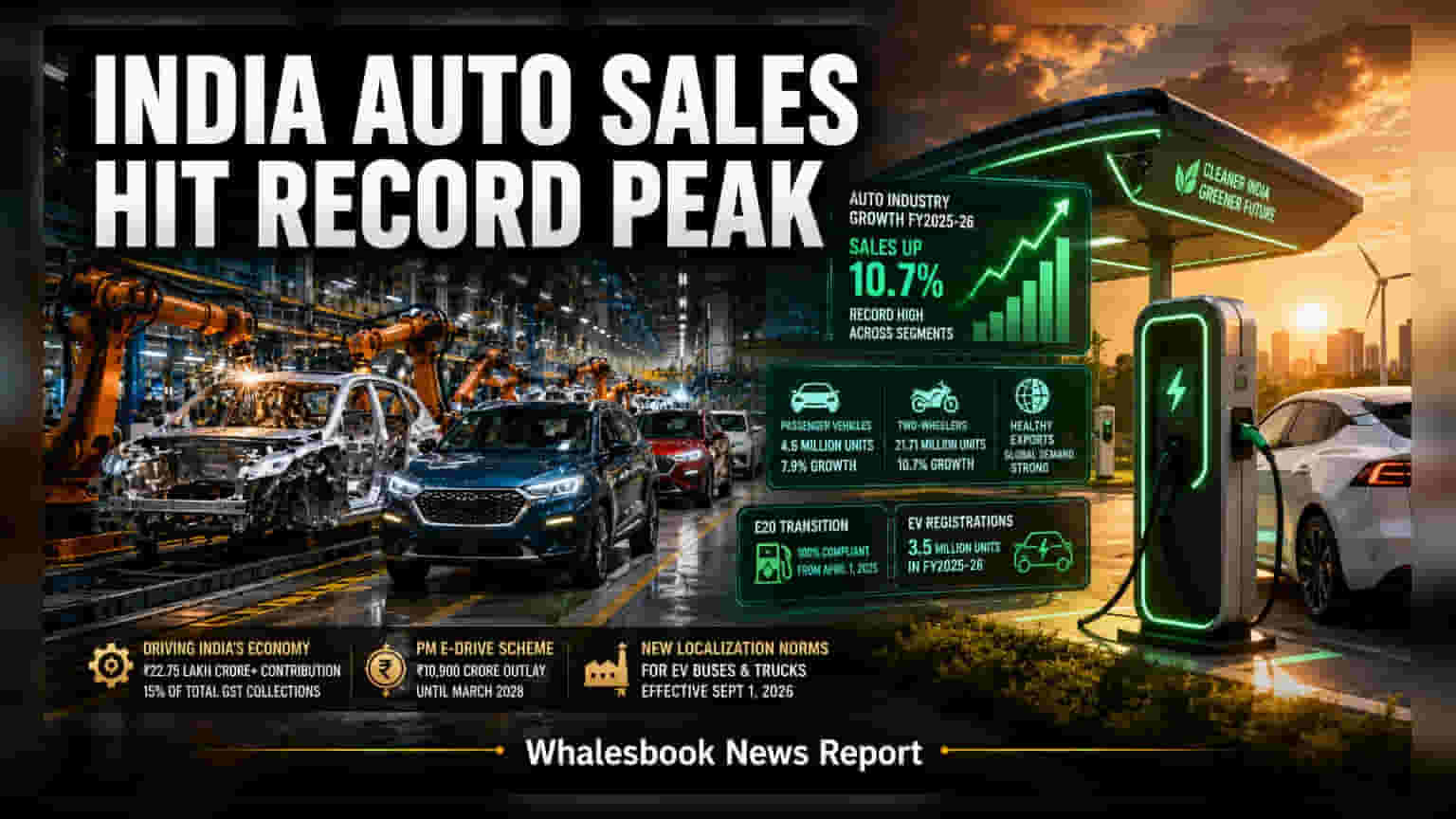
India's automotive sector achieved record sales in FY2025-26, with 4.6 million passenger vehicles sold and EV registrations reaching 3.5 million units. While the sector remains a key economic contributor, investors are evaluating the impact of new localization norms for electric commercial vehicles introduced in September 2026 and the challenge of sustaining double-digit growth from a high base.
The Indian automotive industry concluded the 2025-26 fiscal year with strong growth, cementing its status as a critical engine for the national economy. The sector, which now contributes over Rs 22.75 lakh crore to the economy and accounts for 15% of total GST collections, saw domestic sales hit new highs across major segments.
Passenger vehicle sales reached 4.6 million units, reflecting a 7.9% increase, while the two-wheeler segment witnessed domestic sales of 21.71 million units, up 10.7%. Export performance also remained healthy, indicating that Indian manufacturers are successfully finding demand in global markets for both two-wheelers and passenger vehicles. Beyond internal combustion engines, the industry reached a significant milestone by completing a full transition to E20-compliant gasoline production by April 1, 2025, moving closer to national goals for reduced energy imports.
EV Adoption and Policy Shifts
Electric vehicle (EV) adoption has moved from a niche segment to a broader trend, with total registrations reaching 3.5 million units in FY2025-26. This momentum is supported by the PM E-DRIVE scheme, a government initiative with an outlay of ₹10,900 crore designed to foster EV adoption and infrastructure development through March 2028. However, the path ahead involves navigating new regulatory landscapes.
Effective September 1, 2026, the government introduced stricter localization norms for electric buses and trucks under the Phased Manufacturing Programme. While these rules are aimed at building a robust domestic supply chain, they create short-term hurdles for manufacturers. Companies must now balance the need for rapid production to meet booking demand with the requirement to source parts locally, which can temporarily disrupt production timelines and increase costs.
Investor Monitorables
For investors, the immediate outlook requires balancing the excitement of record-breaking sales with several practical business risks. First, the industry is operating off a high base created by the record growth of FY26. Maintaining double-digit expansion from this level is historically difficult, and the market may see a moderation in growth rates in the coming quarters.
Second, supply chain stability is a major focus area. The dependence on imported rare-earth permanent magnets, which are essential for EV motors, remains a potential point of failure under the new localization requirements. If companies struggle to source these components locally or find alternatives, it could lead to delivery delays for commercial EV orders. Finally, market participants will track how consumer demand holds up against factors like volatile fuel prices and the tapering of certain EV subsidies. The key update to track in the coming months will be monthly registration data and management commentary from major automakers regarding their ability to comply with new localization rules without sacrificing production volume or profit margins.