

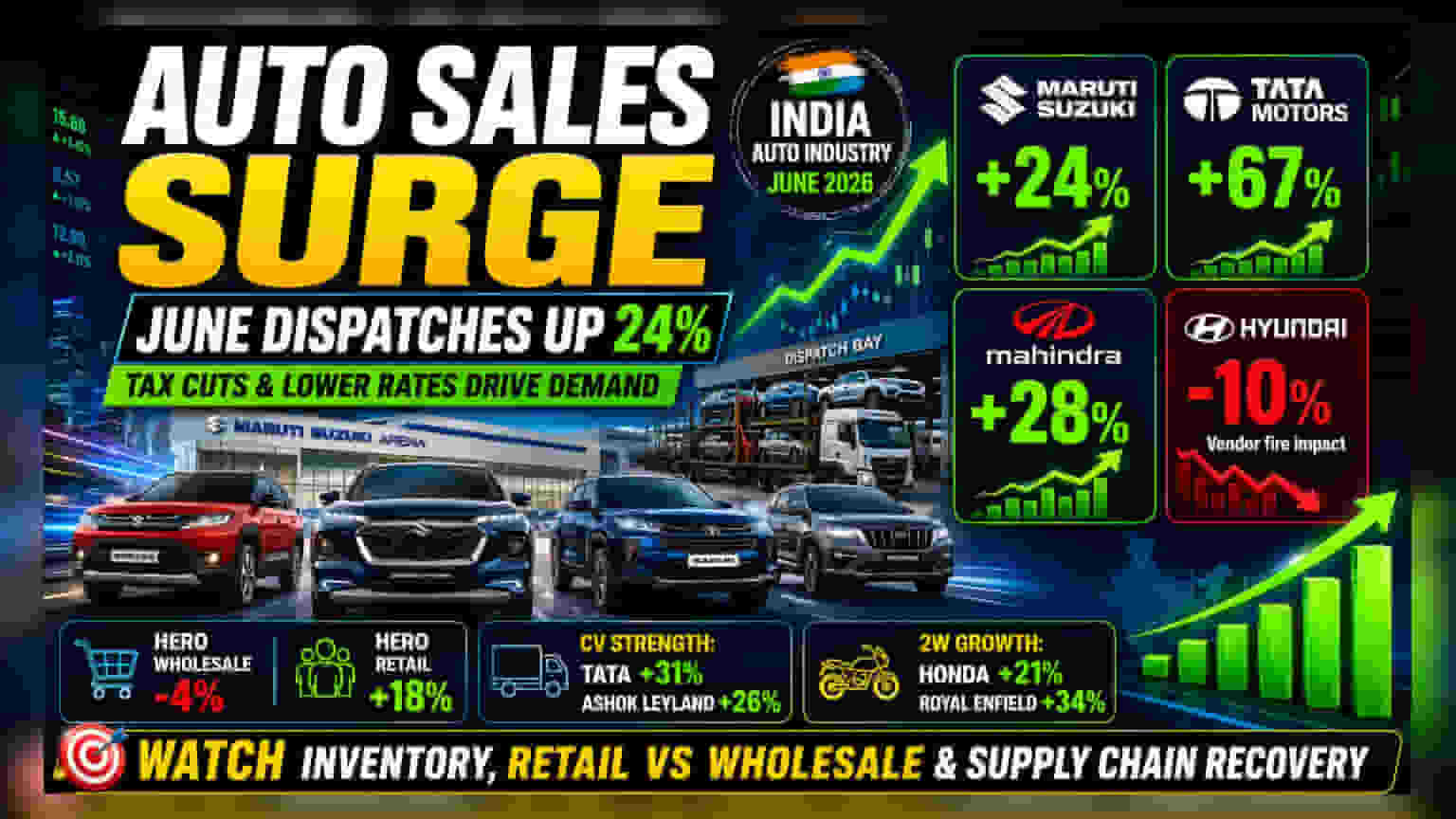
Indian automobile dispatches climbed 24% year-on-year in June 2026, marking three straight months of double-digit growth. While sector demand remains strong due to tax cuts and easier financing, performance varied significantly across companies. Investors should note the difference between wholesale dispatches and retail demand, alongside specific supply chain challenges facing some manufacturers.
What Happened
India’s domestic automobile industry recorded a strong performance in June 2026, with factory dispatches growing by 24% compared to the same month last year. Approximately 400,000 passenger vehicles, including sedans and utility vehicles, were shipped. This result marks the third consecutive month of double-digit growth, following strong performance in April and May. The sector's momentum is largely tied to improved vehicle affordability, helped by recent tax reductions, income tax rebates, and lower interest rates, which have kept consumer demand consistent.
Why Performance Varied Among Leaders
While the sector average shows broad strength, individual company performance revealed distinct differences. Maruti Suzuki, the industry leader, saw its sales climb 24% to 147,187 units, driven by high demand for CNG models and utility vehicles. Tata Motors reported a sharp 67% increase, supported by new product launches and rising electric vehicle adoption, while Mahindra & Mahindra posted a 28% gain.
In contrast, Hyundai Motor India reported a 10% decline in sales, moving 39,635 units. This drop was not necessarily due to a lack of demand, but rather a temporary production loss of approximately 13,900 units resulting from a fire at a vendor's facility. The company has indicated that operations resumed by late June, suggesting that this could be a localized issue rather than a structural demand problem.
The Retail vs. Wholesale Gap
For investors, looking only at wholesale figures (what companies send to dealers) can be misleading. A clear example of this appeared in the two-wheeler segment in June. Hero MotoCorp reported a 4% decrease in wholesale sales to 502,890 units. However, the company also reported that its actual retail sales—what dealers sold to customers—grew by 18%.
This gap often occurs when companies adjust their inventory levels at dealerships. It serves as an important reminder for investors to differentiate between what a company reports as 'dispatched' and the actual 'demand' at the consumer level. Strong retail growth despite lower wholesale numbers can indicate that dealers are effectively clearing inventory.
Commercial Vehicle and Other Trends
Growth extended beyond passenger cars. In the commercial vehicle sector, which is often seen as a barometer for broader economic activity, Tata Motors saw a 31% surge in sales, and Ashok Leyland recorded a 26% rise. In the two-wheeler space, Honda Motorcycle & Scooter India sales climbed 21%, and Royal Enfield saw a 34% increase, signaling broad-based consumption strength.
What Investors Should Track
Moving forward, the primary monitorables remain the sustainability of the tax-driven demand and the stability of supply chains. While tax and interest rate policies have provided a boost, investors should watch whether this demand can hold steady as the base effect normalizes. Additionally, monitoring inventory levels—the difference between wholesale and retail—will be key to understanding which companies are managing their business effectively without overstocking their dealer networks. Finally, keep an eye on how quickly manufacturers like Hyundai can recover lost production volume and clear their order backlogs.