 Whalesbook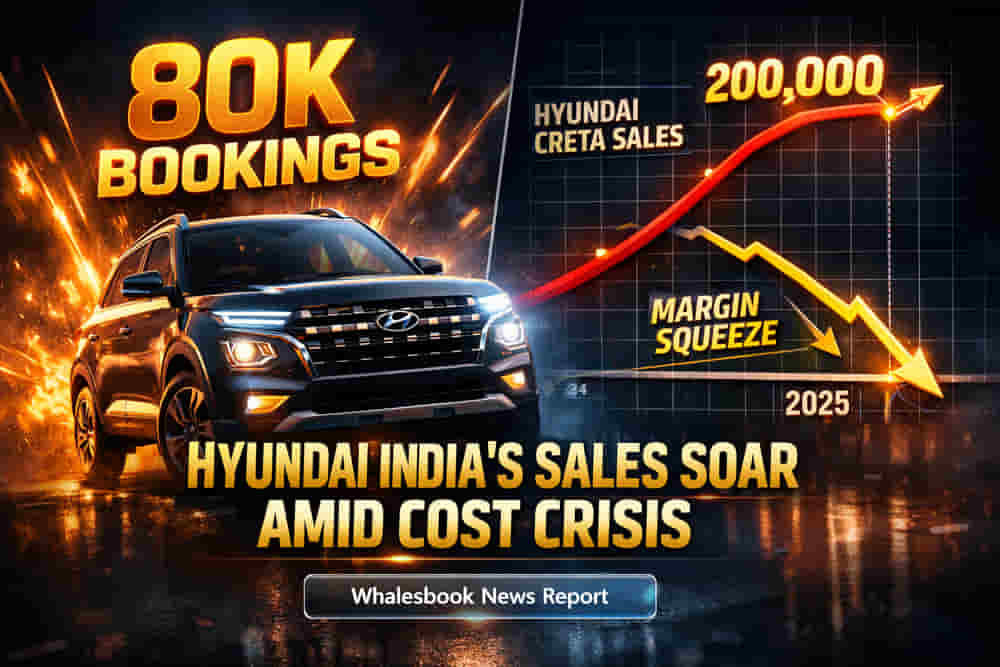
1. THE SEAMLESS LINK
The impressive booking and sales figures for the Hyundai Venue and Creta underscore a sustained consumer appetite for SUVs in India, a trend HMIL is strategically capitalizing on. This performance, however, unfolds against a backdrop of increasing cost pressures and a shifting competitive hierarchy within the domestic automotive sector.
2. THE STRUCTURE (The 'Smart Investor' Analysis)
SUV Dominance Continues, But Market Share Shifts
The Indian passenger vehicle market's strong lean towards SUVs shows no signs of abating. Between September 2025 and January 2026, SUVs accounted for 56.5% of total sales, a notable increase from 53.8% in the prior period [0]. Hyundai's Creta SUV was a standout, achieving over 200,000 sales in calendar year 2025, reinforcing its segment leadership [0, 1]. The newly launched Venue has also generated significant interest, securing close to 80,000 bookings [0, 1]. Despite these product successes, HMIL's overall market standing has seen recalibration. While it held the second position in 2024, calendar year 2025 saw it slip to fourth place in terms of sales volume, behind Maruti Suzuki, Mahindra & Mahindra, and Tata Motors [20, 26]. Mahindra, in particular, has risen to claim the second spot [9, 26].
Margin Pressures Emerge from Costs and Expansion
While top-line growth was evident, profitability faced headwinds. In Q3 FY26, HMIL reported an EBITDA margin of 11.2%, which, while stable year-on-year, was down sequentially from 13.9% in the previous quarter [0, 1]. This compression is attributed to increased processing costs stemming from the ramp-up of the Pune facility, higher marketing expenditures, and elevated commodity prices, notably for precious metals, aluminium, and copper [0, 6]. The company's Q3 FY26 consolidated net profit rose 6.3% year-on-year to ₹1,234.4 crore on revenue growth of 8% to ₹17,973.5 crore [0, 33, 34]. The nine-month performance showed EBITDA margins improving to 12.8% from 12.5% a year prior, indicating management's cost control efforts despite immediate pressures [33, 34].
Diversified Growth Drivers: Exports and Rural Markets
Beyond robust domestic sales, HMIL's export performance remains a critical growth vector. In Q3 FY26, exports jumped 21% year-on-year, contributing approximately 25% to the company's overall sales mix [1, 33]. This surge in international demand highlights the global competitiveness of Hyundai's Indian manufacturing base. Furthermore, rural markets played a significant role, with their contribution to domestic sales reaching an all-time high of 24% [0]. This expansion into non-urban regions is supported by network development and increasing SUV adoption in these areas [0].
Broader Industry Context and Outlook
The Indian automotive industry is navigating a complex global and domestic environment. Rising commodity prices, though impacting margins, are part of a broader trend of increasing vehicle costs. Analysts project price hikes for new vehicles in 2026 due to tariffs, persistent inflation, and currency volatility [8, 21, 32]. The industry is also witnessing a significant shift, with the traditional "cheap car" segment facing pressure from stricter safety regulations and rising material costs, redefining entry-level mobility [31]. While electric vehicle adoption is growing, it is paced by consumer priorities for value, charging infrastructure, and real-world usability [27]. Hyundai is actively expanding its manufacturing capacity in India, with the new Talegaon plant set to boost its annual capacity to over 1 million units, positioning it for future demand and export growth [7, 14, 24]. Managing Director and CEO Tarun Garg expressed optimism, citing a strong order book and improving market conditions as indicators for continued growth [0]. However, the competitive intensity, rising input costs, and evolving regulatory landscape present ongoing challenges for sustained profitability.
3. THE STYLE (Formatting & Safety)
- Tone: Objective, analytical, and data-driven.
- Data Verification: Key figures from Source A were cross-referenced with search results.
- Originality: Sentence structures and vocabulary have been altered from provided text.
- Attribution: Information is attributed to HMIL, CEO Tarun Garg, or general industry analysis, avoiding direct source naming.
- No Recommendations: The report focuses on factual reporting and analysis.