

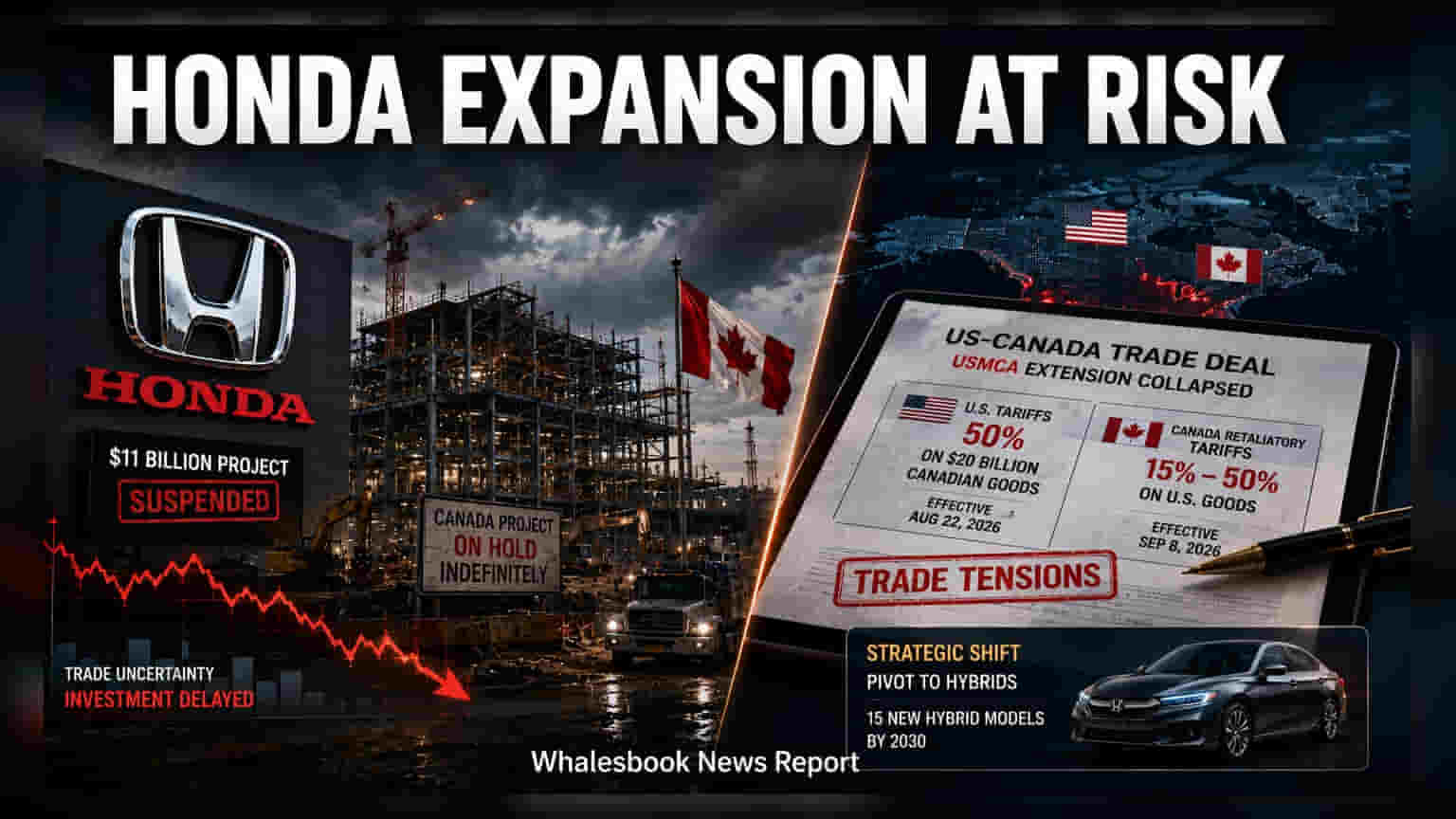
Honda has put plans for its eighth North American assembly plant on hold as trade tensions between the U.S. and Canada escalate. With the USMCA agreement facing new uncertainty and fresh tariffs imposed, the automaker has suspended an $11 billion EV project. This move highlights rising operational risks as the company pivots its manufacturing strategy toward hybrid vehicles to navigate the current policy environment.
Honda is holding back on plans for a new assembly plant in North America. Noriya Kaihara, the company's Executive Vice President, stated that future investment is now tied to the stability of the trade environment between the U.S. and Canada. The company is currently operating near full capacity, but the lack of a clear trade framework has made long-term planning difficult as the automaker looks toward 2030.
Impact of Trade Policy Uncertainty
Trade relations have soured following the collapse of a 16-year extension for the United States-Mexico-Canada Agreement (USMCA) in July 2026. Tensions reached a breaking point on August 22, 2026, when the U.S. imposed 50 percent tariffs on $20 billion worth of Canadian goods. In response, Canada has scheduled retaliatory tariffs of 15 to 50 percent on American products, starting September 8, 2026. This policy climate is directly hitting the company's investment plans. Honda has already indefinitely suspended an $11 billion project in Canada that was initially meant for electric vehicle and battery production. For observers, this reflects a significant shift in capital spending. The company is now choosing to prioritize stability over aggressive growth in the region, effectively hitting the brakes on its earlier industrial expansion targets.
Strategic Shift to Hybrids
The company is also changing its product strategy in response to these conditions. Honda is moving away from its previous goal of making electric vehicles one-fifth of its sales by 2030. Instead, it is pivoting toward hybrid technology, with plans to launch 15 new hybrid models by the end of the decade. To manage current logistical pressures and minimize exposure to cross-border trade friction, the company is shifting production of the five-door Civic hybrid for the U.S. market to Indiana.
Risks and Future Monitorables
The main challenge for the company is the unpredictable nature of regional trade rules. The absence of a long-term USMCA extension means that manufacturers now face annual reviews, creating a constant state of policy uncertainty. If these tariff barriers remain, the company could face higher operational costs and further delays in site selection or workforce expansion. The ability of the management to balance these rising costs while maintaining manufacturing efficiency in North America will be the key factor to monitor. Investors may also track future updates on whether the company restarts any of its suspended projects or if it continues to reallocate resources solely to regions with fewer trade barriers.