

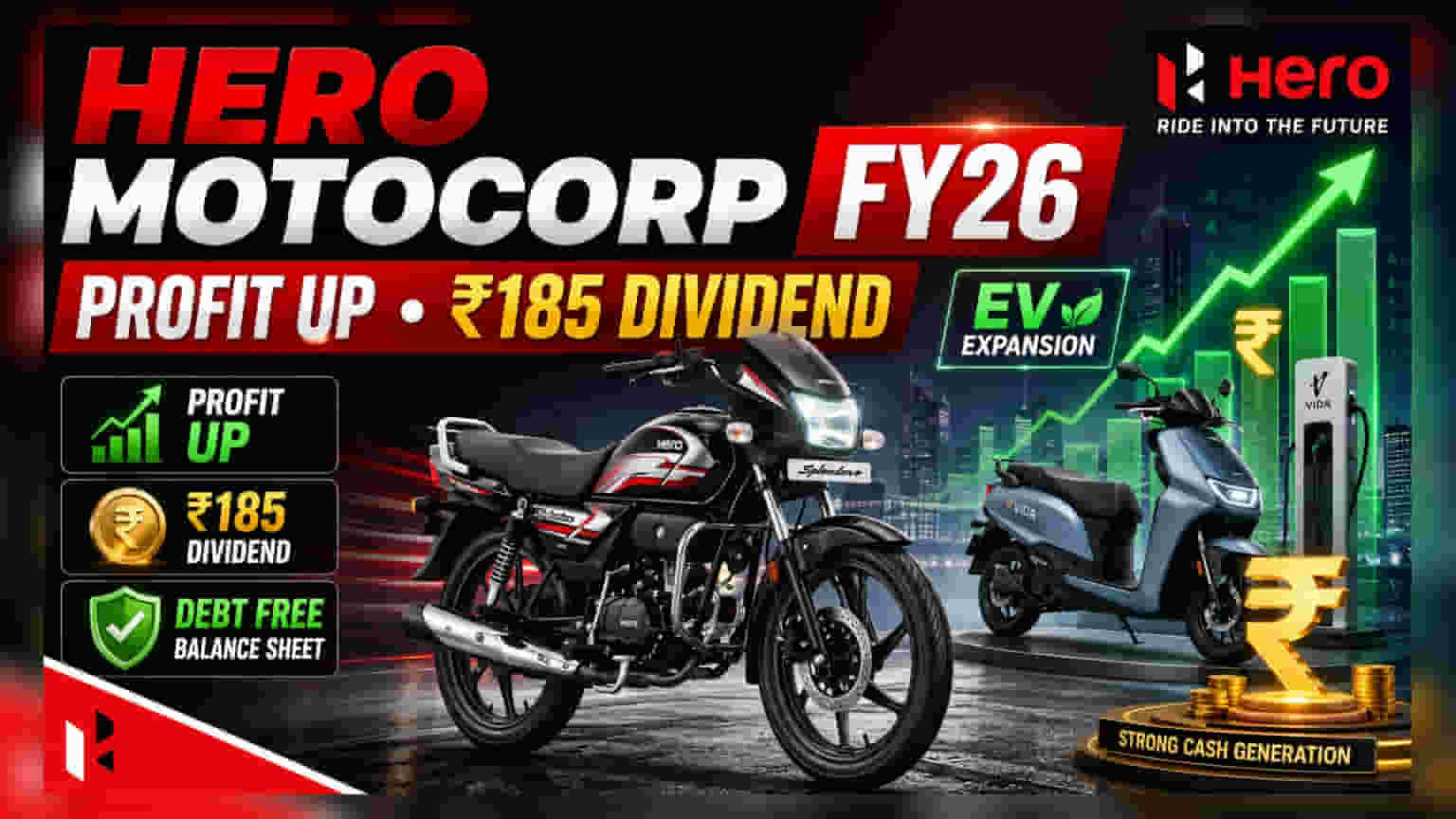
Hero MotoCorp reported a net profit of ₹5,268 crore for FY26 and declared a dividend of ₹185 per share. The company is focusing on EV production growth and international markets while remaining debt-free. Investors are watching how these expansion plans impact long-term margins as competition in the two-wheeler sector intensifies.
What Happened
Hero MotoCorp has announced its financial results for the full year ending in March 2026. The company reported a net profit of ₹5,268 crore, marking a 14% increase compared to the previous year. Revenue also grew by 14.9%, reaching ₹46,830 crore. Following this performance, the board declared a total dividend of ₹185 per share, which is a 12.1% rise from the ₹165 payout in FY25. This payout aligns with the company's historical trend of distributing a significant portion of its profits to shareholders.
The Cash and Expansion Balance
For investors, the most significant highlight is the company’s ability to fund its growth using its own money rather than taking loans. Hero MotoCorp ended FY26 as a debt-free company. The business generated a free cash flow of ₹7,321 crore, which is the cash left over after accounting for necessary business spending. This strong cash generation allowed the company to comfortably cover its total dividend payout of ₹3,501 crore. This demonstrates financial stability, as the firm is not borrowing money to pay its shareholders or fund its operations.
Strategic Investments in EV and Global Markets
The company is currently in a transition phase, moving from a pure internal combustion engine business to including electric vehicles. Under its EV brand, VIDA, Hero MotoCorp saw volumes grow 2.5 times in FY26. Management has planned a capital spending budget exceeding ₹1,500 crore for FY27. This money is earmarked for expanding EV production capacity by 50% by early FY27 and further doubling it by the end of the year. Additionally, the company is investing ₹700 crore in a new parts plant in South India to boost its high-margin aftermarket business.
Risks and Market Competition
While the financial results appear robust, investors should be aware of the competitive pressures in the two-wheeler sector. Hero MotoCorp’s core business relies heavily on the entry-level commuter motorcycle segment, which is sensitive to rural economic conditions and monsoon patterns. In the EV segment, the company faces stiff competition from established peers like TVS Motor Company and Bajaj Auto, as well as aggressive pure-play EV manufacturers. Shifting customer preferences toward electric models could force Hero to increase spending, which might impact profit margins in the short to medium term. Additionally, success in international markets like Brazil and Africa depends on local demand and regulatory environments, which carry their own set of execution risks.
What Investors Should Track
Moving forward, the key factor for investors will be the company’s ability to maintain its profit margins while spending heavily on EV capacity and marketing. Market participants will likely track the volume growth of the VIDA brand to see if it can gain meaningful market share against established EV competitors. Furthermore, the efficiency of the new parts plant in South India and its contribution to overall profitability will be important to observe. Finally, any changes in rural demand patterns will remain a critical monitorable for the company’s core commuter bike portfolio.