

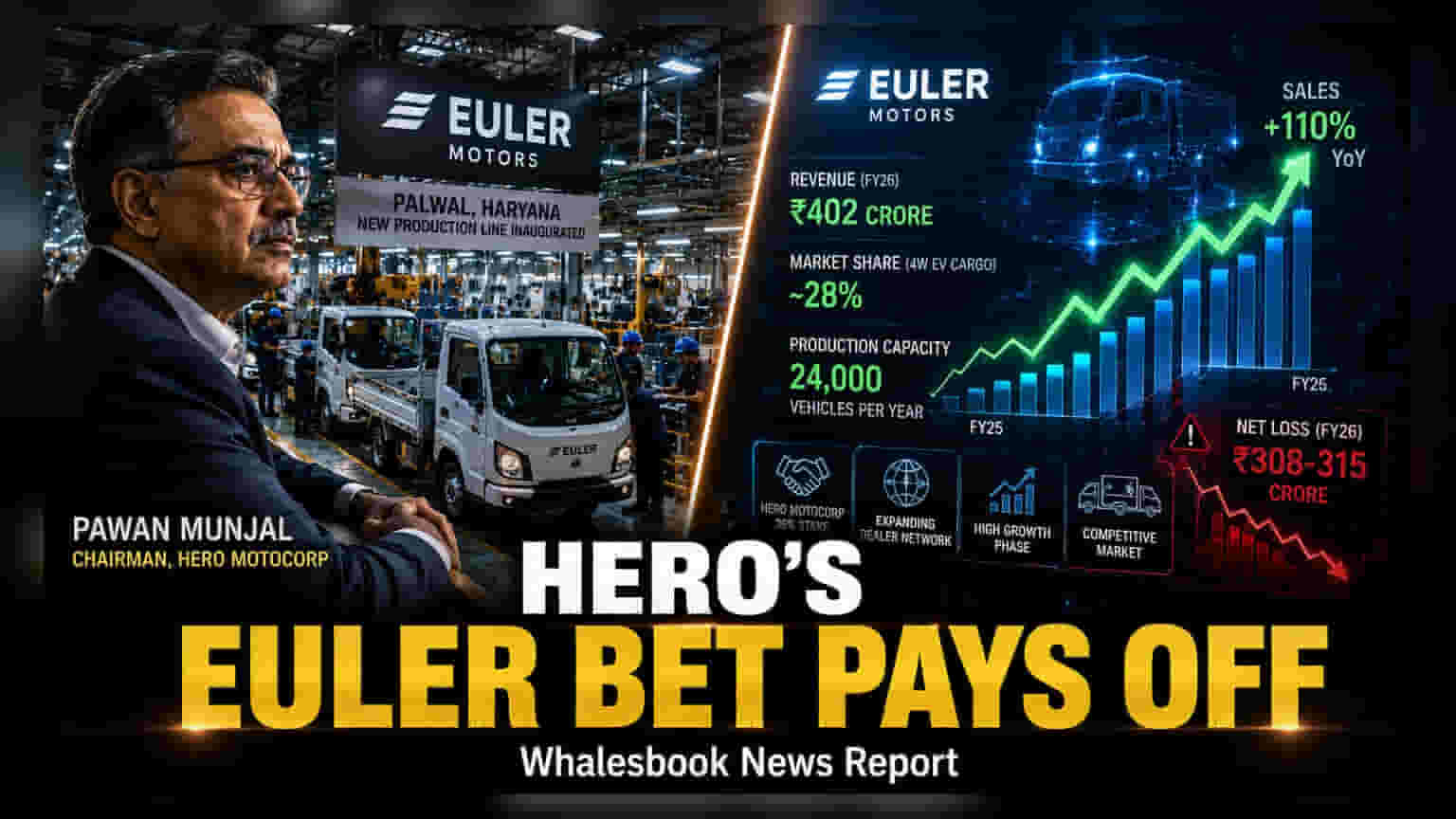
Hero MotoCorp has expanded its commitment to electric commercial vehicle maker Euler Motors by inaugurating a new production line in Palwal, Haryana. While Euler has reported over 100% revenue growth, the company faces challenges including widening losses and intense competition from established auto players. Hero’s approximately 36% stake indicates a long-term strategy similar to its early support for Ather Energy.
Hero MotoCorp has further cemented its electric vehicle strategy by backing a major capacity expansion at Euler Motors. Chairman Pawan Munjal recently inaugurated a new manufacturing line at Euler’s factory in Palwal, Haryana, which increases the company’s annual production capacity to 24,000 vehicles. This investment highlights Hero’s calculated approach to capturing a share of the commercial electric vehicle market, a strategy that mirrors its successful early-stage support for Ather Energy.
Hero MotoCorp currently holds approximately a 36% stake in Euler Motors. This partnership goes beyond just funding; it includes executive-level support and integration with Hero’s broader business network. For Euler Motors, this has translated into a rapid expansion of its footprint, with the company now claiming a market share of roughly 28% in the four-wheeler electric cargo segment as of August 2026.
Financial performance for the fiscal year 2026 shows a clear trend of high growth but also significant cost pressure. Euler Motors reported revenue of approximately ₹402 crore, marking a 110% increase compared to the previous year. However, this growth has come at the cost of profitability, with net losses widening to between ₹308 crore and ₹315 crore. Such losses are often characteristic of startups in an aggressive scaling phase, where capital is heavily diverted toward infrastructure, dealership expansion, and technological development.
While the expansion into electric four-wheelers provides a new avenue for growth, the sector is increasingly crowded. Euler Motors faces direct competition from established automotive giants like Tata Motors and Mahindra Electric, both of which have significant resources and existing distribution channels. This competitive landscape may lead to pricing pressure, which could make it difficult for new entrants to maintain healthy profit margins.
Additionally, the company remains vulnerable to supply chain issues. Cost pressures from fluctuating prices of raw materials, particularly semiconductors, copper, and aluminum, continue to be a challenge for all electric vehicle manufacturers. For investors and market observers, the key monitorables will be how Euler Motors manages its cash burn in the coming quarters and whether it can effectively use its expanded production capacity to improve unit economics and narrow its losses in an increasingly competitive environment.