

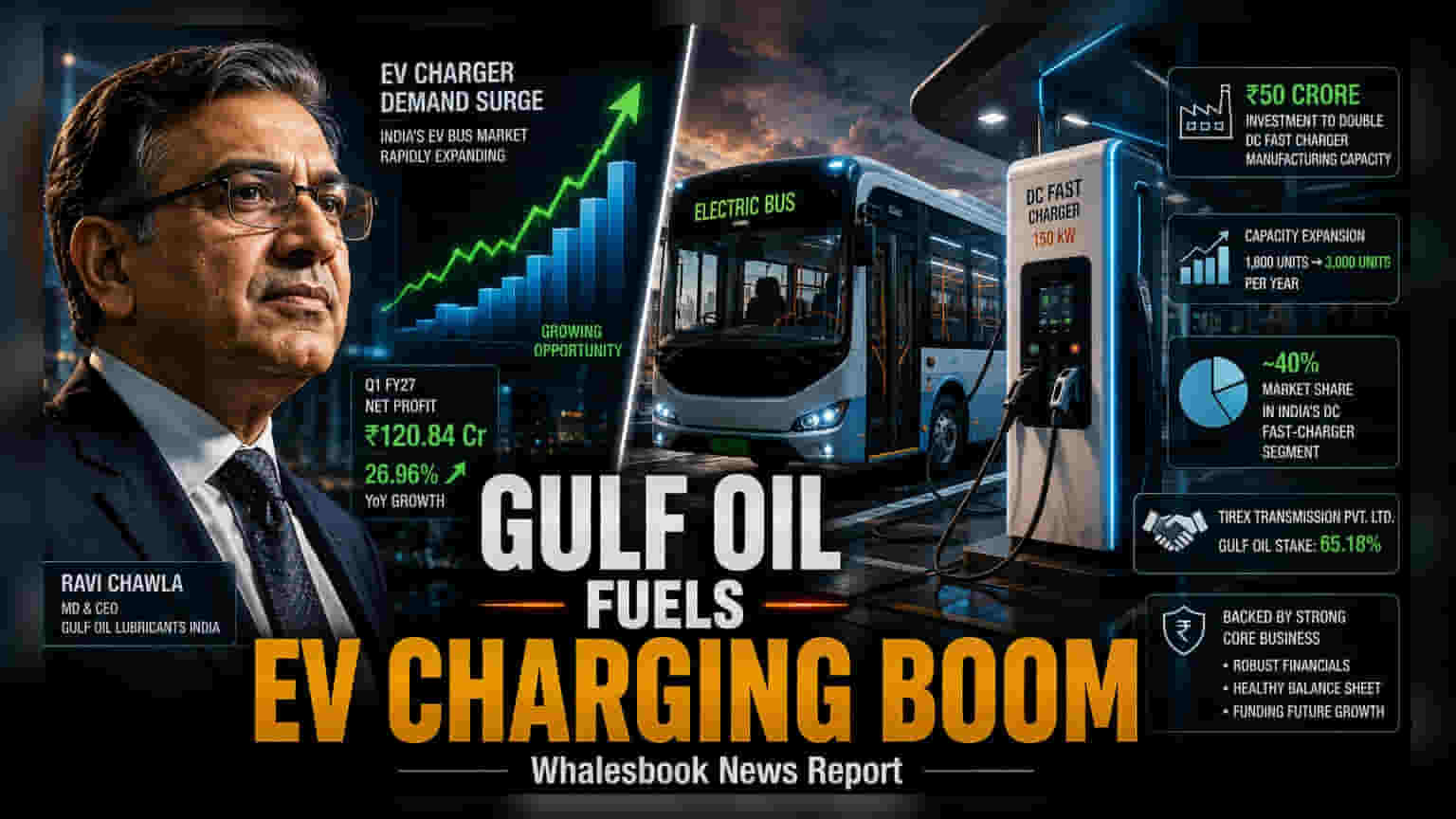
Gulf Oil Lubricants India is investing ₹50 crore to increase its annual DC fast-charger production capacity from 1,800 to 3,000 units in Ahmedabad. The move aims to capture rising demand in the Indian electric bus market. Investors will track how this infrastructure push balances against the company’s core lubricant business and potential import cost pressures.
Gulf Oil Lubricants India is expanding its footprint in the electric vehicle (EV) infrastructure space. The company has announced a ₹50 crore investment to nearly double its manufacturing capacity for DC fast chargers at its Ahmedabad facility. This project will increase the annual production capacity from 1,800 units to 3,000 units, aimed at supporting the rapid growth of India's electric bus market.
The strategic expansion is being executed through Tirex Transmission Pvt. Ltd., a company in which Gulf Oil has progressively increased its stake to 65.18%. With an existing estimated market share of 40% in India’s DC fast-charger segment, the company is positioning itself to benefit from government-backed procurement schemes that are driving the adoption of electric buses and commercial fleet electrification.
Financial Context and Core Business
The company’s ability to fund this expansion relies on the consistent performance of its core lubricant business. In its most recent financial update for the quarter ended June 30, 2026, the company reported a consolidated net profit of ₹120.84 crore, representing a 26.96% increase compared to the same period in the previous year. This financial strength provides the necessary headroom to invest in new growth areas like EV infrastructure.
Investor Monitorables and Risks
While the expansion into EV chargers represents a diversification strategy, investors should consider several operational and financial factors. The profitability of the core lubricant business remains sensitive to fluctuations in crude oil and base oil prices. Significant volatility in these raw material costs can pressure operating margins, regardless of performance in the EV charger segment.
Additionally, the EV charger business currently relies on importing certain components to maintain competitiveness. This creates exposure to foreign exchange fluctuations and potential supply chain disruptions. The company’s stated goal is to improve domestic value addition, but execution speed and the ability to source components locally will be critical for long-term margin stability.
Finally, there is a long-term industry trend to observe. As the adoption of electric vehicles accelerates, the total demand for traditional automotive lubricants may experience moderation. The company is effectively navigating a transition, attempting to build a new revenue stream in the EV sector to offset potential long-term declines in its traditional market. Investors will likely watch the commissioning timeline of the new production capacity and the company’s ability to maintain its market share in the face of rising competition in the charging infrastructure space.