

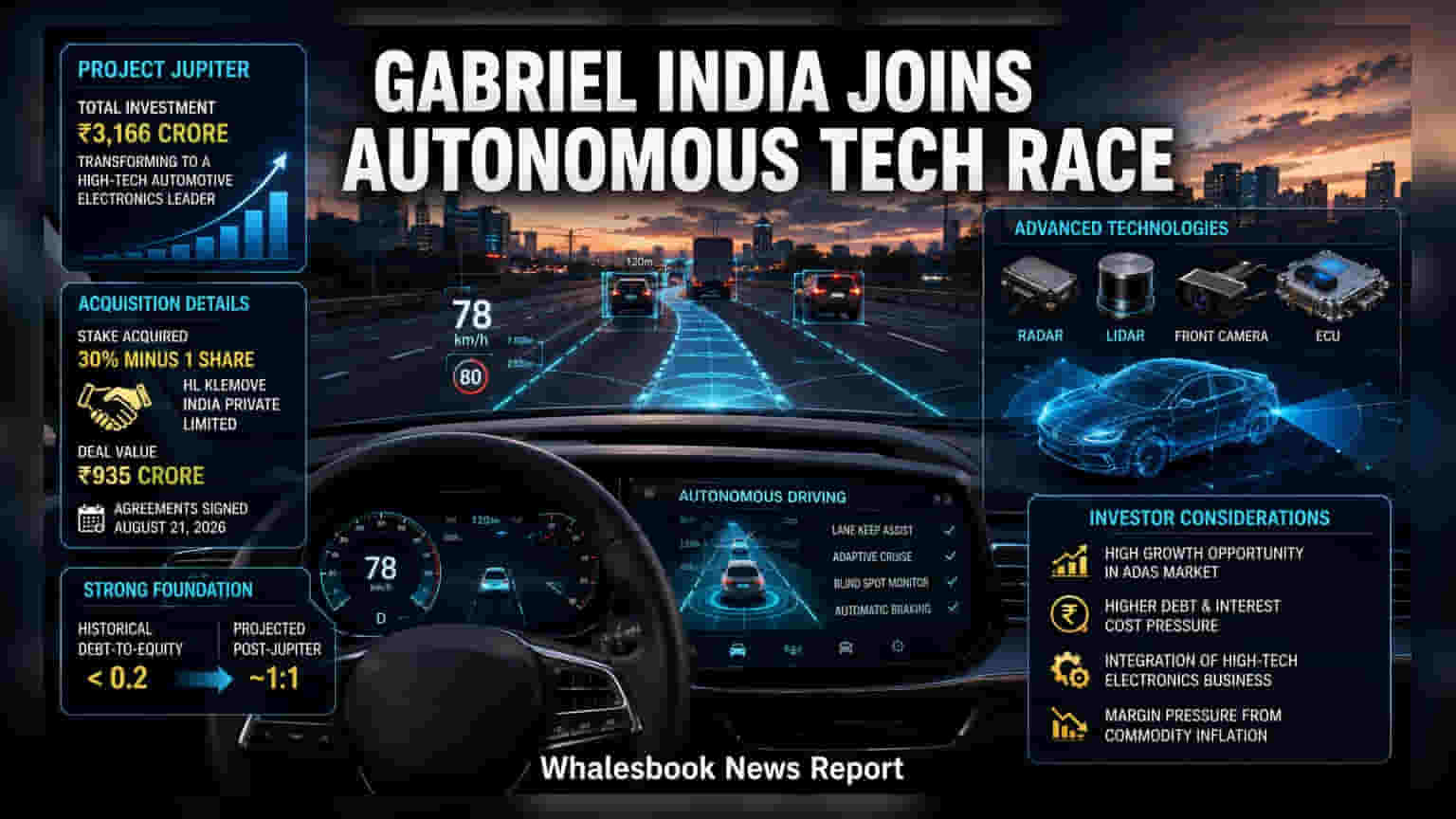
Gabriel India is acquiring a 30% stake in HL Klemove India for ₹935 crore to enter the autonomous driving and ADAS market. This move is part of the company's broader ₹3,166 crore 'Project Jupiter' plan to shift from mechanical parts to automotive electronics. Investors should track how this investment, which will increase the company's debt levels, affects its balance sheet and profit margins over the coming quarters.
Gabriel India, the flagship company of the ANAND Group, has formalized a major entry into the autonomous driving technology market by acquiring a 30% minus one share stake in HL Klemove India Private Limited. The transaction, valued at approximately ₹935 crore, was finalized through definitive agreements signed on August 21, 2026. This move is a central piece of the company’s larger strategic roadmap known as 'Project Jupiter,' which involves a total investment of ₹3,166 crore aimed at transforming the firm from a traditional mechanical suspension manufacturer into a high-tech automotive electronics player.
Under this partnership, Gabriel India plans to localize the production of advanced safety and driving components. These include radar systems, LiDAR, front cameras, and electronic control units—technology that is becoming essential as vehicle manufacturers shift toward software-defined features. By integrating HL Klemove’s global expertise in electronic systems, the company intends to capture a larger share of the growing Advanced Driver Assistance Systems (ADAS) market in India.
For investors, this shift toward high-technology manufacturing comes with significant financial considerations. Historically, Gabriel India has maintained a conservative balance sheet with a debt-to-equity ratio of less than 0.2. However, the funding required for 'Project Jupiter' and this acquisition is expected to change that dynamic, with the debt-to-equity ratio projected to move toward 1:1. While the company aims for long-term growth through this portfolio expansion, the increased use of debt will put more pressure on the company to manage its interest costs effectively.
There are also operational risks that shareholders should monitor. Successfully integrating a high-tech electronics business into a company that has traditionally focused on mechanical automotive components can be complex. The company will need to ensure that its manufacturing processes and technical talent can adapt to these new product lines without hurting overall efficiency. Furthermore, there is the risk of margin pressure. As the company scales these new technologies, it may face challenges in passing on commodity cost inflation to original equipment manufacturers, which could affect short-term profitability.
The market’s focus will now turn to the execution of 'Project Jupiter.' Key things to track in the coming quarters include the company's ability to manage its rising debt levels, the integration progress of HL Klemove India, and whether these new electronic products can generate the expected revenue growth to offset the higher capital spending and borrowing costs.