

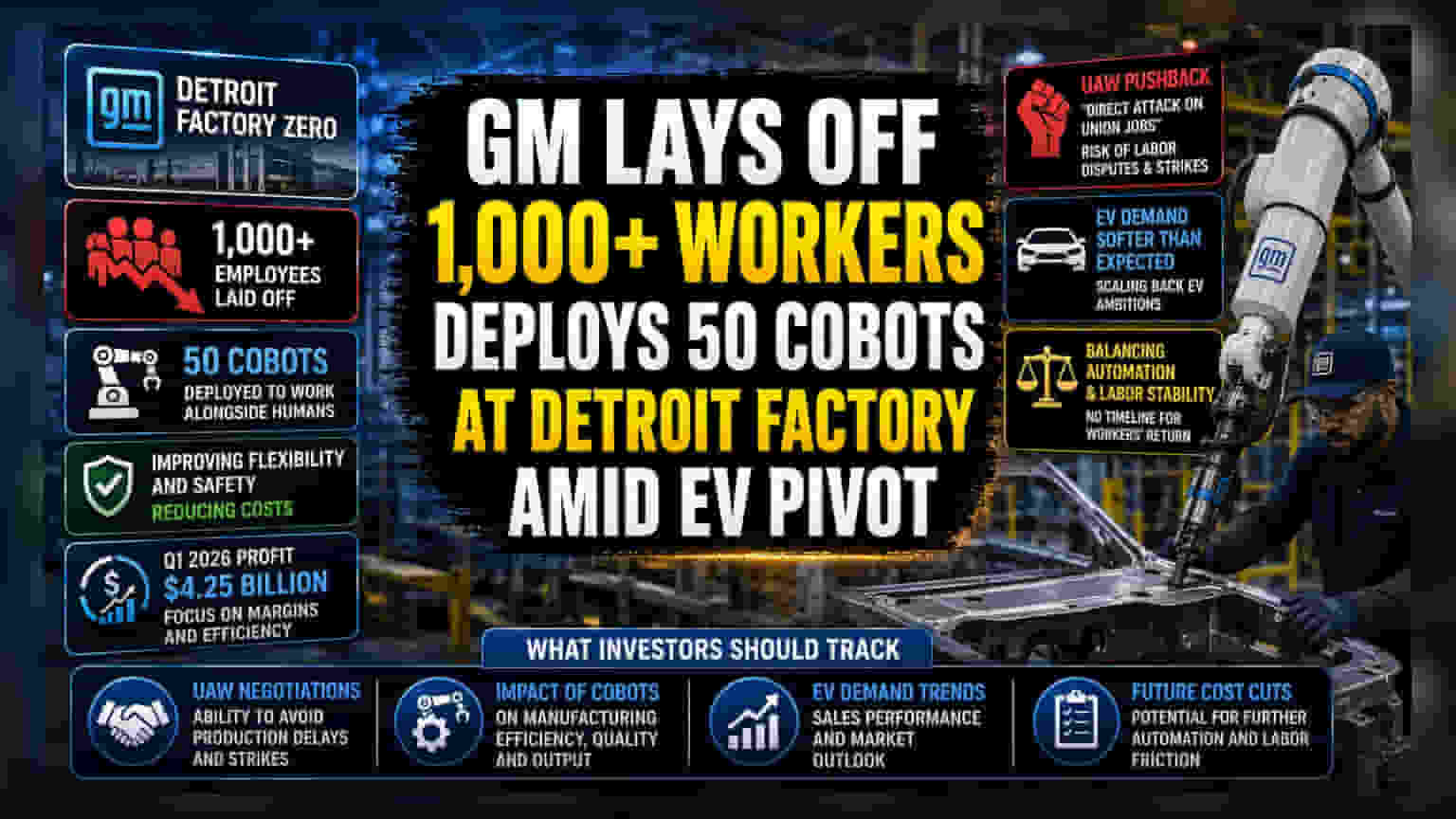
General Motors has cut over 1,000 jobs at its Detroit Factory Zero facility, replacing them with 50 collaborative robots. This cost-cutting move follows the automaker's decision to scale back its electric vehicle (EV) production targets. Investors should monitor potential labor tension with the United Auto Workers (UAW) union, which opposes the layoffs, alongside the company’s efforts to maintain profit margins amid shifting market demand.
What Happened
General Motors (GM) has reduced its workforce by over 1,000 employees at its Detroit Factory Zero assembly plant. Simultaneously, the company has deployed 50 collaborative robots, often called "cobots," onto its production lines. Unlike traditional industrial robots that operate behind safety cages, these machines are designed to work alongside human staff to assist with tasks such as attaching vehicle body panels.
The company states this shift is part of a broader plan to improve manufacturing flexibility and safety. However, the move also highlights the company's reaction to changing market conditions, particularly regarding its electric vehicle (EV) business.
The Strategic Shift
This automation drive comes as General Motors adjusts its business strategy. The automaker has recently scaled back its EV ambitions, citing lower-than-expected demand for certain electric models. By introducing cobots, GM is attempting to reduce operational costs and protect its profit margins.
While the company reported a profit of $4.25 billion in the first quarter of 2026, it remains focused on managing expenses. For investors, this suggests that the company is prioritizing efficiency and cost control over aggressive volume expansion in the current market environment.
The Labor Tension Risk
The United Auto Workers (UAW) union has strongly pushed back against the layoffs. James Cotton, the UAW Local 22 president, has publicly criticized the decision, labeling it a direct attempt to cut costs at the expense of union members. The union has argued that such moves threaten the job security of its members, who recently secured significant wage increases in the 2023 contract.
This creates a potential risk for investors. Historically, disputes with the UAW have led to strikes and production halts, which can impact company operations. With the union already highlighting a trend of declining labor hours per vehicle, future contract negotiations may become more complex or expensive if the company continues to prioritize automation over headcount.
How Investors May Read This
The core investor angle here is the balance between margin protection and labor stability. While automation typically lowers long-term labor costs and can improve consistency, it carries the risk of social friction and potential operational disruption. The company claims these layoffs are temporary, but no specific timeline for the return of these workers has been provided.
Investors should keep an eye on how these labor relations develop. Any escalation in tensions could affect production timelines or lead to increased labor costs in the future. Additionally, the success of this shift will depend on whether the automation actually improves the plant's output efficiency without compromising quality or triggering further disputes.
What Investors Should Track
Moving forward, the primary monitorables include the company’s ability to navigate UAW negotiations without production delays, the actual impact of these cobots on manufacturing efficiency, and future updates on EV demand. If demand for the company’s electric vehicles remains soft, the pressure to cut costs further may continue, which could lead to additional friction with the labor force.