 Whalesbook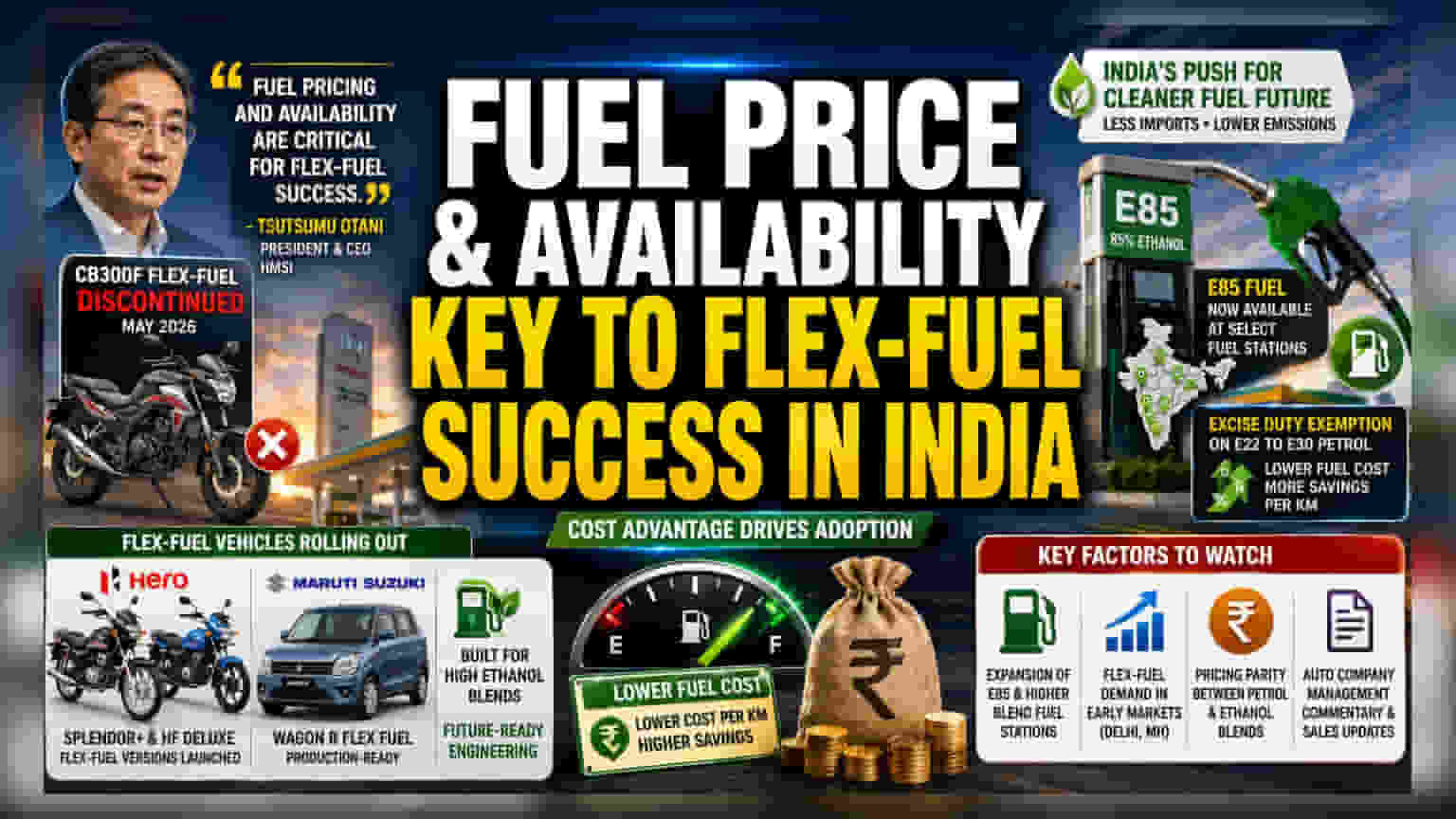


Honda Motorcycle and Scooter India (HMSI) CEO Tsutsumu Otani has stated that flex-fuel vehicle adoption depends on competitive fuel pricing and widespread availability. While the government is actively pushing ethanol blends, the recent discontinuation of the Honda CB300F Flex-Fuel highlights the difficulty of gaining consumer demand. As listed manufacturers like Hero MotoCorp and Maruti Suzuki enter this space, investors should watch whether these vehicles can offer real-world cost benefits to buyers.
What Happened
Tsutsumu Otani, President and CEO of Honda Motorcycle and Scooter India (HMSI), has identified fuel pricing and availability as the most critical factors for the success of flex-fuel vehicles in India. While government support—such as recent excise duty exemptions for higher ethanol-blended fuels—provides a policy tailwind, the company emphasizes that genuine customer adoption will only occur if these vehicles offer clear financial advantages. The comments come at a time when the Indian government is accelerating its push for ethanol-blended petrol to reduce crude oil imports and lower carbon emissions.
The Demand Challenge
The road to widespread adoption is not straightforward. In a recent example of the market's sensitivity, Honda discontinued its CB300F Flex-Fuel model in May 2026. The bike, which was designed to run on high ethanol blends, failed to gain significant traction, leading to its removal from the manufacturer’s lineup. This experience serves as an important case study for the industry: engineering capability alone does not guarantee sales. For consumers, the decision to purchase a flex-fuel vehicle often comes down to the total cost of ownership, which includes both the vehicle price and the price-per-kilometer compared to traditional petrol models.
The Competitive Landscape
While Honda has hit a pause button, other major players are actively rolling out flex-fuel technology. Hero MotoCorp recently launched the flex-fuel versions of its high-volume commuter motorcycles, the Splendor+ and HF Deluxe. Similarly, Maruti Suzuki has showcased the production-ready Wagon R Flex Fuel. These manufacturers are betting that a combination of future-ready engineering and aggressive expansion into the mass-market segment will help them overcome the initial hurdles of consumer hesitation. The success of these models will depend on how quickly fuel retailers can make higher ethanol blends, such as E85, available beyond limited test cities.
The Fuel Pricing Puzzle
To make flex-fuel vehicles attractive, the government is trying to make the fuel itself cheaper. As of June 2026, the central government has announced excise duty exemptions on petrol blended with 22% to 30% ethanol (E22 to E30). This follows the introduction of E85 fuel—which is 85% ethanol—at select fuel stations. The policy logic is simple: if E85 or other high-ethanol blends are priced significantly lower than regular petrol, the consumer’s cost per kilometer drops, creating a compelling reason to choose a flex-fuel engine.
Risks and Considerations
Investors should keep in mind that this transition faces several structural risks. First, there is the infrastructure gap; without a nationwide network of pumps offering high-blend ethanol, the utility of these vehicles is limited. Second, there is the technical adaptation factor. Regular petrol vehicles cannot simply run on high-ethanol blends, meaning flex-fuel technology requires specific engine modifications and durable components. If the price difference between ethanol-blended fuel and regular petrol narrows, or if vehicle maintenance costs are perceived to be higher, demand could remain sluggish, similar to what was seen with previous experiments in the segment.
What Investors Should Track
As the industry pivots toward this new technology, the key monitorables are straightforward. Investors should watch for the actual, on-ground expansion of E85 and higher-blend fuel stations. The pace of this rollout will dictate how quickly manufacturers can sell these vehicles. Additionally, management commentary from listed auto companies will be vital; look for updates on how demand for their new flex-fuel models is shaping up in early markets like Delhi and Maharashtra. Finally, any changes to the pricing parity between petrol and ethanol blends will be the ultimate signal of whether this segment is ready for mass-market adoption.