

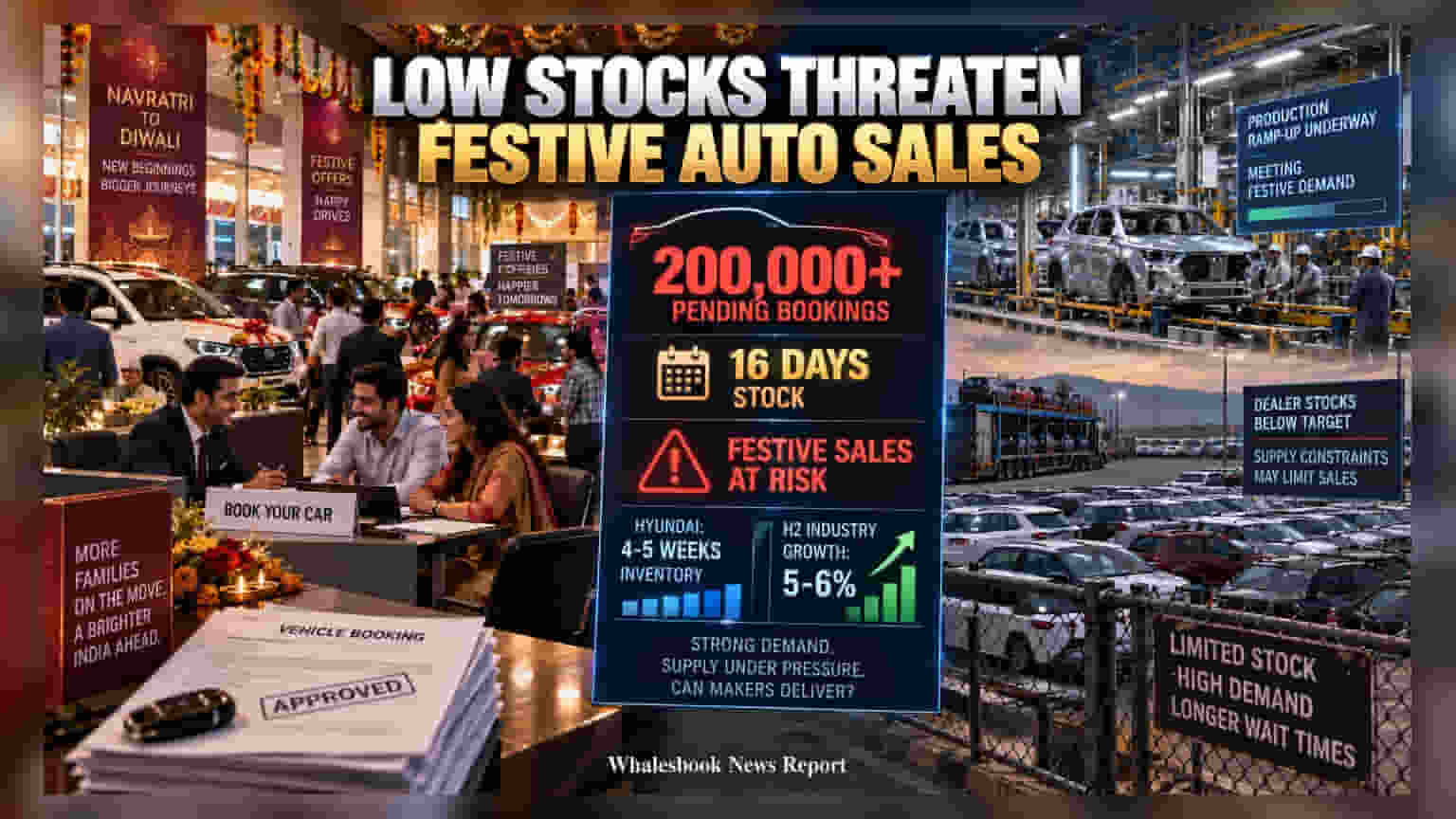
As the Indian auto industry enters the peak Navratri-to-Diwali season, automakers report high demand but face tight dealer inventories. Maruti Suzuki struggles with a 200,000-vehicle backlog, while others race to boost production. Investors should track whether manufacturers can resolve these supply issues to convert record-high bookings into revenue.
The period from Navratri to Diwali is the most critical time for the Indian auto industry, contributing roughly one-third of total annual vehicle sales. While consumer demand remains healthy, manufacturers are currently struggling to build enough inventory at dealer locations. This supply gap creates a risk where automakers may be unable to fulfill customer orders, potentially limiting the expected sales growth during this peak season.
Maruti Suzuki, the market leader, is facing a significant challenge in meeting this demand. The company currently holds over 200,000 pending customer bookings. However, its dealer network inventory is currently at about 16 days of sales, which is well below the target of roughly one month of stock usually maintained during the festive season. The company has noted that its new automated production lines are still in the process of stabilizing, which limits the number of vehicles available for immediate delivery. Investors should monitor how quickly these new production lines reach full capacity, as any delay here could impact delivery numbers for the second half of the year.
In contrast, some competitors are taking active steps to address these constraints. Hyundai Motor India, for instance, has a more comfortable inventory position of about four to five weeks. To prepare for the festive demand and an upcoming midsize SUV launch, the company is adding a third production shift at its Talegaon plant in Maharashtra. This move highlights how manufacturers are trying to balance rising demand with the need to keep dealer networks adequately stocked.
Despite the festive excitement, the broader industry outlook for the second half of the fiscal year is showing signs of moderation. Executives estimate that industry growth might slow to around 5-6% during this period. A major reason for this slower growth expectation is the high comparison base from the previous year. Because sales were very strong in the same period last year, achieving high percentage growth becomes statistically more difficult this time around.
The key monitorable for investors during this festive season is the execution capability of each automaker. It is no longer just about the level of customer bookings or consumer interest. The real test is whether these companies can ramp up production fast enough to ensure that vehicles are available at showrooms. If supply cannot keep up with demand, automakers risk losing sales to competitors or seeing potential customers cancel their bookings. Investors will be looking for updates on production capacity and delivery data in the upcoming monthly sales reports to see if these inventory issues are being resolved.