

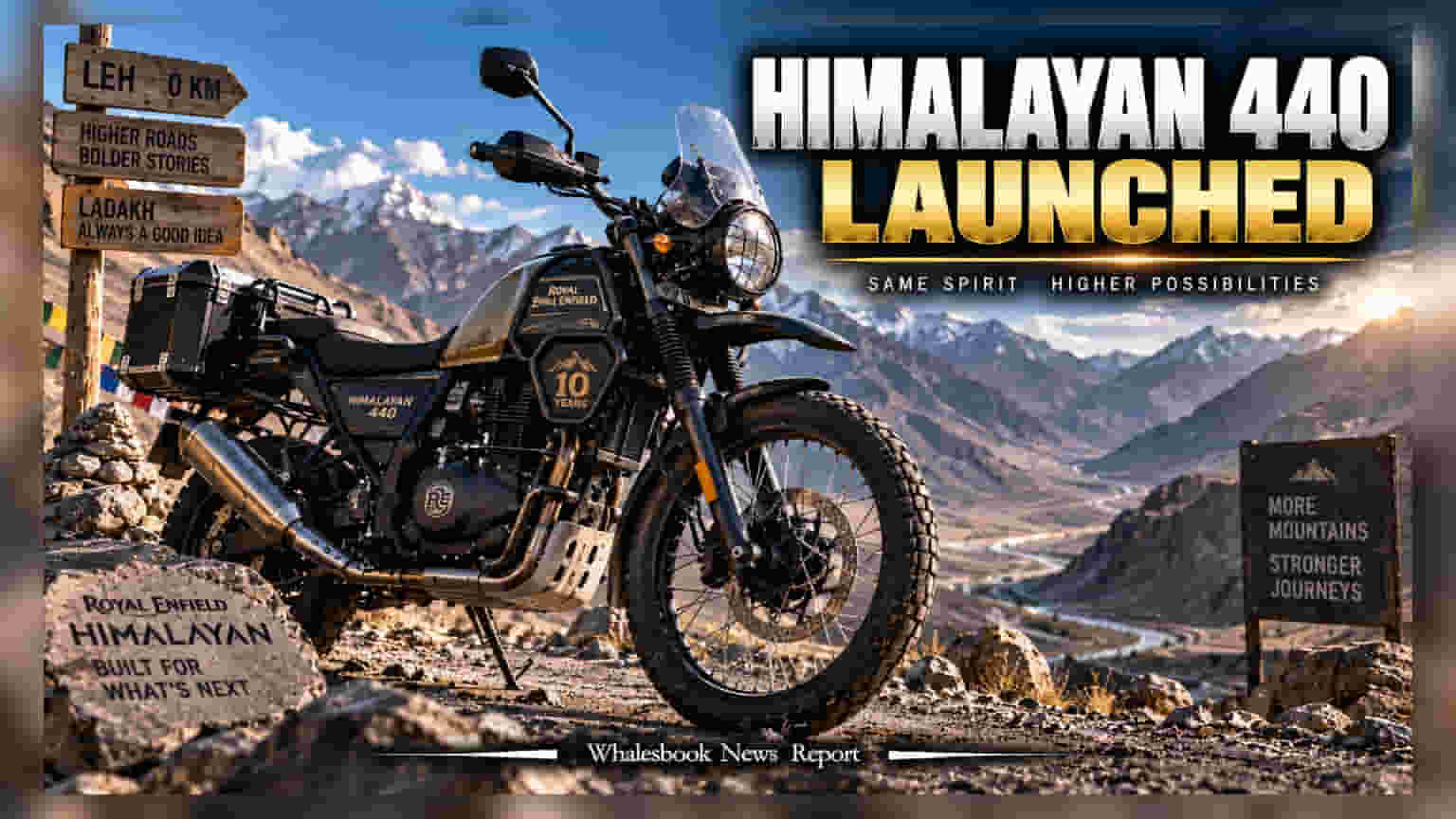
Eicher Motors has launched the Royal Enfield Himalayan 440 at an ex-showroom price of ₹2,29,000, with bookings now open across India. This new model fills a gap in the company’s adventure motorcycle portfolio. Investors should monitor whether this launch drives volume growth or influences sales of the brand's existing 450cc variants.
Eicher Motors has officially expanded its Royal Enfield adventure motorcycle portfolio with the launch of the Himalayan 440. Unveiled at the company’s inaugural Himalayan Basecamp event in Ladakh, the motorcycle is priced at ₹2,29,000 (ex-showroom). Bookings for the new model commenced on September 4, 2026, via the company’s digital portal and authorized dealerships.
Product Positioning and Strategy
The Himalayan 440 is powered by a 443cc single-cylinder engine that produces 25.4 bhp and 34 Nm of torque, paired with a six-speed transmission. This launch is a strategic move to provide a more accessible and simplified adventure-touring experience compared to the existing Himalayan 450. By introducing this model, the company is attempting to bridge the gap in its current dual-sport lineup, aiming to attract riders who may find the 450cc variant too aggressive or complex for their specific needs.
Eicher Motors shares closed at ₹7,630.50 on September 4, 2026. The company recently reported a consolidated net profit of ₹14.63 billion for the June 2026 quarter, on revenues of ₹66.32 billion. Investors often look at new product launches as potential drivers for future revenue growth, especially in the premium motorcycle segment where Royal Enfield maintains a strong presence.
Risks and Market Context
While the expansion of the portfolio is aimed at growth, there are several business factors to consider. One primary concern is the potential for brand cannibalization, where the Himalayan 440 might take sales away from the company’s own Himalayan 450 or the Scram 440 models rather than bringing in entirely new customers. This is a common challenge when a company adds multiple products to a similar price and use-case segment.
Additionally, there is a tax-related factor to consider. Since the Himalayan 440 features an engine larger than 350cc, it falls into a higher GST tax slab of 40%. This higher tax burden impacts the final pricing and can make it harder for the company to maintain competitive margins compared to its sub-350cc offerings. Furthermore, the company continues to face input cost pressure, with inflationary factors affecting margins by approximately 3.0% to 3.5%, according to recent industry trends. The company’s ability to manage these costs through value-engineering and production efficiency will be important for maintaining profitability.
The most important monitorable for shareholders will be the acceptance of the Himalayan 440 in the market over the coming quarters. Specifically, investors will look for data on how the model performs against its direct competitors and whether it helps in increasing the total volume of premium motorcycles sold without negatively affecting the profit margins of the existing product lineup.