 Whalesbook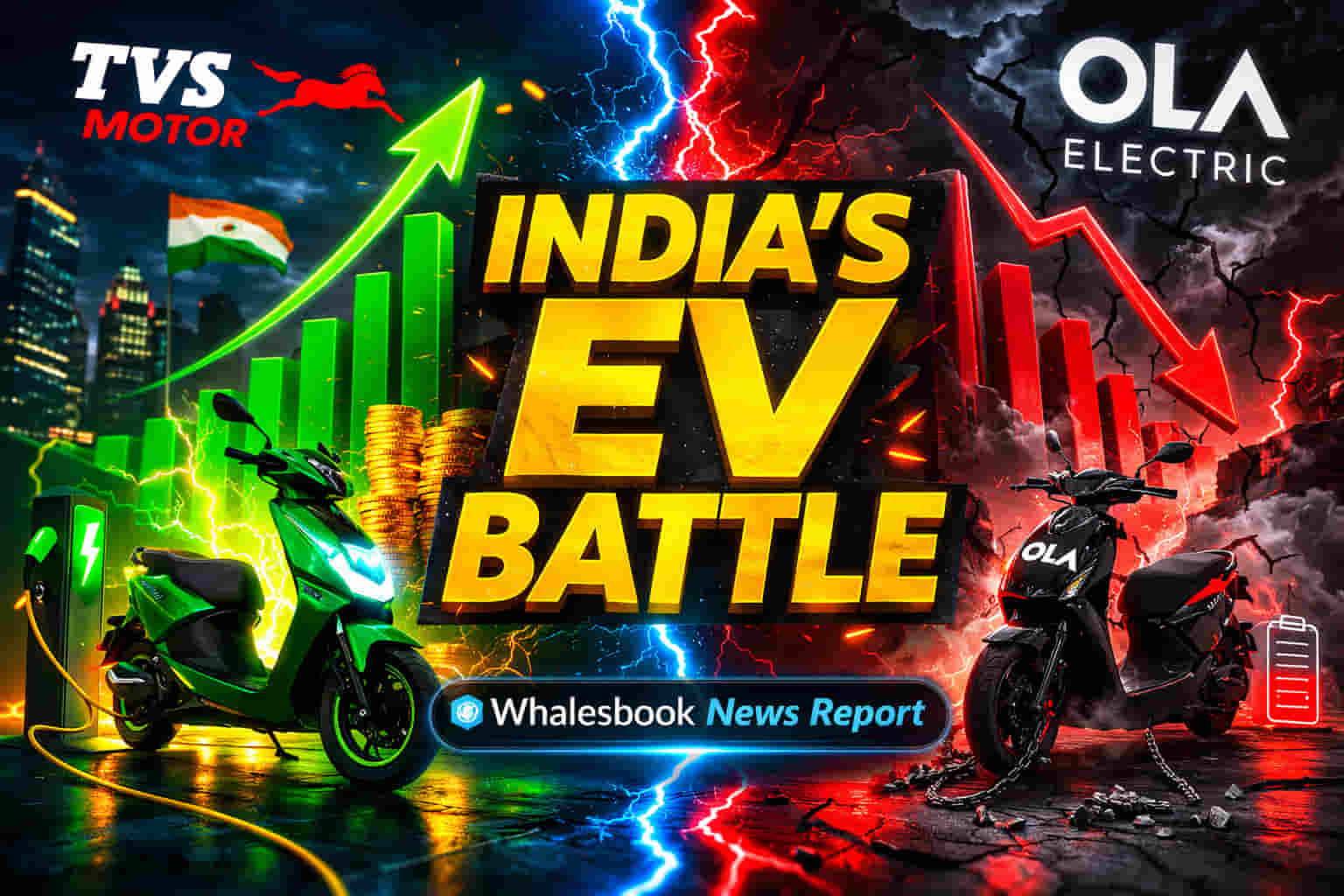


### The Seamless Link
The robust year-on-year growth in electric two-wheeler registrations underscores a healthy underlying momentum within the segment. This expansion is increasingly driven by improved product quality and more expansive distribution networks, complemented by greater stability introduced by legacy original equipment manufacturers (OEMs). As monthly volumes consistently surpass 100,000 units, the industry is now operating on a considerably higher structural base than in the previous fiscal year. Crucially, the demand construct is evolving, with electric two-wheelers transitioning from primarily aspirational purchases to decisions more heavily influenced by economic considerations, signaling sustained growth durability.
### The Core Catalyst
In February 2026, the electric two-wheeler market registered 1.05 lakh units, marking a significant 36% surge compared to the 76,350 units recorded a year prior. TVS Motor Company solidified its market leadership, posting an impressive 61% year-on-year growth and expanding its market share. Hero MotoCorp demonstrated exceptional expansion, more than tripling its sales volumes from the previous year and elevating its market share to 11.30%. Bajaj Auto secured the second position, contributing 12% growth to the overall segment performance. This sector-wide ascent, however, was sharply contrasted by Ola Electric, which experienced a substantial 55% decline in volumes and saw its market share contract significantly to 3.68%. The 14% month-on-month decrease observed in February was largely attributed to seasonal factors and normalization post-strong January sales, combined with the reduced number of days in the month, rather than any fundamental demand slowdown.
### The Analytical Deep Dive
The Indian electric two-wheeler market is undergoing a profound shift, characterized by the ascendancy of legacy players and the struggles of newer entrants. By January 2026, established manufacturers like TVS Motor, Bajaj Auto, and Hero MotoCorp collectively commanded approximately 60% of the market, a substantial leap from their 34% share in 2023. This consolidation indicates a maturation phase where consumer preference is increasingly leaning towards reliability, established service networks, and consistent execution, attributes where incumbent OEMs inherently possess an advantage.
TVS Motor, with a trailing P/E ratio of 64.89 as of February 2026, trades at a premium to its peers, reflecting its market leadership and perceived growth stability. Hero MotoCorp's P/E stands at approximately 20.88, while Bajaj Auto's is around 30.85. This divergence in valuation highlights differing investor perspectives on growth potential and risk. TVS Motor's reported 61% year-on-year growth in February 2026, coupled with its strong market share, validates its strategy [cite:News1]. Hero MotoCorp’s more than tripling of volumes is a testament to its expanding reach, potentially leveraging its vast dealer network for its Vida brand. Bajaj Auto, with a steady 12% growth, continues to benefit from its popular Chetak range and strong export performance.
Recent government policies, including Budget 2026's focus on battery manufacturing incentives and localization, and upcoming CAFE 3 norms, are further accelerating the transition to electric mobility. The easing of rare-earth magnet supply constraints is also expected to support high-teen E2W growth in the upcoming fiscal year. This supportive macro environment has underpinned the market's move from an aspirational purchase to a more economically driven decision, reinforcing demand durability [cite:News1].
### The Forensic Bear Case
Ola Electric's trajectory presents a stark counterpoint to the market's overall health. The company's 55% volume decline in February 2026 and a fall in market share from over 11% to just 3.68% are critical red flags [cite:News1]. Reports indicate Ola’s market share has significantly eroded, falling to approximately 16% in 2025 from 36.7% in 2024. This decline is attributed to intensifying competition from legacy players and critical issues with consumer trust and service scalability. A 70.4% volume fall in January 2026 further emphasizes these challenges.
The market's consolidation favors established players with robust dealer networks and proven after-sales service capabilities. Startups that relied on early-mover advantage are now facing intense pressure. While Ather Energy has managed to grow by strategically positioning its products, Ola Electric's struggles highlight the difficulties newer entrants face in sustaining momentum when faced with operational consistency and rising customer expectations. Furthermore, TVS Motor's significantly higher P/E ratio compared to Hero MotoCorp and Bajaj Auto suggests an elevated valuation that could be vulnerable should competitive pressures intensify and market share gains stagnate.
### The Future Outlook
Analysts anticipate continued growth in the electric two-wheeler segment, with estimates suggesting high-teen expansion in the next fiscal year. The market's structural base has elevated, and demand is consolidating at higher levels, shifting towards economic viability rather than just aspiration [cite:News1]. Government initiatives aimed at boosting localization, battery manufacturing, and charging infrastructure are expected to provide further impetus. The transition to cleaner mobility is set to accelerate, with established OEMs likely to continue capturing market share from newer, less-established players. The industry's forward trajectory will likely be defined by consistent execution, scalable distribution, and a strong emphasis on customer reliability and service.