

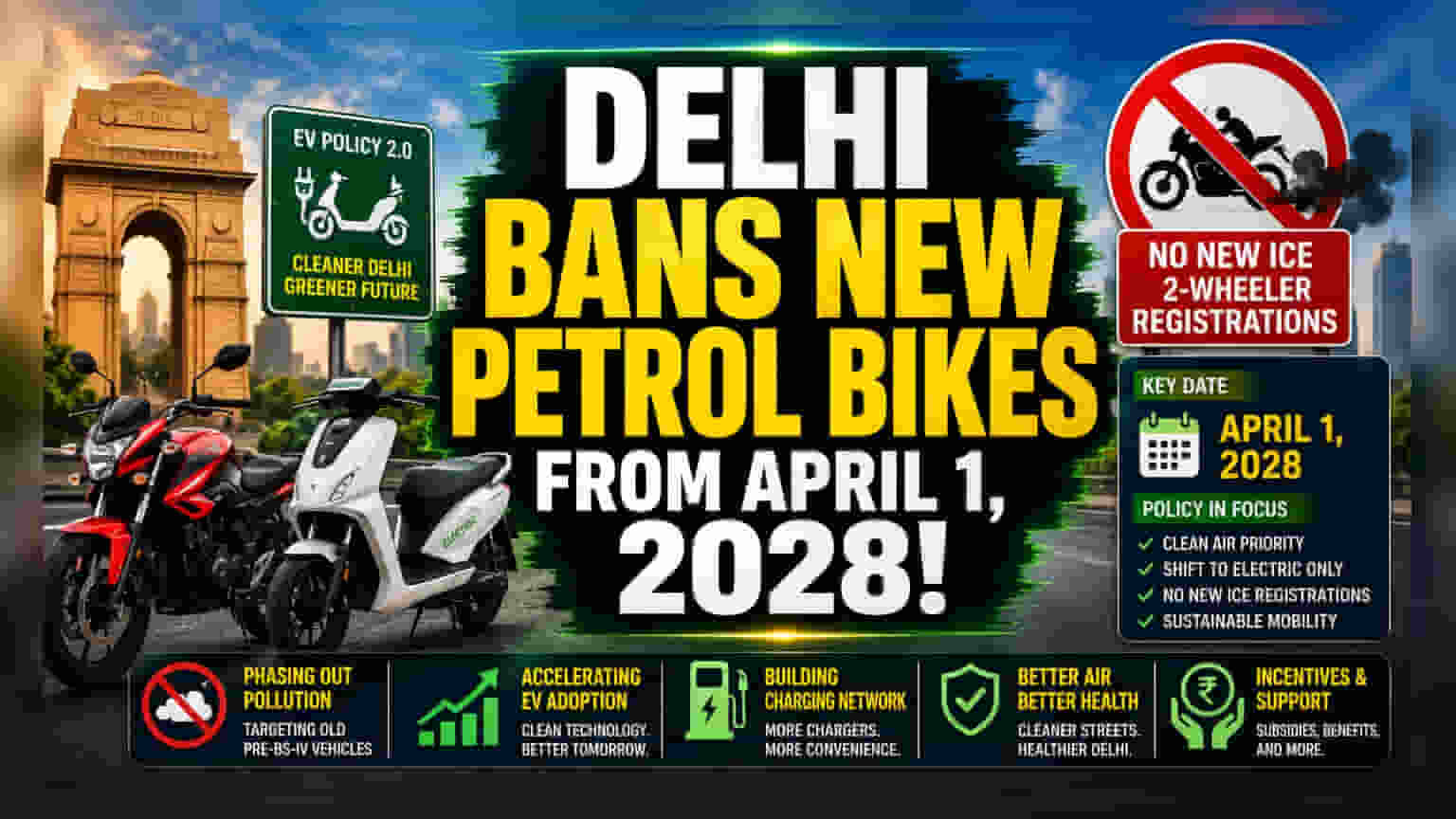
The Delhi government is proceeding with its plan to ban the registration of new petrol two-wheelers from April 1, 2028, under its upcoming EV Policy 2.0. Despite pushback from the automotive industry regarding the feasibility of this timeline and its impact on consumer choice, the mandate aims to accelerate the transition to electric mobility in the capital.
What Happened
The Delhi government has confirmed its decision to proceed with a ban on the registration of new internal combustion engine (ICE) two-wheelers starting April 1, 2028, as part of its new Electric Vehicle (EV) Policy 2.0. This mandate marks a significant shift in the capital's approach to electric mobility, moving from voluntary adoption incentives to strict regulatory timelines. The policy, which is expected to be tabled at the upcoming Cabinet meeting and implemented by next month, replaces the previous EV policy that expires on June 30, 2026.
The Industry-Government Standoff
The Society of Indian Automobile Manufacturers (SIAM) had formally urged the Delhi government to reconsider this specific clause. The industry’s argument centers on the fact that modern Bharat Stage VI (BS-VI) petrol two-wheelers are equipped with advanced emission control systems, such as electronic port fuel injection and three-way catalytic converters, which significantly reduce particulate matter.
Automakers have argued that banning modern, cleaner petrol vehicles will not materially improve Delhi's air quality. Instead, they proposed that the policy should focus on aggressively phasing out older, pre-BS-IV vehicles, which are estimated to account for nearly 99.5% of particulate matter emissions from the two-wheeler segment. Despite this, the government has maintained its stance on the 2028 deadline for new petrol two-wheeler registrations.
Why This Matters For Automakers
For major two-wheeler manufacturers including Bajaj Auto, Hero MotoCorp, and TVS Motor, this policy shift represents a tightening regulatory environment in a key market. Delhi accounts for a significant volume of vehicle sales, and a forced transition to electric-only registrations in the capital creates a new pressure point for product planning and inventory management.
While EV adoption is growing, automakers have expressed concerns that for many users—particularly delivery workers and long-distance commuters who prioritize range, cost, and load-bearing capacity—the current EV ecosystem may not yet fully replace petrol alternatives by 2028. This mandate effectively forces companies to accelerate their electric vehicle portfolio and supply chain capabilities for the Delhi market to ensure they do not lose market share when the registration ban takes effect.
The Infrastructure Challenge
Beyond the manufacturing and sales aspects, the success of this mandate rests on the city's readiness. Industry experts and analysts have highlighted that the transition requires a massive scaling up of charging infrastructure. Currently, the actual installation of charging points has trailed behind initial targets. A successful transition by 2028 will depend not only on the availability of electric motorcycles and scooters but also on whether the grid and charging network can handle the increased load, avoiding the risk of customer inconvenience.
What Investors Should Track Next
Investors may monitor the final notification of the EV Policy 2.0, which will clarify the subsidy structures and specific operational rules. Key monitorables include the rollout pace of charging infrastructure, the quarterly sales mix of electric versus petrol two-wheelers in the Delhi region, and any subsequent policy adjustments or extensions regarding charging support or infrastructure-related investments.