

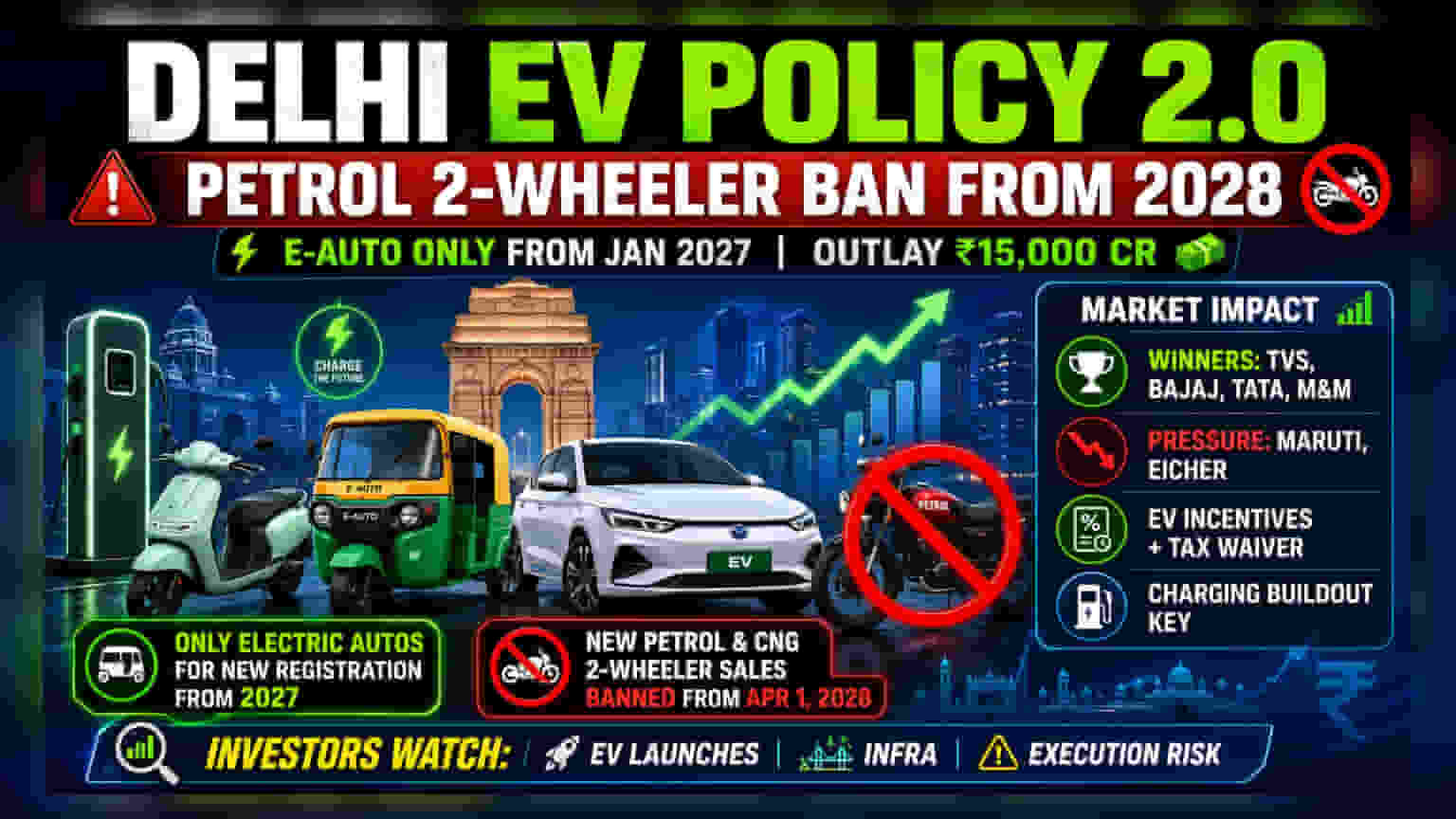
Delhi has launched its EV Policy 2.0 with a Rs 15,000 crore budget, banning new petrol and CNG two-wheeler registrations from April 2028. Electric autorickshaws will be mandatory for new registrations from 2027. While this supports EV-focused players like TVS and Bajaj, it creates pressure for manufacturers like Eicher Motors and Maruti Suzuki that have limited electric vehicle offerings.
What Happened
The Delhi government has announced its EV Policy 2.0, a plan spanning until March 2030 with a total scheme outlay of Rs 15,000 crore. This policy introduces strict deadlines to speed up the adoption of electric vehicles in the capital. Starting January 1, 2027, only electric autorickshaws will be eligible for new registrations. The regulation becomes even stricter on April 1, 2028, when the sale and registration of new petrol and CNG two-wheelers will be banned entirely. The policy includes financial support, such as purchase incentives for two-wheelers and three-wheelers, along with road tax and registration fee waivers for electric cars priced under Rs 30 lakh.
Impact on Market Players
The policy creates a clear divide between manufacturers who are already active in the electric space and those who are not. Bajaj Auto and TVS Motor are positioned to benefit as they have established EV products. In the three-wheeler segment, Bajaj Auto and Mahindra and Mahindra are also expected to see positive impacts due to the shift toward electric autorickshaws. For electric cars, companies like Tata Motors and Mahindra and Mahindra may see demand support from the tax waiver incentives. Conversely, Maruti Suzuki faces a disadvantage because the current policy excludes hybrid vehicles from the incentives, which is a segment where the company has a strong focus.
The Challenge for Eicher Motors
Eicher Motors, known for its Royal Enfield brand, faces the most direct challenge under this new framework. Currently, the company has no electric vehicle presence in its portfolio. Although Delhi accounts for a small portion of its total sales, the policy could affect the company’s future growth in the region. There is also an investor concern that if other Indian cities adopt similar mandates, the lack of an electric model could become a broader structural issue for the brand. Analysts have noted that the market may watch how quickly the company can introduce an electric offering to compete in this changing landscape.
Execution and Implementation Risks
While the policy aims to boost EV usage, there are significant practical hurdles. One major risk is the enforcement of these bans. Because Delhi is close to neighboring states like Haryana and Uttar Pradesh, there is a risk that buyers may simply register their petrol vehicles in these border regions to bypass the ban, which could undermine the policy's effectiveness within the capital. Additionally, the charging infrastructure is still developing. While the policy requires dealers to install public charging stations, the current lack of widespread charging points and the limited availability of high-performance electric motorcycles remain real issues. The timeline for the two-wheeler ban is also considered aggressive, given that petrol two-wheelers currently dominate the majority of vehicle sales in the city.
What Investors Should Track
The most important monitorable is how quickly manufacturers can launch competitive electric models, especially in the motorcycle segment where options are currently limited. Investors may also track sales data to see if buyers shift their registrations to neighboring states, which would reveal the real-world impact of the bans. Finally, company-specific updates on charging infrastructure expansion and the management's strategy to address the policy changes will be key indicators of how companies like Eicher Motors and Maruti Suzuki plan to navigate this transition.