

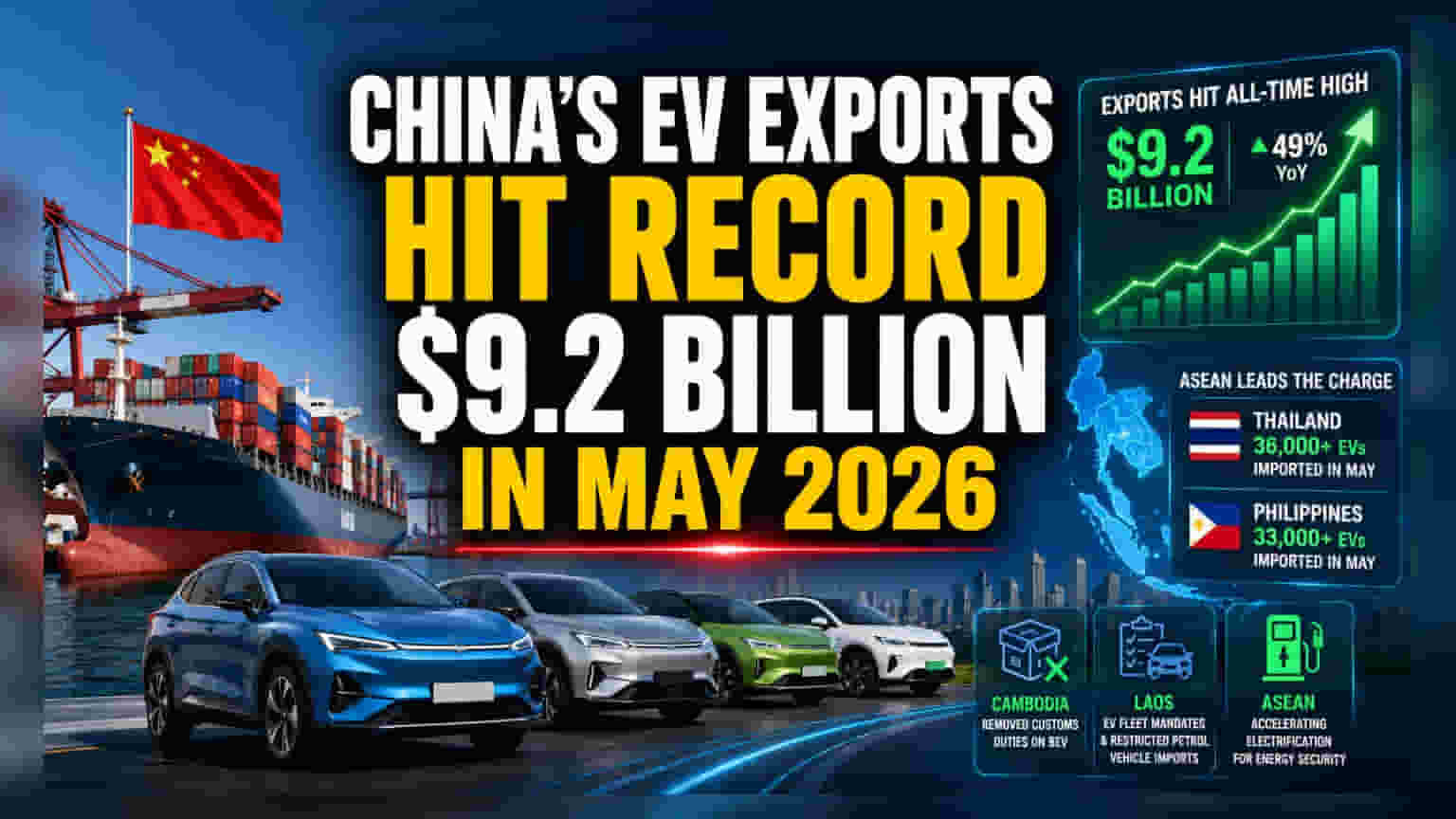
China’s electric vehicle exports reached a record $9.2 billion in May 2026, rising 49% year-on-year. Driven by strong demand from Southeast Asia, this surge highlights the region's shift toward electrification to improve energy security, creating intense competitive pressure for global and Indian automakers operating in these markets.
What Happened
China’s electric vehicle (EV) exports reached an all-time high of $9.2 billion in May 2026, according to data from the energy think tank Ember. This figure represents a sharp 49% increase compared to the same period last year, surpassing the previous record of $9.1 billion set just one month prior in April 2026. This data confirms that Chinese manufacturers are rapidly expanding their presence in international markets, with a clear focus on the Association of Southeast Asian Nations (ASEAN).
The ASEAN Electrification Push
Southeast Asian countries are aggressively adopting policies to speed up the switch from fossil-fuel cars to electric alternatives. The primary driver for this shift is energy security. By reducing reliance on imported fuel, these nations hope to protect their economies from global oil price volatility. Thailand and the Philippines have been at the forefront of this trend, importing over 36,000 and 33,000 Chinese EVs respectively in May alone. Other nations are also creating supportive frameworks; Cambodia has removed customs duties on battery EVs, while Laos has implemented mandates for EV fleet adoption and restricted petrol vehicle imports.
Competitive Impact on the Auto Sector
For investors, this trend carries significant implications for the global and Indian automotive landscape. Chinese EV manufacturers are known for high-volume, cost-effective production. As they secure a dominant foothold in ASEAN, it creates a challenging environment for other international automakers. Indian companies that are expanding their footprints in Southeast Asia or competing in global export markets face a difficult reality: matching the aggressive pricing and the integrated supply chain efficiency that Chinese EV majors currently offer.
This shift also reflects a broader business strategy. As major Western markets like the U.S. and the European Union increasingly look at trade barriers or tariffs on Chinese EVs, Chinese manufacturers are pivoting toward emerging markets. This redirection of supply puts ASEAN markets at the center of a global price war, where profit margins for all players may come under pressure.
Business Risks and Reality Check
The rapid surge in Chinese exports is heavily tied to government incentives in the destination countries. If ASEAN nations later reduce these incentives or change import policies to protect domestic manufacturing, the demand for imported Chinese EVs could slow down. Furthermore, the focus on electrification is a capital-heavy transition for these countries, requiring significant investment in charging infrastructure. Any delay in building this infrastructure could curb the actual usage of these vehicles, despite high import numbers.
What Investors Should Track
Investors tracking the automotive and auto-ancillary sectors should monitor a few key factors. First, watch for any shifts in import duty policies within ASEAN, as these directly affect the cost-competitiveness of vehicles. Second, observe the export strategies of major Indian automakers. While the domestic Indian market is the primary focus, any entry into ASEAN markets will be heavily tested by the pricing strategies of Chinese competitors. Finally, monitor whether global pricing pressure forces traditional automakers to lower prices, which would squeeze profit margins across the industry.